

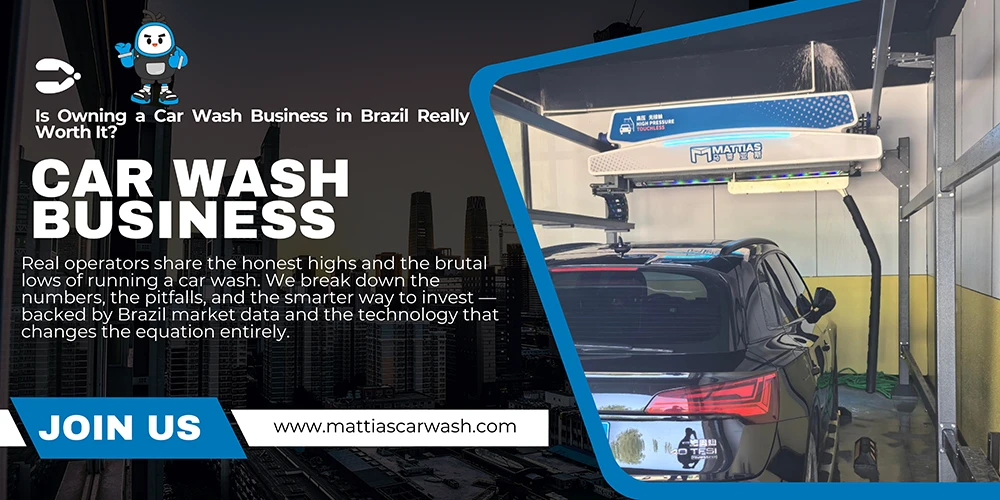

Real operators share the honest highs and the brutal lows of running a car wash. We break down the numbers, the pitfalls, and the smarter way to invest — backed by Brazil market data and the technology that changes the equation entirely.
|
US$1.36B
Brazil car wash market by 2030
|
5.2%
CAGR growth 2025–2030
|
50–70%
Profit margin (automated operations)
|
Brazil’s car wash industry is quietly booming. With a vehicle fleet that grew by 4.7 million units in 2024 alone and a car care market posting 11.6% revenue growth in the last 12 months, the opportunity is hard to ignore. But owning a car wash — especially one run the traditional way — is not as passive or as simple as it looks from the outside.
This article draws on the candid experiences shared by car wash owners and operators in online business communities, layered with hard market data and investment benchmarks specific to Brazil. If you are considering starting, buying, or upgrading a car wash business in Brazil in 2025, read this before you spend a single real.
Why Entrepreneurs Are Drawn to the Car Wash Business
Walk past a busy car wash on a Saturday morning and the appeal is obvious: cars lined up, cash flowing, and seemingly minimal effort from the owner. For entrepreneurs in Brazil’s growing middle class — particularly those looking for a scalable, location-based service business — the car wash has become an attractive entry point into self-employment and passive income.
And the numbers, at first glance, back this up. According to Grand View Research, the Brazilian car wash service market generated USD 1,009.2 million in 2024, and is forecast to reach USD 1,361.4 million by 2030, expanding at a 5.2% compound annual growth rate. Brazil also leads Latin America in car wash market revenue — making it one of the most fertile environments in the region for this type of business.
The self-serve car wash is a hidden gem for entrepreneurs seeking a steady, scalable, and relatively low-maintenance investment. Unlike full-service operations, you are not running a large payroll. The machine does the heavy lifting.
— Mattias Car Wash Industry Analysis
Beyond revenue projections, the business model has structural advantages that other service sectors lack. Car care is non-discretionary: Brazilians wash their cars regardless of economic conditions. The vehicle fleet is enormous and growing. And for automated formats — touchless, rollover, or tunnel systems — the labor costs are dramatically lower than traditional hand-wash operations.
✓ The Highs
Steady, Recurring DemandVehicle owners need to wash their cars constantly. Unlike seasonal businesses, car washes generate consistent cash flow year-round across Brazil’s diverse climate zones. |
✓ The Highs
Low Labor in Automated ModelsAutomated car washes eliminate the need for large staff. One person can manage a multi-bay facility, dramatically improving operating leverage and net margin. |
✓ The Highs
Scalable & Semi-Passive IncomeOnce a system is properly installed and maintained, an automated car wash can operate 24/7 without the owner on-site, making it one of the few genuinely scalable service businesses. |
✓ The Highs
Low Barrier Compared to AlternativesCompared to franchises or retail businesses, an automated car wash can be established at a competitive price point, especially with modern equipment options from global manufacturers. |
The Real Lows: What Car Wash Owners Don’t Tell You
Here is where the romanticized version of the car wash business runs into reality. Business forums and owner communities are full of operators who entered the market excited about passive income, only to discover that the “minimal supervision” model requires far more attention than advertised.
One widely shared story from a Texas car wash owner on TikTok went viral: he left his self-serve facility for just 48 hours and returned to overflowing trash bins, mud-covered bays, and broken equipment. “Buy a car wash, they said,” he remarked sarcastically as he documented the chaos. This story resonated with thousands of car wash owners because it reflected a universal truth: the machine does not babysit itself.
⚠ The Lows
Maintenance Is RelentlessCar washes are large industrial machines operating continuously. Pumps, motors, solenoids, compressors, and electrical systems all require preventative maintenance. Neglect for even a few days leads to costly breakdowns and lost revenue. |
⚠ The Lows
Vandalism and TheftUnattended car washes in less trafficked areas are vulnerable to equipment damage and theft. Coin box theft and deliberate machine abuse are reported regularly by operators, especially in traditional self-serve formats. |
⚠ The Lows
Utility Costs Erode MarginsWater and electricity represent the largest ongoing costs. In Brazil, water costs and electricity tariffs can significantly impact profitability — particularly for older machines with poor efficiency ratings. |
⚠ The Lows
Location Is Everything — and ExpensiveA car wash in the wrong location — too remote, poorly visible, or near heavy competition — will underperform regardless of equipment quality. Prime commercial real estate in Brazilian urban centers is costly. |
⚠ The Lows
Customer Experience Drives RetentionClean bays, working equipment, and clear pricing are the minimum standard. One bad experience — a broken machine, unclear instructions, a dirty wash result — and customers walk, often permanently. |
⚠ The Lows
Environmental RegulationsIn Brazil, car wash businesses require municipal and environmental licenses. Water runoff management, effluent treatment, and proper drainage are legally mandated — and non-compliance leads to fines or forced closure. |
The core insight from veteran operators:Most car wash businesses fail not because of poor demand, but because of poor equipment choices and underestimated operational requirements. The solution is not to avoid the business — it is to enter it with the right machines and the right systems from day one.
Part Three
What Does It Actually Cost to Start a Car Wash in Brazil?
Before committing capital, every serious investor needs a realistic picture of the full cost structure — not just the equipment price. Here is a breakdown based on current market data from the Brazilian car wash sector.
Investment Cost Breakdown — Brazil 2025 |
|||
|---|---|---|---|
| Business Scale | Startup Investment (BRL) | Approx. USD | Payback Period |
| Small (manual / basic self-serve) | R$ 20,000 – R$ 50,000 | ~US$3,500–9,000 | 12–18 months |
| Medium (semi-automated) | R$ 60,000 – R$ 150,000 | ~US$11,000–27,000 | 12–24 months |
| Automated (touchless / rollover) | R$ 150,000 – R$ 300,000+ | ~US$27,000–55,000 | 18–36 months |
| Tunnel (high-volume) | R$ 400,000 – R$ 800,000+ | US$72,000–145,00 | 2–4 years |
| * Investment ranges include equipment, civil works, licensing, and 3 months of working capital. USD figures based on an approximate BRL/USD rate of 5.5. All figures are estimates and will vary by city, land costs, and equipment choice. | |||
Key Ongoing Operating Costs in Brazil
Beyond startup capital, operators should budget for the following monthly recurring costs:
- Rent/land cost: Varies enormously by city and location. São Paulo commercial zones command significantly higher rents than interior cities. Many successful operators reduce this cost by locating at gas stations or shopping center car parks.
- Water and electricity: The largest ongoing operational expense. Modern automated machines with water-recycling technology reduce this cost by up to 60% compared with traditional operations.
- Chemical supplies: Shampoos, waxes, detergents, and surface protectants. Budget R$2,000–R$8,000 per month, depending on volume.
- Equipment maintenance: Professional automated systems from reputable manufacturers can operate for years with proper preventative care, but budget 5–8% of equipment value annually for servicing.
- Licensing and compliance: Municipal licenses, environmental permits, fire safety certificates, and periodic regulatory inspections are mandatory in Brazil.
- Marketing: Social media, local SEO, and promotional campaigns to drive customer acquisition, particularly during the first 12 months of operation.
The automotive services sector in Brazil posted R$9.167 billion in revenues across the last 12 months — an increase of 11.6%. The consumer demand is not the problem. For car wash operators, the question is always: are you set up to capture it efficiently?
— Brazilian Franchise Sector Q3 2025 Report
Part Four
How Smart Investors Are Solving the Lows — Through Automation
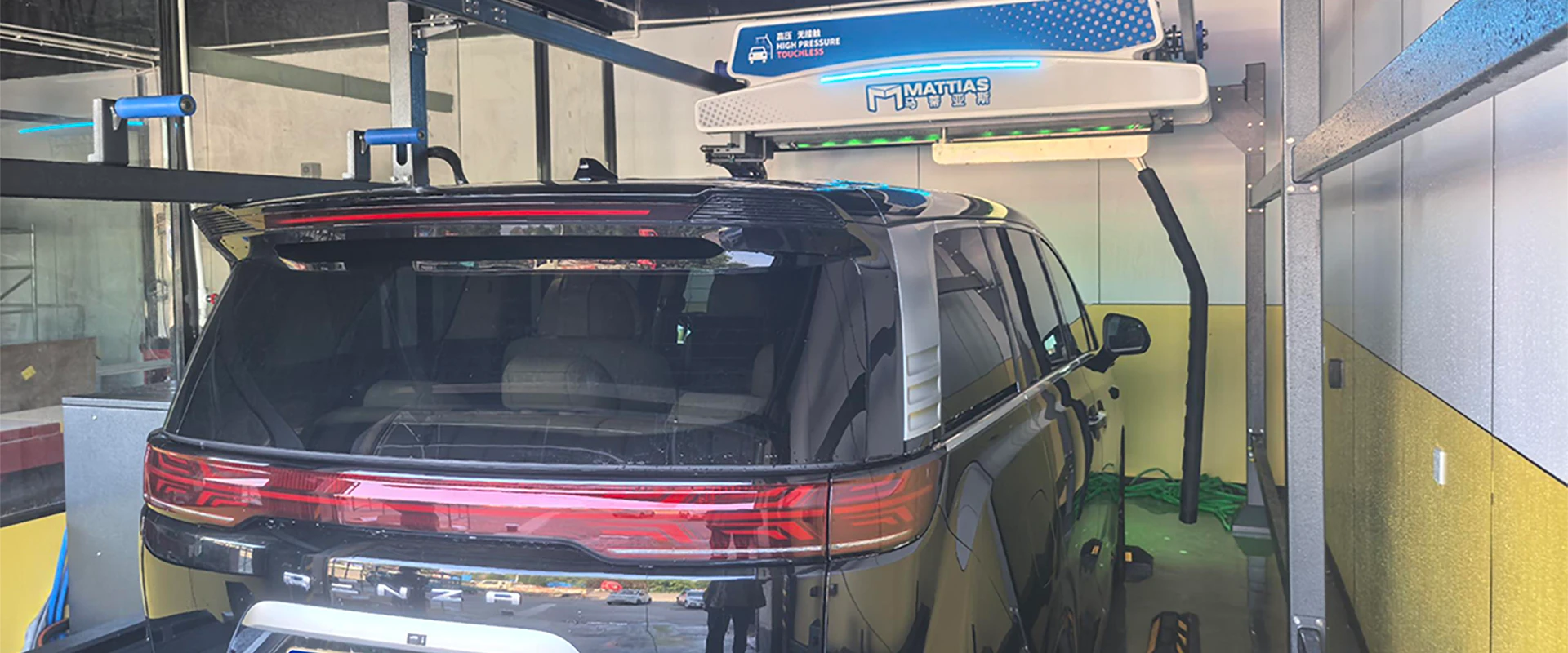
Every experienced car wash operator in Brazil who has achieved sustainable profitability will tell you the same thing: the turning point came when they stopped depending on labor and started depending on machines. The evolution from manual hand-washes to automated, touchless, and tunnel systems is not just a technology upgrade — it is a complete shift in the business model.
The problems that sink most car wash operations — inconsistent wash quality, high turnover among staff, mounting utility bills, customer complaints — are all structurally reduced by modern automated wash systems. Here is why automation is the dominant investment thesis among serious car wash operators entering the Brazilian market today:
- Labor independence: Automated systems require minimal human oversight. A single trained operator or even a remote monitoring setup can manage multiple bays, freeing the owner from daily on-site presence.
- Consistent wash quality: Unlike manual operations where quality depends on individual workers, automated machines deliver the same result every time. Consistent quality is the foundation of customer loyalty.
- Higher throughput: An automated rollover or tunnel system can wash far more vehicles per hour than a manual crew, directly increasing daily revenue potential without adding headcount.
- Water recycling capability: Modern machines incorporate closed-loop water recycling systems that reclaim and reuse up to 75% of wash water — dramatically reducing utility bills and ensuring environmental compliance.
- 24/7 operation potential: Automated systems can operate around the clock with appropriate site security, maximizing revenue per square meter of commercial real estate.
- Higher perceived value: Customers associate automated, touchless car washes with premium quality — allowing operators to price services at a premium compared to traditional manual washes.
|
Mattias Car Wash Systems · Featured Product
WS100 Touchless Car Wash Machine — Compact Entry-Level Automation |
|
|---|---|
|
Ideal for operators entering the Brazilian automated car wash market for the first time. The WS100 delivers a professional touchless wash experience with no brushes touching the vehicle — eliminating the risk of surface scratches and making it attractive to Brazilian consumers who are increasingly protective of their vehicles’ paintwork.
|
|
Best For |
Key Advantage |
| Small to mid-sized standalone car wash sites, gas station adjuncts | Touchless technology — no paint scratches, minimal maintenance downtime |
Operation |
Market Fit |
| Automated, minimal staffing requirement | Mid-sized cities and suburban commercial zones across Brazil |
| US$9,000 – US$13,200 | Inquire Now → |
| Machine ex-factory · CIF pricing available | |
|
Mattias Car Wash Systems · Premium Model
M-WS310 Touchless Car Wash Machine — High-Capacity Professional Grade |
|
|---|---|
|
For operators who are serious about building a premium car wash brand in Brazil’s growing urban markets. The M-WS310 is a high-capacity touchless system designed for locations with strong vehicle throughput. Its advanced chemical application and high-pressure rinse architecture ensures a thorough, streak-free clean that drives repeat business.
|
|
Best For |
Key Advantage |
| High throughput capacity — maximize revenue during peak hours | High-traffic commercial sites, premium standalone car wash businesses |
Operation |
Market Fit |
| Fully automated with remote monitoring capability | São Paulo, Rio de Janeiro, Belo Horizonte and other major metro areas |
| US$25,000 – US$30,000 | Inquire Now → |
| Machine ex-factory · CIF pricing available | |
|
Mattias Car Wash Systems · Volume Leader
M-LM535 Rollover Car Wash Machine — In-Bay Automatic System |
|
|---|---|
|
The M-LM535 brings the proven in-bay rollover format to medium and large-scale operations in Brazil. According to market data, rollover/in-bay systems represented the largest revenue segment in Brazil’s car wash market in 2024 with a 55.59% revenue share — making this the category with the deepest consumer familiarity and demand. This machine is engineered for durability in Brazil’s tropical climate.
|
|
Best For |
Key Advantage |
| Gas station forecourts, dedicated auto care parks, commercial hubs | Largest revenue segment in Brazil — proven consumer demand, fast ROI |
Operation |
Market Fit |
| Semi-automated, adaptable to various site configurations | Brazil-wide, particularly strong in interior cities with lower real estate costs |
| US$30,000 – US$35,200 | Inquire Now → |
| Machine ex-factory · CIF pricing available | |
|
Mattias Car Wash Systems · Highest Volume
M-SD0900D 9-Brush Tunnel Car Wash Machine — Enterprise-Grade Throughput |
|
|---|---|
|
For the serious investor or operator building a destination car wash facility in Brazil, the M-SD0900D tunnel system offers the highest vehicle throughput of any format. Tunnel car washes are the fastest-growing segment in Brazil’s car wash market — and for good reason. The economics are compelling: a well-run tunnel system can wash hundreds of vehicles per day at a price premium, with operating costs per car declining as volume increases.
|
|
Best For |
Key Advantage |
| High-volume standalone wash facilities, franchise operators, commercial fleet services | Fastest-growing segment in Brazil — strongest long-term revenue trajectory |
Configuration |
Market Fit |
| 9-brush full coverage; adaptable tunnel lengths for different site footprints | Major metropolitan corridors, shopping center adjacencies, highway service zones |
| Contact for Quote | Request Proposal → |
| Custom configuration available · Project consultation included | |
Profitability Benchmarks: What Can You Actually Earn?
Let’s talk numbers. The most honest profitability analysis for car wash businesses in Brazil considers three variables: daily vehicle throughput, average ticket value, and operating cost ratio. Here are realistic benchmarks for automated car wash operations:
Automated Car Wash: Illustrative P&L — Brazilian Market |
||
|
50–70%
|
12–24mo
|
14–15%
|
|
Gross margin on automated operations — among the highest in service retail
|
Typical payback period for a well-located mid-range automated car wash
|
Net profit margin benchmark for the car wash industry globally
|
Revenue Scenario: Mid-Scale Automated Car Wash in Brazil
Based on industry benchmarks and the Brazilian market context, here is a conservative illustrative scenario for a mid-scale automated operation (e.g., a rollover or touchless system in a medium-traffic urban location):
| Revenue / Cost Item | Monthly (BRL estimate) | Annual (BRL estimate) |
|---|---|---|
| Revenue (30 cars/day × R$40 avg ticket × 26 operating days) | R$ 31,200 | R$ 374,400 |
| Less: Chemicals & consumables (~10%) | – R$ 3,120 | – R$ 37,440 |
| Less: Utilities — water & electricity (~12%) | – R$ 3,744 | – R$ 44,928 |
| Less: Rent / site cost (~15%) | – R$ 4,680 | – R$ 56,160 |
| Less: Labour & admin (~8%) | – R$ 2,496 | – R$ 29,952 |
| Less: Maintenance & misc (~5%) | – R$ 1,560 | – R$ 18,720 |
| Net Operating Profit (~50%) | R$ 15,600 | R$ 187,200 |
| * Illustrative scenario only. Actual revenue depends on location, local pricing, vehicle throughput, and operating efficiency. In high-volume locations or with higher average ticket values, results may be significantly better. | ||
This scenario also assumes a relatively conservative 30 vehicles per day. A well-located automated car wash in a Brazilian city with strong vehicle traffic can realistically serve 60–100+ vehicles per day, particularly when combined with a membership or loyalty subscription model — a format growing rapidly in Brazil’s car care market.
Part Six
Who Should — and Should Not — Invest in a Car Wash Business in Brazil
This business is a strong fit for you if:
- You own or have access to a commercially zoned land or building in a high-traffic area of a Brazilian city or town.
- You are seeking a semi-passive income stream with predictable revenue and you are willing to invest in quality equipment upfront.
- You already operate a gas station, convenience store, or auto service facility and want to add a high-margin revenue stream.
- You are an investor looking for a business with 14–50%+ margins and a realistic 12–36 month payback horizon.
- You are interested in the tunnel or rollover segment and can commit to a larger initial investment in exchange for higher daily throughput and faster scale.
Think carefully if:
- You are planning to enter the manual hand-wash segment. Labor-intensive operations in Brazil face rising wage costs and are increasingly uncompetitive against automated alternatives.
- Your target location has limited vehicle traffic or is in a saturated micro-market with multiple established competitors within a short radius.
- You are expecting a purely passive, hands-free investment. Even the most automated systems require periodic attention, maintenance scheduling, and site management.
The Car Wash Business in Brazil Is Not Easy — But the Opportunity Is Real
The operators who thrive in the Brazilian car wash market share a common profile: they took the business seriously from day one, invested in the right equipment, chose their location carefully, and built systems rather than relying solely on manual labor. The ones who struggled entered with unrealistic passive income expectations, cut corners on equipment quality, and underestimated the operational discipline the business demands.
Brazil’s growing vehicle fleet, rapidly expanding middle class, and rising consumer expectation for professional auto care services create a structural tailwind for car wash businesses over the next decade. The rollover and tunnel segments, in particular, are posting the fastest growth rates in the market — and automation is the investment vehicle that captures that growth most efficiently.
The highs of this business are real. So are the lows. The difference between those who win and those who don’t often comes down to a single decision made at the start: the equipment they chose to build their business around.
Ready to Build Your Car Wash Business in Brazil?
Mattias Car Wash Systems has helped operators across Latin America choose, configure, and commission automated car wash equipment that matches their market, budget, and business goals.
No commitment required. Our team will provide a tailored equipment recommendation and estimated ROI analysis for your specific site and market.
Products: WS100 · M-WS310 · M-LM535 · M-SD0900D · Available for export to Brazil with full technical support