

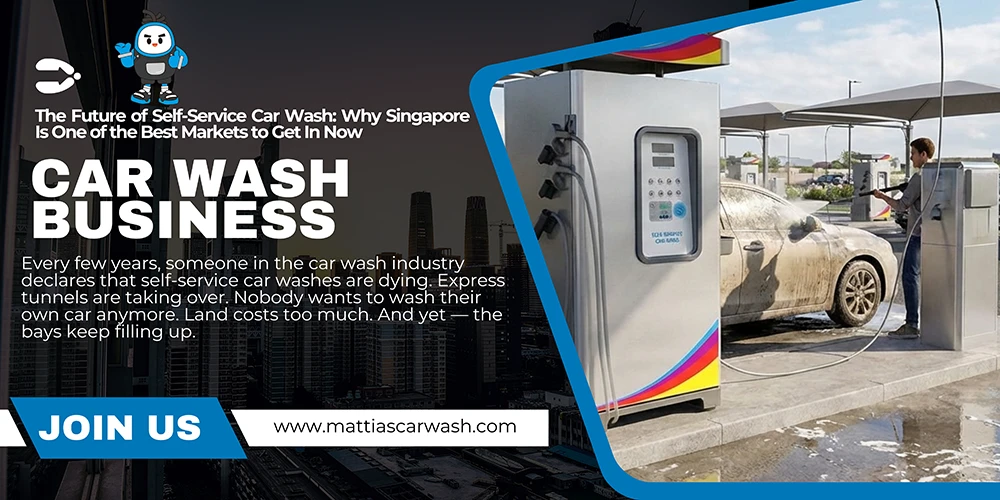

Every few years, someone in the car wash industry declares that self-service car washes are dying. Express tunnels are taking over. Nobody wants to wash their own car anymore. Land costs too much. And yet — the bays keep filling up.
On the CarWashForum, one operator recently put it plainly: “As long as this type of customer exists, there will always be a business model for self-serve.“ He’s been watching express tunnels rise and fall around him. His self-serve bays? Still busy.
So what does the future of the self-service car wash business actually look like — and more specifically, what does it look like in a city like Singapore, where car ownership is expensive, land is scarce, and the culture of keeping your car spotless is very real?
Let’s break it down.
The Self-Serve Business Isn’t Dying — It’s Evolving
The global self-service car wash market was valued at USD 4.5 billion in 2024 and is projected to reach USD 7.5 billion by 2032, growing at a compound annual growth rate (CAGR) of 6.62%. That’s not the trajectory of a dying industry.
What is changing is the customer. Forum veterans make a distinction that matters: the self-serve customer and the tunnel customer are fundamentally different people.
The tunnel customer wants speed and convenience — they want to drive through and forget about it. The self-serve customer wants control. They’re the detail-oriented driver who paid good money for their car and isn’t about to let a rotating brush system near their paintwork. They’re the pickup truck owner who came in with actual mud, not just dust. They’re the motorcycle and boat and RV owner who simply can’t fit into a tunnel.
As one forum veteran with over 20 years in the car wash business noted: “There are always going to be people who want to do it themselves.“
The self-serve model has also been evolving quietly for decades. What started as a coin slot and a wand has grown to include foam pre-soak, vacuum bays, tyre inflation, ozone disinfection, and now cashless payment, digital monitoring systems, and all-in-one self-service kiosks. The machines have gotten smarter. The service has gotten broader. The margin of differentiation between a poorly run bay and a well-run one has never been wider — which is exactly why this is such an opportune time to enter the market with the right equipment.
Why Singapore Is a Particularly Strong Market
Singapore presents a compelling case study for self-service car wash investment, for reasons that most markets simply don’t have.
1. Cars Here Are Extremely Expensive — and Owners Show Them Respect
The average car in Singapore costs upwards of SGD 100,000 once you factor in the Certificate of Entitlement (COE). When someone has paid that much for a vehicle, they are not indifferent about how it gets washed. They want it done right. The self-serve customer in Singapore is motivated, careful, and willing to spend — not just to save money, but to maintain quality.
2. The Urban Density Problem Creates a Structural Gap
Most Singaporeans live in HDB flats without private driveways or outdoor hoses. Washing a car at home is simply not an option. This creates a consistent, captive demand for external car wash services that does not exist in suburban markets overseas.
Self-service kiosks already exist across HDB multi-storey carparks, and they are actively used. Singapore Expats Forum members have noted coin-operated wash bays in estates across the island — and demand for them consistently outstrips supply in many neighbourhoods.
3. Labour Costs Are High, Which Favours Automation
With Singapore’s tight labour market, full-service hand washes have become expensive and operationally complex. A well-equipped self-service kiosk sidesteps the labour problem entirely — the customer does the work, the machine does the rest. Low headcount requirements translate directly into better margins for the operator.
4. 24-Hour Operation Is Already the Norm
Singapore’s car wash culture has adapted to urban schedules. Brands like Autowash24 — launched in 2022 as Singapore’s first 24-hour automated contactless car wash — demonstrate clear consumer appetite for round-the-clock access. Self-service kiosks that operate continuously without staffing are a natural fit for this market.
What Does It Cost to Start a Self-Service Car Wash in Singapore?
This is where many aspiring operators get stuck. Let’s be transparent about the numbers.
Equipment Investment
A professional all-in-one self-service car wash kiosk — the kind that includes high-pressure water rinse, foam system, vacuum, tyre inflation, and a smart payment/monitoring system — represents your primary capital outlay.
Equipment at this level, such as the Mattias M-F761AX Self-Service Car Wash, is typically priced in the range of USD $4,200–$4,500 per unit (approximately SGD $5,700–$6,100). This is a single, integrated machine that replaces what would otherwise require multiple separate installations.
The M-F761AX includes:
- High-pressure water rinse
- Foam system (patented invention pending) that reduces solution and water consumption by up to 90%
- Vacuum cleaning bay
- Tyre inflation
- Ozone disinfection and negative ion purification
- A 1.5-inch LED smart monitoring display with automatic refill reminders
- Waterproof circuit boards for reliability
- Elevated base with nylon pads for rust resistance
For a multi-bay installation — say, two to four units — your equipment cost sits between USD $8,400–$18,000 (SGD $11,400–$24,400), before installation.
Site and Infrastructure Costs
In Singapore, site acquisition or leasing terms vary significantly. Common deployment models include:
- Partnership with HDB or commercial carpark operators: leasing designated wash bay spaces, which dramatically lowers initial capital requirements compared to building from scratch
- Petrol station or commercial lot co-location: sharing an existing commercial footprint
- Industrial estate deployment: lower land cost, typically high vehicle density
Infrastructure costs — plumbing connections, electrical supply, drainage, and basic shelter — for a multi-bay setup typically range from SGD $30,000–$80,000, depending on whether you’re fitting out an existing bay or constructing from the ground up.
You will also need to factor in:
- Water softener systems (such as the RSRH-3D or RSRH-6D dual-valve dual-tank softener at 3–6 tons/hour capacity) to protect equipment and ensure wash quality in Singapore’s water conditions
- PUB connection and water usage metering
- ACRA business registration and relevant licensing
A reasonable all-in starting budget for a 2–3 bay self-service site in Singapore: SGD $120,000–$200,000, depending on site choice and fit-out requirements.
What Are the Realistic Returns?
Industry benchmarks provide a useful reference. In the US, self-service car wash bays average approximately USD $1,500–$1,847 per bay per month in revenue, roughly SGD $2,000–$2,500 per bay monthly.
In Singapore, pricing dynamics are notably stronger. Existing self-service kiosk services charge between SGD $6–$15 per wash, depending on service level. At a usage rate of 15–25 vehicles per day per unit:
| Scenario | Daily Washes | Avg. Spend (SGD) | Monthly Revenue/Unit |
|---|---|---|---|
| Conservative | 15 | $8 | ~$3,600 |
| Moderate | 20 | $10 | ~$6,000 |
| Strong | 30 | $12 | ~$10,800 |
Operating costs for a self-service kiosk business are lean by design. With no staff on-site, the primary recurring costs are:
- Site rental/lease: SGD $1,500–$3,500/month (location dependent)
- Water and electricity: SGD $600–$1,200/month
- Detergent and consumables: SGD $300–$600/month
- Maintenance and repairs: SGD $300–$500/month
This gives estimated net margins of 50–60%, consistent with global self-service car wash benchmarks. At a moderate revenue of SGD $6,000/month per unit with a 2-unit setup, an operator can generate SGD $12,000/month gross with running costs of approximately SGD $5,000–$6,000/month, netting SGD $6,000–$7,000/month before tax — enough to recover the initial investment within 18–30 months in a well-chosen location.
What Makes or Breaks a Self-Serve Business: Lessons From Operators
Forum veterans are consistent on one point: location is everything, but it’s not the only thing.
The most successful self-serve operators share a few traits. They maintain their equipment obsessively. A broken wand, a foaming system that doesn’t foam, a vacuum that loses suction — these drive customers away permanently. They invested in quality upfront so they spend less time firefighting.
They also adapted to cashless payments early. In Singapore, where PayNow and contactless payment is the default, any wash bay that still only accepts coins is at a structural disadvantage.
And critically, they chose the right equipment. As one forum operator with a 5-bay SS in Northern California noted, after multiple express tunnel competitors opened within two miles: “My car wash is clean, modern and busier than ever.” The differentiator wasn’t price — it was quality and reliability.
This is the business case for investing in purpose-built professional equipment from the start, rather than retrofitting consumer-grade pressure washers. The Mattias M-F761AX was engineered specifically for commercial self-service deployment: its independent high-pressure water and foam liquid systems allow uninterrupted operation, its smart monitoring prevents downtime from supply depletion, and its waterproof circuit boards are built for the kind of continuous 24/7 humidity exposure that Singapore’s climate demands.
The Competitive Moat: Why Self-Serve Isn’t Going Away in Singapore
The most honest summary from industry participants: the self-serve segment is not growing in the same explosive way that express tunnel washes are being built — but it has a structural resilience that express tunnels don’t.
Express tunnels have high overhead. They need volume. They face risk from subscription saturation. And they simply cannot wash everything — oversized vehicles, motorbikes, boats, and owners who insist on being hands-on will always look for the self-serve bay.
In Singapore, there is an additional structural advantage: the HDB carpark ecosystem. With millions of vehicles registered in a dense urban footprint, and regulations that already accommodate and license car cleaning operations within residential carparks, the self-serve kiosk model fits naturally into how Singaporeans already think about car maintenance. You’re not introducing a new habit — you’re upgrading the infrastructure around an existing one.
The operators who win in this space over the next decade will be the ones who invest in reliable, full-featured equipment now, choose sites with genuine catchment density, and operate with the kind of consistency that builds a loyal base of return customers.
The future of self-serve isn’t uncertain. It’s waiting for the right operator to show up with the right machine.
Ready to Explore Your Options?
If you’re considering entering the self-service car wash business in Singapore, the Mattias M-F761AX offers a commercially proven, all-in-one platform that covers every function your customers need — from high-pressure rinse and rich foam to vacuum cleaning, tyre inflation, and smart monitoring — in a single integrated unit built for professional deployment.
For operator inquiries, equipment specifications, and Singapore-specific installation guidance, contact the Mattias team directly.
Mattias is a professional manufacturer of self-service car wash equipment. The M-F761AX is designed for commercial deployment with patented foam technology, smart monitoring systems, and industrial-grade durability.