










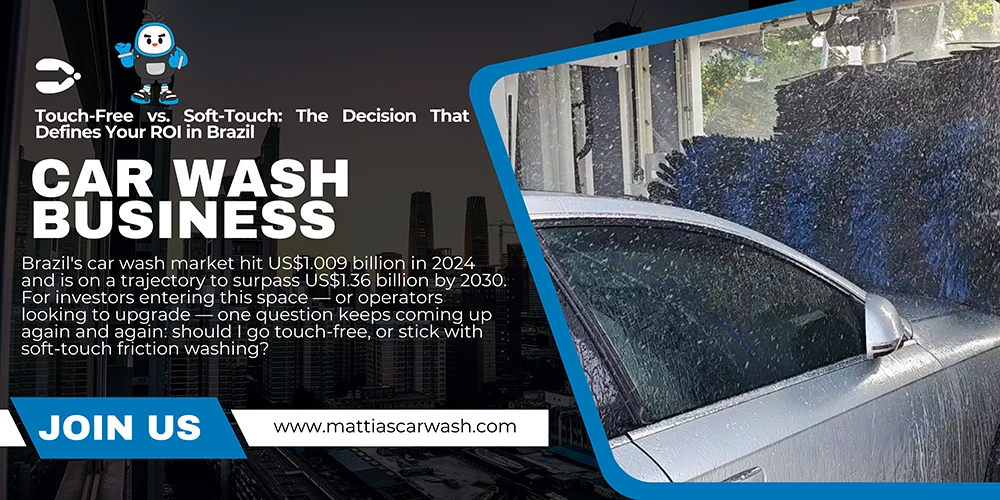

Car wash operators across the Americas are wrestling with this question. Here’s what the data — and real operators — say about which technology wins in a booming Latin American market.
| Brazil’s car wash market hit US$1.009 billion in 2024 and is on a trajectory to surpass US$1.36 billion by 2030. For investors entering this space — or operators looking to upgrade — one question keeps coming up again and again: should I go touch-free, or stick with soft-touch friction washing? |
It’s not a trivial choice. The two technologies differ not just in how they clean cars, but in their capital requirements, operating costs, liability exposure, customer appeal, and long-term profitability. Get it right and you build a business that practically runs itself. Get it wrong and you find yourself with empty bays while a competitor down the road has a queue.
We’ve spent time in the trenches alongside real car wash operators, studied recent forum discussions among experienced IBA (In-Bay Automatic) owners, and combined that with on-the-ground market intelligence for Brazil. What follows is the most honest, data-grounded comparison you’ll find on this topic.

What Exactly Are We Comparing?
Before diving into the business case, let’s be precise about definitions. Both touch-free and soft-touch are categories of In-Bay Automatic (IBA) car wash systems — the machines where the car stays stationary and the equipment moves around it, as opposed to tunnel systems where the car is conveyed through a fixed cleaning arch.
Touch-Free (Touchless)
Touch-free car wash systems clean vehicles exclusively using high-pressure water jets and chemical solutions — no physical contact between any brush, cloth, or foam material and the vehicle’s painted surface. The wash arch moves over and around the car, applying pre-soaks, detergents, high-pressure rinses, spot-free water, and drying agents. The cleaning result depends heavily on the chemistry quality and water pressure calibration.
Soft-Touch (Friction / Cloth)
Soft-touch or friction systems use rotating foam brushes, cloth strips, or microfiber materials that make gentle contact with the vehicle surface to physically agitate and remove dirt. They typically achieve a more thorough physical clean, particularly on heavily soiled vehicles, and rely less on expensive chemical formulas. However, any physical contact introduces potential liability for surface damage.
|
Key Insight from Operators
Experienced IBA operators confirm that in touch-free washing, chemical quality drives roughly 85–99% of the final wash result. The machine is merely the delivery mechanism. In soft-touch, the mechanical action does more of the work, which means lower chemical costs but higher maintenance complexity. |
The Numbers That Matter: Brazil’s Market Opportunity
Understanding why this decision matters starts with understanding the scale of the opportunity in Brazil.
| $1B+ | 5.2% | 55% | 8–10% |
| Brazil car wash market revenue in 2024 | Projected annual market growth (CAGR) through 2030 | Revenue share held by roll-over/IBA segment in 2024 | Annual growth in registered auto-care businesses since 2020 |
Brazil holds approximately 2.9% of the global car wash market and is the dominant player in Latin America. The roll-over/in-bay segment — the category that encompasses both touch-free and soft-touch IBA machines — captured over half of all market revenue in 2024. That’s the segment you’d be entering.
What’s driving this? A rapidly expanding middle class with rising disposable income, growing urban car ownership, a cultural emphasis on vehicle aesthetics (cars are a genuine status symbol in Brazil), and an accelerating shift from informal roadside washing to professional automated services. Major cities like São Paulo, Rio de Janeiro, Brasília, and Belo Horizonte are already seeing significant consolidation and professionalization of car care.
The Business Case: Cost & Profitability Breakdown
Let’s get specific. Here’s what it realistically costs to build or acquire a car wash operation in Brazil in 2025, and what you can reasonably expect to earn.
Starting a New IBA Operation in Brazil
| Estimated Startup Costs — Single-Bay IBA (Brazil, 2025) | |
| Land lease or purchase (urban area, annual/upfront) | US$18,000–$45,000 |
| Building/bay construction & civil works | US$35,000–$65,000 |
| Touch-Free IBA machine (entry-level) | US$9,000–$30,000 |
| Water supply, plumbing, electrical installation | US$8,000–$15,000 |
| Payment kiosk, signage, safety equipment | US$5,000–$10,000 |
| Permits, licensing, legal setup | US$2,000–$5,000 |
| Working capital (3 months) | US$6,000–$12,000 |
| Total Estimated Investment (Touchless IBA) | US$83,000–$182,000 |
Buying an existing car wash operation in Brazil can offer a faster path to profitability, with established locations in mid-sized cities typically transacting at US$80,000–$250,000 depending on revenue multiples, equipment age, and location quality. Urban locations in São Paulo and Rio command significant premiums.
Revenue & Profitability Potential
| Operational Economics — Touchless IBA (Single Bay, Urban Brazil) | |
| Average wash ticket price (standard) | R$30–R$60 (US$5.50–$11) |
| Daily vehicle throughput (busy urban location) | 80–180 cars/day |
| Monthly gross revenue (100 cars/day avg.) | US$16,500–$33,000 |
| Chemical cost per car (touchless) | US$0.80–$1.50 |
| Chemical cost per car (soft-touch) | US$0.30–$0.80 |
| Water + utilities per car | US$0.25–$0.60 |
| Monthly operating expenses (full) | US$4,500–$10,000 |
| Estimated Net Monthly Profit | US$8,000–$18,000 |
These figures assume a reasonably trafficked urban or suburban location with minimal staff (one or two part-time employees for maintenance and customer support). The payback period for a well-positioned touchless IBA in Brazil typically runs 18 to 36 months, with higher-end tunnel operations taking longer but generating proportionally greater revenue.
Before a tunnel was built nearby, I was probably 60/40 soft-touch. Now with the tunnel close, my friction washes have dropped off significantly — I’m running about 60/40 touchless. The market changes around you.
— Greg Pack, Automatic Car Wash Operator, Car Wash Forum (2026)
Touch-Free vs. Soft-Touch: A Head-to-Head Comparison
| Factor | Touch-Free | Soft-Touch / Friction |
|---|---|---|
| Cleaning performance | Good–Excellent (chemistry-dependent) | Excellent (especially heavy soil) |
| Chemical costs | Higher (~$1/car more) | Lower |
| Damage liability risk | Very low — no physical contact | Present — occasional claims |
| Daily supervision needed | Minimal | Moderate (brush cleaning, wall washing) |
| Maintenance complexity | Moderate (pump/nozzle focused) | Higher (brush replacement, grease-free but more cleaning) |
| Customer trust / perception | Growing preference, especially near tunnels | Strong loyalty among existing users |
| Scalability (multi-bay) | Excellent — lower operational burden per bay | Good — but more staff time required |
| Appeal in tunnel-heavy markets | Higher differentiation value | Competes directly with tunnels for friction users |
| Machine entry price | US$9,000–$30,000+ | US$25,000–$35,000+ |
What Real Operators Say — And What It Means for Brazil
Operators who’ve run both types of equipment consistently note a few critical truths that don’t always show up in equipment brochures.
Location Context Is Everything
The competitive landscape around your site fundamentally shapes which technology wins. In markets with multiple express tunnel car washes nearby, soft-touch IBA operators find their friction customers defecting to tunnels — because tunnels offer a similar experience at similar prices with more throughput. Touch-free IBA operators, by contrast, offer something tunnels typically cannot: a no-contact wash in a personal, supervised bay environment. In Brazil’s rapidly urbanizing markets, where express tunnels are expanding but have not yet saturated secondary cities, touch-free IBA presents a genuinely differentiated proposition.
Liability Management Is Simpler Than You Think
Operators who’ve managed soft-touch machines for years report that the feared damage liability issue is generally manageable with good cameras and clear policies. Typical annual claim payouts at a busy IBA are measured in hundreds of dollars — not thousands. The bigger financial drain in touch-free is, in fact, chemicals: experienced operators confirm that touchless chemical costs run approximately US$0.80–$1.50 per vehicle more than equivalent soft-touch operations. Over 100 cars a day, that’s $80–$150 in additional daily costs — which must be recaptured through pricing or volume.
Operational Simplicity Favors Touch-Free for Lean Operations
For operators managing multiple locations or running with minimal on-site staff — a common model in Brazil’s growing automated car wash segment — touch-free systems require significantly less day-to-day intervention. There’s no need to regularly clean brush systems that sling foam and dirt onto bay walls, and maintenance tends to focus on a smaller number of high-pressure components that are more straightforward to diagnose and repair.
I have owned friction bays and love the cleaning. But I now choose touch-free because they require less daily supervision — and because offering touch-free is important for marketing. Not touching the car is a genuinely compelling message to customers who care about their paint.
— Islandwash, Car Wash Operator, Car Wash Forum (2026)
The Brazil-Specific Advantage for Touch-Free
Several factors make touch-free technology particularly well-positioned for the Brazilian market specifically:
Water Efficiency Pressure
Water scarcity is a recurring concern in regions like São Paulo, the Northeast, and parts of Minas Gerais. Municipal regulations around commercial water usage are tightening. Modern touch-free systems — particularly those with reclaim water technology — can reduce fresh water consumption per wash cycle significantly, improving regulatory standing and reducing one of the largest operating costs.
Growing Premium Segment
Brazil’s expanding upper-middle class increasingly owns higher-value vehicles — imported SUVs, luxury sedans — whose owners are specifically concerned about paint protection. Touch-free washing directly addresses that concern. A “zero-contact” wash can command a 20–30% price premium over a standard soft-touch wash in premium urban locations.
Automation-Ready Consumer Behavior
Brazilian consumers in major metros have rapidly adopted app-based payment, QR code payment, and automated retail experiences. The self-service touchless IBA model — where a customer drives in, pays via kiosk or app, and receives a no-contact wash with minimal human interaction — maps well onto these evolving consumer preferences.
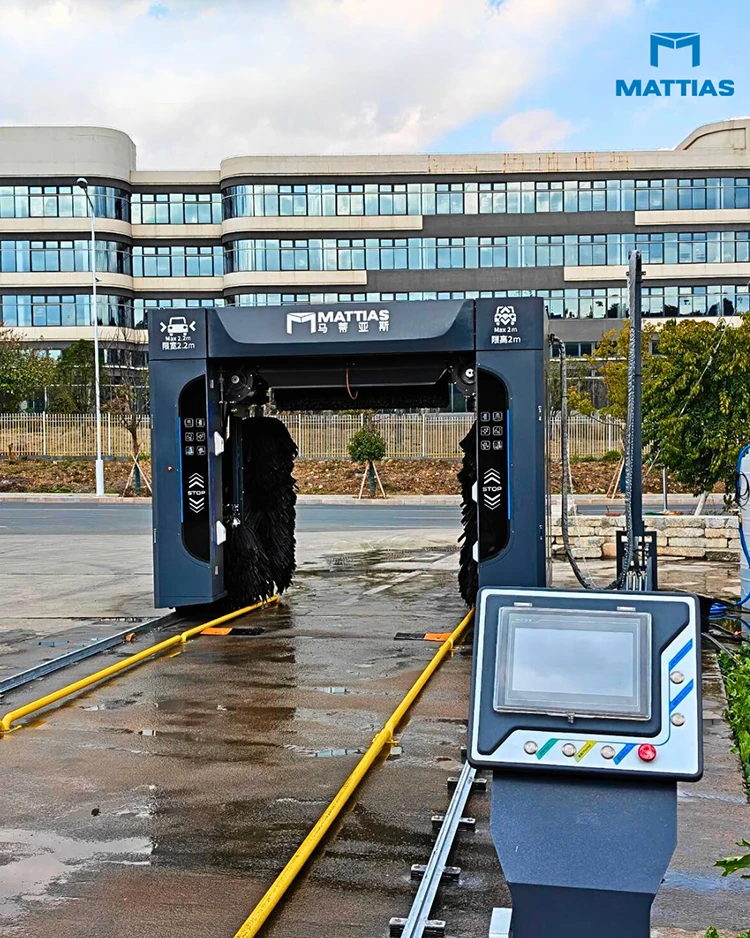
Mattias Car Wash Equipment: Built for Markets Like Brazil |
|
| Whether you’re entering the market with a single touchless bay or scaling to a full tunnel operation, Mattias offers a complete equipment lineup designed for reliability, ease of operation, and strong return on investment. All machines are engineered for performance in demanding tropical and semi-arid climates. | |
| Touchless · Entry Investment | Touchless · Premium |
| WS100 Touchless | M-WS310 Touchless |
| The ideal entry point for new operators. High-performance touchless technology in a compact, cost-efficient frame. Proven reliability for urban self-service sites. | Our flagship touchless in-bay system. Advanced nozzle geometry, superior chemical delivery architecture, and full smart connectivity. Built for high-volume premium locations. |
| US$9,000 – US$13,200 | US$25,000 – US$30,000 |
|
|
| Rollover IBA · Friction | Tunnel System · Scale |
| M-LM535 Rollover | M-SD0900D Tunnel |
| Our professional rollover soft-touch system for operators who want maximum cleaning performance with full brush-based friction washing. Excellent for high-demand suburban sites. | 9-brush tunnel system for operators building full-scale throughput operations. The preferred choice for high-traffic commercial sites, fleet washing, and franchise models. |
|
US$30,000 – US$35,200
|
Contact for pricing |
|
|
How to Choose: A Framework for Brazil Investors
There’s no single right answer — but there is a right answer for your specific situation. Here’s a practical decision framework:
Choose Touch-Free If…
You’re launching in an urban market near existing express tunnel competition; you want to run the operation with minimal staff or remotely; you’re targeting a premium demographic with higher-value vehicles; you’re constrained on space and want maximum simplicity; or you’re making your first investment and want to minimize liability and operational complexity.
Choose Soft-Touch If…
You’re in a secondary market without nearby tunnel competition; your target customer base is price-sensitive and values aggressive cleaning over paint protection; you’re building a multi-bay operation where the lower per-car chemical cost translates to meaningful margin improvement; or you’re taking over an existing friction operation with an established customer base.
Consider Both If…
You’re building a dual-bay or multi-bay site. Experienced operators consistently recommend pairing one touch-free and one soft-touch bay when building dual-IBA locations — capturing both customer segments and providing backup capacity when one machine is in maintenance. The data suggests 60–70% of IBA revenue in touch-free dominant markets comes from the touchless bay, making it the anchor investment, with the soft-touch bay serving as profitable secondary capacity.
Our Recommendation for BrazilFor most first-time investors entering Brazil’s car wash market in 2025, a touchless IBA machine represents the lower-risk, higher-scalability starting point. The combination of zero-contact appeal, simpler operations, and strong positioning against both tunnels and informal washing creates a compelling customer value proposition. As the market matures and you understand your local customer mix, adding a soft-touch bay as a second investment delivers the best of both worlds. |
Ready to Build Your Car Wash Business in Brazil? |
|
| Talk to the Mattias team about the right equipment mix for your market, budget, and growth plan. We offer investment analysis support, equipment consultation, and full installation packages. | |
| Request a Quote | Download Spec Sheets |
Market data references: Grand View Research / Horizon Databook (Brazil Car Wash Service Market, 2025); Bonafide Research (Brazil Car Wash Services Market Overview, 2029); Cognitive Market Research (Global Car Wash Market Report, 2025). Operator insights sourced and paraphrased from Car Wash Forum community discussions (March 2026). Operational cost and revenue estimates are indicative ranges based on available market data and should not be construed as guaranteed financial outcomes. Investment decisions should be made with appropriate local due diligence.