


If you’ve been researching car wash investments, you’ve probably run into wildly different numbers. One broker says $500K, another floats $3M for what looks like a similar location. Online forums are full of investors who paid too much—or walked away from deals that would have made them rich.
So what’s a car wash actually worth in 2026?
The honest answer: it depends on the type of wash, the equipment running it, and whether you can prove consistent cash flow. This guide breaks down the real valuation framework that buyers, sellers, and M&A advisors use—along with what operators on the ground are seeing in the current market.
The Three Valuation Methods That Actually Matter
Every serious car wash transaction uses at least one of these three frameworks. Most use all three as cross-checks.
1. Earnings Multiple (SDE or EBITDA)
This is the most important metric for any car wash acquisition. Sellers Discretionary Earnings (SDE) captures everything a full-time owner takes home: net profit, owner salary, depreciation, and normalized add-backs. EBITDA is the preferred metric when private equity or institutional buyers are involved, as it reflects earnings under a professional management structure.
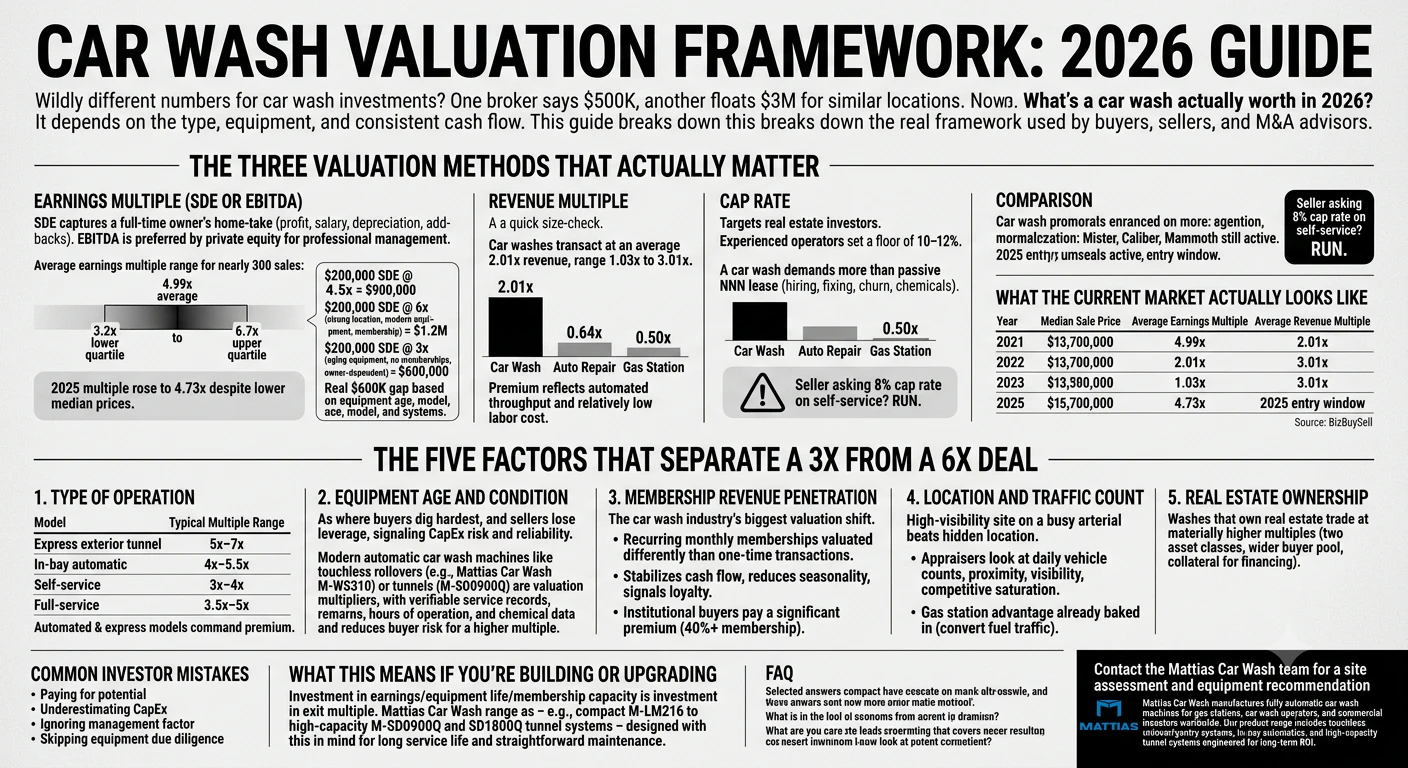
According to transaction data from BizBuySell covering nearly 300 car wash sales over five years, the average earnings multiple for sold car wash businesses sits at 4.99x, with the range running from 3.2x at the lower quartile to 6.7x at the upper quartile. In 2025 specifically, this multiple rose to 4.73x despite lower median sale prices—a sign that quality assets continue to attract strong demand even as smaller, weaker operations drag down the median.
In practice:
- A wash generating $200,000 in annual SDE at a 4.5x multiple = $900,000 valuation
- The same earnings at 6x (strong location, modern equipment, membership revenue) = $1.2M
- At 3x (aging equipment, no memberships, owner-dependent) = $600,000
The gap between those outcomes—$600K—is not abstract. It’s the real-dollar consequence of equipment age, business model, and operational systems.
2. Revenue Multiple
Revenue multiples offer a quick size-check. Car washes sold on BizBuySell transact at an average of 2.01x revenue, with the range running from 1.03x (lower quartile) to 3.01x (upper quartile). This is notably high compared to other automotive businesses: auto repair shops trade at just 0.64x revenue, and gas stations at 0.50x.
The premium reflects car washes’ core advantage—automated throughput with relatively low labor cost.
3. Cap Rate
Cap rate is more common for real estate investors entering the car wash space. Most experienced operators set a floor of 10–12% cap rate before a deal makes sense. Investment real estate might pencil at 6%, but a car wash demands more: you’re hiring, fixing equipment, managing churn, and dealing with chemical suppliers. That’s not a passive NNN lease.
If a seller is asking a price that implies an 8% cap rate on a self-service wash, run.
What the Current Market Actually Looks Like
Here’s the hard data from the most recent transaction cycles:
| Year | Median Sale Price | Average Earnings Multiple | Average Revenue Multiple |
|---|---|---|---|
| 2021 | $1,000,000 | 5.96x | 2.53x |
| 2022 | $779,500 | 4.94x | 2.00x |
| 2023 | $725,000 | 4.58x | 1.68x |
| 2024 | $882,500 | 4.12x | 1.72x |
| 2025 | $700,000 | 4.73x | 1.81x |
Source: BizBuySell transaction data, 296 reported car wash sales, 2021–2025.
The 2021 spike was driven by private equity aggressively acquiring car wash real estate and platforms. Since then, values have normalized—but they haven’t collapsed. Institutional buyers like Mammoth Holdings, Caliber Car Wash, and Mister Car Wash are still active, particularly targeting express exterior tunnels with strong membership penetration.
For independent operators and gas station investors, the current window (2025–2026) may offer reasonable entry points before another consolidation wave drives multiples higher again.
The Five Factors That Separate a 3x from a 6x Deal
Not all car washes are created equal. Here’s what appraisers and buyers actually look at when deciding which end of the multiple range applies:
1. Type of Operation
Wash type is the single biggest driver of valuation multiples and buyer interest.
| Type | Model | Typical Multiple Range |
|---|---|---|
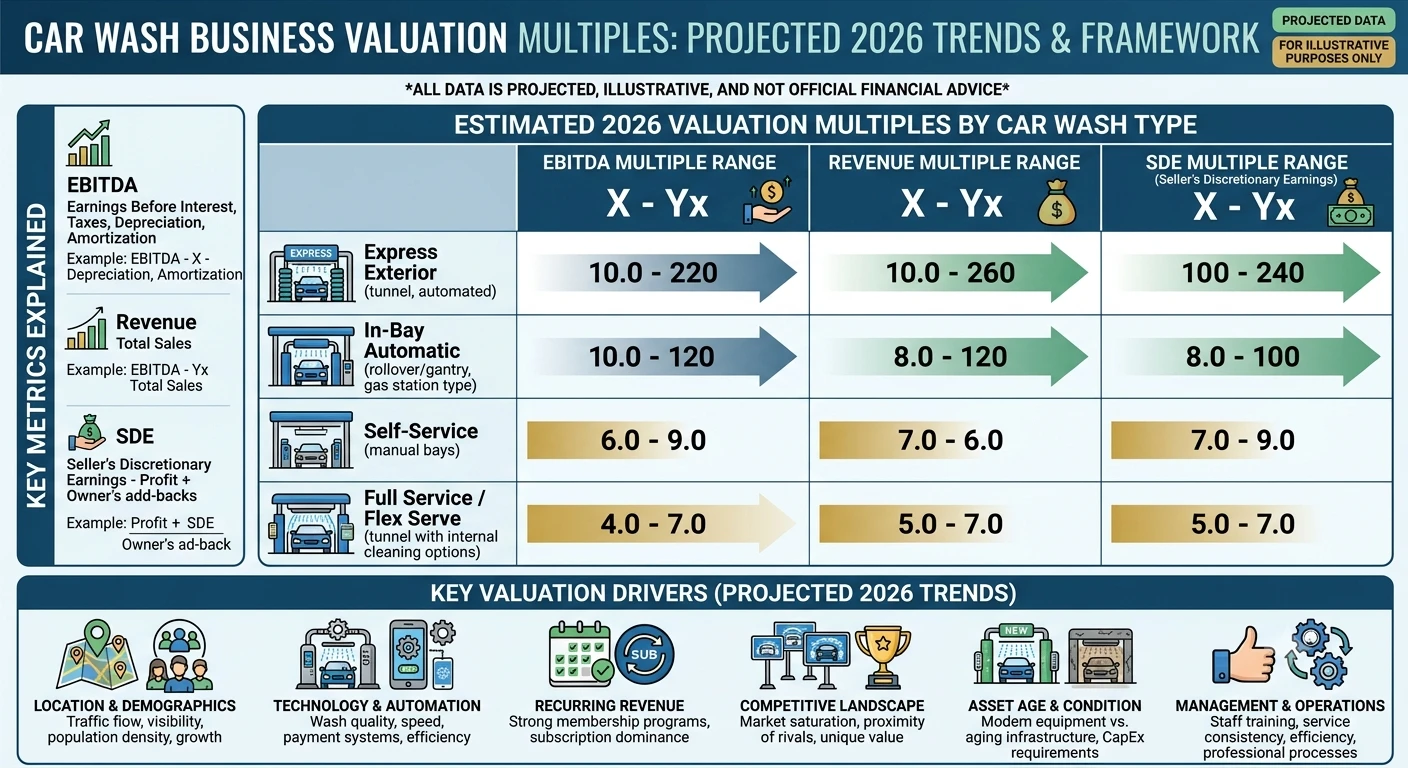
| Express exterior tunnel | Highest throughput, membership-ready | 5x – 7x SDE |
| In-bay automatic (touchless) | Moderate throughput, low labor | 4x – 5.5x SDE |
| Self-service (coin/card bays) | Lowest active management, location-sensitive | 3x – 4x SDE |
| Full-service | Labor-intensive, harder to scale | 3.5x – 5x SDE |
Automated and express models consistently command premium multiples because margins are predictable and scalable. Labor-intensive operations face a ceiling.
2. Equipment Age and Condition
This is where buyers dig hardest during due diligence—and where sellers lose the most negotiating leverage.
Equipment condition affects valuation on two levels: it signals future capital expenditure risk, and it signals revenue reliability. A 15-year-old in-bay machine with failing brushes and a patched controller tells a buyer they’re inheriting a problem. A 3-year-old, well-maintained automatic tells them they’re inheriting a system.
Buyers evaluate: remaining useful life, maintenance records, chemical systems, water reclaim capability, and whether the equipment supports modern payment and membership integration.
This is why operators increasingly view equipment investment not just as a capital cost, but as a valuation multiplier. Modern automatic car wash machines—particularly touchless systems that minimize physical wear on both vehicle finishes and the machine itself—tend to hold their performance profile longer, which translates directly into higher appraisal values at exit.
A well-specified machine like the Mattias Car Wash M-WS310 (rollover/gantry touchless) or the M-SD0900Q tunnel system, for example, brings predictable throughput, modern control architecture, and the kind of maintenance documentation that serious buyers want to see. Equipment that can be verified—hours of operation, service logs, chemical consumption data—removes risk from the buyer’s calculation. Reduced risk means a higher multiple.
3. Membership Revenue Penetration
The car wash industry’s biggest valuation shift over the past five years has been the rise of unlimited wash memberships. A wash generating $400,000/year in recurring monthly memberships is valued very differently than one generating the same gross revenue from one-time transactions.
Recurring revenue stabilizes cash flow forecasting, reduces seasonality risk, and signals customer loyalty. Institutional buyers will pay a significant premium for a wash where 40%+ of revenue is membership-based. If you’re building or acquiring a wash today without a membership program, you’re leaving valuation on the table.
4. Location and Traffic Count
A high-visibility site on a busy arterial beats a hidden location with lower traffic, even with identical equipment and financials. Appraisers look at daily vehicle counts, proximity to residential density, visibility from the road, and competitive saturation in the trade area.
For gas station operators adding a car wash bay or tunnel, the location advantage is already baked in—you have daily fuel traffic that can be converted to wash customers with a well-placed CTA at the pump.
5. Real Estate Ownership
Washes that own their real estate trade at a materially higher multiple than leased-land operations. The real estate adds a second asset class to the transaction, attracts a wider buyer pool, and provides collateral for acquisition financing. In some markets, land value alone exceeds the business value of the wash operating on it—which is why some car wash sites get redeveloped the moment a sale closes.
Common Investor Mistakes (and How to Avoid Them)
Paying for potential. The most common error is buying based on what a wash could generate under better management or with upgraded equipment. You should never pay for future upside—negotiate based on documented, trailing twelve months of cash flow.
Underestimating CapEx. Equipment replacement, water treatment systems, and facility maintenance are substantial ongoing costs. Set aside 5–7% of monthly revenue for preventive maintenance as a baseline.
Ignoring the management factor. A car wash isn’t truly passive at the small-operator level. Staffing (if any), chemical management, equipment servicing, and customer issue resolution require active oversight. Price that labor into your return expectations.
Skipping equipment due diligence. Always get an independent equipment assessment before closing. Aging systems with deferred maintenance can easily represent $50,000–$200,000 in near-term capital expenditure that erodes your purchase logic entirely.
What This Means If You’re Building or Upgrading (Not Just Buying)
For gas station investors and car wash operators evaluating new builds or equipment upgrades, the valuation framework above works in reverse: every investment that increases documented earnings, extends equipment useful life, or adds membership revenue capacity is an investment in your eventual exit multiple.
This is why equipment selection matters beyond the immediate operational question. A modern, commercial-grade automatic car wash system that can be integrated with membership management software, that generates reliable throughput data, and that carries a verifiable service record—these aren’t just operational conveniences. They’re valuation assets.
The Mattias Car Wash machine range is designed with this in mind: from the compact in-bay M-LM216 touchless car wash machine suited for a single-bay gas station add-on, to the high-capacity M-SD0900Q and SD1800Q tunnel systems built for volume operations. Each system is engineered for long service life, straightforward maintenance documentation, and throughput consistency—exactly the operational profile that supports premium exit multiples.
FAQ
Q: What is the average earnings multiple for a car wash in 2026? A: Based on recent transaction data, the average earnings multiple for sold car wash businesses is approximately 4.7x–5.0x seller’s discretionary earnings. High-performing locations with membership programs and modern equipment can reach 6x–7x, while weaker operations may transact at 3x–3.5x.
Q: What type of car wash has the highest valuation? A: Express exterior tunnels with unlimited membership programs consistently command the highest multiples, followed by touchless in-bay automatics. Labor-intensive full-service operations and older self-service bays tend to sell at the lower end of the range.
Q: Does equipment age affect car wash valuation? A: Significantly. Buyers discount heavily for aging equipment because it represents both revenue risk and near-term capital expenditure. Well-maintained, modern equipment extends revenue reliability and reduces buyer risk—both of which support higher multiples. Equipment service records and throughput data are increasingly required in due diligence.
Q: What cap rate should I require when buying a car wash? A: Experienced operators typically set a minimum of 10–12% cap rate. Car washes require active management—staffing, equipment maintenance, chemical procurement—unlike passive real estate, which justifies demanding a higher return on capital.
Q: How does membership revenue affect car wash valuation? A: Substantially. Recurring monthly membership revenue stabilizes cash flow, reduces seasonality risk, and signals customer loyalty—all factors that justify higher multiples. Institutional buyers actively target washes where 40%+ of revenue is membership-based.
Q: What’s the difference between SDE and EBITDA for car wash valuation? A: SDE (Seller’s Discretionary Earnings) reflects total owner benefit and is used for owner-operated small businesses. EBITDA reflects earnings after a normalized management structure and is preferred by private equity and institutional buyers. The same business may show different values under each metric; understanding which applies to your situation is important for accurate pricing.
Q: Can adding a car wash to a gas station increase overall property value? A: Yes. A well-configured automatic car wash at a gas station creates a secondary revenue stream, increases daily dwell time, and can improve the overall property valuation on both the business and real estate dimensions. The key is choosing equipment scaled to your site’s daily traffic count.
Q: How long does it take for a car wash investment to pay for itself? A: ROI timelines vary by investment size and model. High-volume express tunnels typically see payback periods of 4–7 years on equipment. In-bay automatics added to existing gas station sites—where land and infrastructure are already in place—can achieve shorter payback windows, particularly with membership programs driving predictable recurring revenue.
A car wash in 2026 is worth what its documented cash flow, equipment condition, membership penetration, and location can justify—multiplied by what a buyer believes about the future of those variables.
The investors and operators who achieve 6x+ exits aren’t getting lucky. They’re building systems that are easy to verify, scalable, and not dependent on the current owner showing up every day. That starts with the right equipment, the right revenue model, and the discipline to run clean books.
If you’re evaluating a new installation or equipment upgrade and want to understand what configuration makes sense for your site, contact the Mattias Car Wash team for a site assessment and equipment recommendation →
Mattias Car Wash manufactures fully automatic car wash machines for gas stations, car wash operators, and commercial investors worldwide. Our product range includes touchless rollover/gantry systems, in-bay automatics, and high-capacity tunnel systems engineered for long-term ROI.