










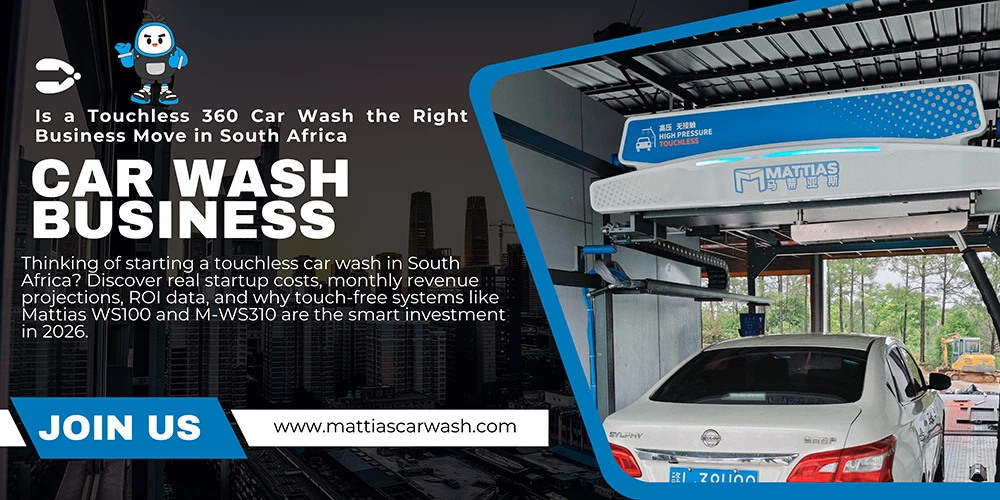

There’s a question being asked more and more in car wash business circles across South Africa: “Should I go touchless car wash?”
It started surfacing loudly on global operator forums — one post in particular caught our attention. An entrepreneur in the early stages of building a car wash business in South Africa wrote on CarWashForum:
“I’m in the early research stages of potentially starting a touchless 360 laser car wash in South Africa. The touchless segment here is practically non-existent. Around 95% of car wash businesses are manual hand-wash operations.”
That sentence — 95% manual hand-wash operations — is not a warning sign. It’s a market opportunity hiding in plain sight.
If you’re a car wash operator, entrepreneur, or investor in South Africa eyeing the automatic and touchless car wash space, this guide is for you. We’ll break down what the global forum community is saying, what the numbers look like on the ground in South Africa, and why a touch-free car wash system may be the smartest business decision you make in 2025.
Why South Africa’s Car Wash Market Is at a Tipping Point
South Africa’s car wash industry has operated the same way for decades: low wages, buckets, sponges, and a team of hand-washers. The model works — until it doesn’t. Labor turnover, inconsistent quality, water waste, and rising overhead costs are squeezing margins for traditional operators.
Meanwhile, the broader market is shifting dramatically. South Africa’s automated car wash penetration currently sits at around 18% (2024) — but is projected to climb to 35% by 2029. That’s a near-doubling of market share in five years, driven by:
- Rising vehicle ownership in urban centers like Johannesburg, Cape Town, and Durban
- Consumer preference for fast, consistent, and paint-safe cleaning
- Cashless payment adoption, which jumped from 22% to 67% post-COVID
- Water restrictions and environmental regulation that favor closed-loop, water-recycling systems
- A growing middle class with higher-end vehicles — particularly SUVs, German sedans, and vehicles with ceramic coatings or PPF film
That last point matters enormously for touchless technology. As more South African drivers invest in premium paint protection, they become unwilling to risk brush scratches at traditional automatic washes. A no-contact, high-pressure wash becomes not just preferred — it becomes the only acceptable option for a growing segment of the market.
What the Global Operator Community Says About Touchless 360 Systems
Operators on international car wash forums have spent years debating the merits of touchless vs. friction systems. Here’s what the community wisdom looks like when filtered through the lens of a market like South Africa:
1. Touchless is a “first-mover” advantage in untapped markets
The South Africa-based entrepreneur who posted on CarWashForum was told by experienced operators: “The touchless segment here is practically non-existent.” In a market dominated by hand-wash operations, being the first to offer a professional touchless 360 car wash experience in your city or suburb is a significant competitive moat.
2. Equipment quality and support matter more than price
One of the most heated debates in the forum thread centers on equipment sourcing. The original poster noted the difference between U.S./EU systems and Chinese systems — but observed that in South Africa, both options share the same local support challenge: no local technician networks, no local spare parts warehouses.
This is exactly why buyers should prioritize manufacturers who offer:
- Comprehensive remote support and diagnostics
- Pre-shipment testing and international warranty
- Accessible spare parts supply chains
- Clear installation guidance and operator training
3. Chemistry is the silent killer — or the silent hero
Multiple veteran operators across forums emphasize that touchless car wash success or failure hinges on chemical management. High-pressure water alone isn’t enough — the right pH-balanced, two-step presoak system (low pH followed by high pH) is what truly powers a clean, spot-free result. In South Africa, where hard water is common in many areas, water softening equipment and chemistry management are not optional extras — they are core infrastructure.
4. Throughput determines profitability
As one forum contributor noted about investing in touchless equipment: “Throughput is money.” A well-configured single-bay touchless system washing 8+ cars per hour can generate significant daily revenue, but only if you choose equipment with the speed and reliability to sustain peak-hour performance.
The Real Numbers: What Does a Touchless Car Wash Business Cost in South Africa?
Let’s get specific. Here’s a realistic cost and revenue framework for a touchless car wash operation in South Africa in 2025.
Startup Cost Breakdown (Single-Bay Touchless System)
| Cost Component | Estimated Range (ZAR) |
|---|---|
| Touchless car wash machine (entry-level) | R185,000 – R250,000 (≈ USD $9,000–$13,200) |
| Touchless car wash machine (mid-to-high level) | R460,000 – R560,000 (≈ USD $25,000–$30,000) |
| Site preparation & civil works | R80,000 – R200,000 |
| Plumbing, electrical, water softener | R40,000 – R100,000 |
| Payment terminal / kiosk | R15,000 – R40,000 |
| Signage & branding | R10,000 – R30,000 |
| Chemical stock (initial) | R8,000 – R20,000 |
| Total (Entry-level setup) | R338,000 – R640,000 |
| Total (Premium setup) | R613,000 – R950,000+ |
Buying an existing wash business: Acquiring a going-concern touchless wash operation typically commands a valuation of 2.5x–3.5x annual net operating income, provided equipment is in good condition and the lease is secure. A well-run site generating ZAR 600,000/year in gross revenue with a NOI of ZAR 300,000+ would be valued at approximately ZAR 750,000 – R1,050,000 on the open market.
Revenue Potential: What Can You Realistically Earn?
A touchless car wash system operating in a well-located South African site generates income as follows:
Scenario A — Entry-Level Single Bay (e.g., Mattias WS100)
- Capacity: 8–10 cars/hour
- Operating hours: 8 hours/day
- Daily throughput (conservative 50% utilization): ~40 cars/day
- Average wash price: ZAR 80–120 per car
- Daily gross revenue: ZAR 3,200 – 4,800
- Monthly gross revenue: ZAR 96,000 – 144,000
- Operating costs (water, electricity, chemicals, maintenance): ~ZAR 20,000–35,000/month
- Monthly net profit estimate: ZAR 61,000 – 109,000
Scenario B — Premium High-Throughput System (e.g., Mattias M-WS310)
- Capacity: 10–15 cars/hour
- Operating hours: 10 hours/day
- Daily throughput (60% utilization): ~75–90 cars/day
- Average wash price: ZAR 100–150 per car (premium positioning)
- Daily gross revenue: ZAR 7,500 – 13,500
- Monthly gross revenue: ZAR 225,000 – 405,000
- Operating costs: ~ZAR 50,000–80,000/month
- Monthly net profit estimate: ZAR 145,000 – 325,000
Note: Revenue projections assume a standalone, well-located site. Fuel station integrations, shopping mall placements, and gated community installations can significantly improve utilization rates. Premium add-ons — ceramic coating sprays (priced at ZAR 199+ per application) have been shown to boost per-car revenue margins by up to 40%.
The Case for Going Touch-Free First
If you’re weighing touchless versus soft-touch (brush) systems for the South African market, here’s the strategic argument for starting touch-free:
1. Paint-safe is a premium positioning tool. South African consumers with higher-end vehicles — especially those in the ZAR 400,000+ vehicle segment — are acutely concerned about scratch risk. A touchless wash commands a price premium and builds customer loyalty.
2. Lower long-term maintenance costs. No brushes mean no brush replacements, no brush contamination issues, and no customer damage claims. Forum operators consistently cite brush maintenance as one of the highest-recurring costs in friction-based systems.
3. 24/7 operation capability. Fully automated touchless systems can operate around the clock with minimal staffing. In South Africa’s urbanizing cities, a 24/7 self-pay touchless bay at a fuel station or shopping center is a genuinely differentiated offering.
4. Water efficiency for regulatory compliance. South Africa’s water scarcity regulations are tightening. Advanced touchless systems with water recycling capabilities reduce consumption to as low as 70 liters per wash — a fraction of the 200–300 liters used by a manual hand wash team. This not only helps with environmental compliance but significantly cuts ongoing water bills.
5. First-mover advantage in an underpenetrated market. With touchless penetration near zero in most South African cities, launching a professional touchless 360 operation now means you define the category before competitors arrive.
Introducing the Mattias Touch-Free Car Wash Solutions for South Africa
Mattias is a specialized manufacturer of professional automatic car wash systems, offering a full range of solutions from self-service bays to high-throughput tunnel systems. For the South African market, we recommend two touchless models that match the local market’s needs and investment appetite:
Mattias WS100 — The Smart Entry Point for New Investors
Price: USD $9,000 – $13,200 (approx. ZAR 165,000 – 242,000)
The WS100 is Mattias’s entry-level touchless car wash machine, designed for operators launching their first automated site or adding a touchless bay to an existing operation.
Key specifications:
- 360° rotating high-pressure wash arm with precision nozzle technology
- Multi-cycle program: pre-soak, high-pressure rinse, foam application, spot-free rinse, dry
- Compact footprint — fits into existing single bays without major structural modification
- Touchscreen operator panel with programmable wash packages
- Compatible with cashless payment integration (QR code, NFC, card)
- Water consumption: optimized low-volume cycles
- Suitable for: fuel stations, stand-alone bays, small-to-medium car wash sites
Why it works for South Africa: The WS100’s lower capital cost and compact design make it ideal for entrepreneurs testing the touchless market in secondary cities like Port Elizabeth, Bloemfontein, or Pretoria East — where real estate costs are lower and competition remains thin.
Mattias M-WS310 — The Professional-Grade 360 Touchless System
Price: USD $25,000 – $30,000 (approx. ZAR 455,000 – 550,000)
The M-WS310 is Mattias’s flagship touchless in-bay automatic system — built for high-traffic commercial locations that demand speed, cleaning precision, and reliability day after day.
Key specifications:
- Advanced 360° rotating arch with intelligent vehicle profiling sensors
- High-pressure water jets (up to 1,500 PSI) with variable-angle nozzle configuration
- Multi-stage wash program: underbody pre-rinse, two-step presoak, triple foam, high-pressure body wash, spot-free rinse, chemical wax/sealant application, power dry
- PLC-controlled intelligent motion system — optimizes wash path per vehicle shape
- Integrated IoT monitoring: remote diagnostics, wash count data, chemical level alerts
- Water recycling system option: reclaims and reuses up to 85% of wash water
- Throughput: 10–15 vehicles/hour
- Suitable for: high-traffic fuel stations, shopping mall entrances, car dealerships, fleet wash centers, standalone premium car wash sites
Why it works for South Africa: The M-WS310 is purpose-built for operators who want to run a premium, semi-passive business with minimal staff, maximum throughput, and a wash quality that converts first-time visitors into loyal repeat customers. Its IoT connectivity means you can monitor operations remotely — critical for South African investors managing sites across multiple locations.
Key Considerations Before You Launch
Based on real forum operator experience and South African market conditions, here are the factors you must address before opening day:
Site selection: High vehicle traffic count is non-negotiable. Target sites adjacent to fuel stations, retail centers, or commuter routes with daily vehicle counts of 8,000+. A touchless system needs volume to justify the investment.
Water supply and quality: Test your local water hardness. Hard water requires a water softener system upstream of the machine — this is a necessary cost, not an optional upgrade. Failing to address water quality is the single most common reason touchless wash results disappoint customers.
Chemical management: Partner with a professional car wash chemical supplier who will calibrate your presoak concentrations and pH balance on-site. The machine delivers the pressure; the chemistry delivers the clean. Both must be optimized together.
Payment infrastructure: Install a cashless pay station from day one. Cash-only operations lose a measurable share of potential customers and create management headaches.
Pricing strategy: Position your touchless service as a premium product relative to local hand-wash competitors. A hand wash in your area may cost ZAR 60–80. Price your base touchless package at ZAR 90–120, and offer an upgraded wash with foam, wax sealant, and spot-free rinse at ZAR 150–180. The premium positioning pays.
Final Word: South Africa’s Touchless Window Is Open — But Not Forever
The entrepreneur on CarWashForum who flagged that South Africa’s touchless car wash market is “practically non-existent” was identifying a gap, not a dead end. That gap is beginning to close. Urban consumers are upgrading their vehicles. Water regulations are tightening. Labor costs are rising. And the global trend toward automation in car care is impossible to reverse.
The operators who move into the touchless space in South Africa now — with the right equipment, the right site, and the right chemical management — will own the category before latecomers realize the opportunity has passed.
Mattias is ready to support your journey. Whether you’re a first-time investor exploring the WS100 as an entry point, or an experienced operator ready to deploy the M-WS310 across multiple sites, our team is available to advise on equipment selection, site feasibility, installation, and ongoing support.
Ready to Get Started?
Contact the Mattias team today for a detailed ROI analysis for your specific site and a personalized equipment recommendation.
Email: info@mattiascarwash.com Website: www.mattiascarwash.com WhatsApp: [+8618676736775]
Mattias manufactures a full range of automatic car wash systems including self-service car wash machines, rollover gantry systems, tunnel car wash systems, and touchless in-bay automatic systems. Our products are available for export globally, with direct manufacturer pricing and comprehensive after-sales support.