







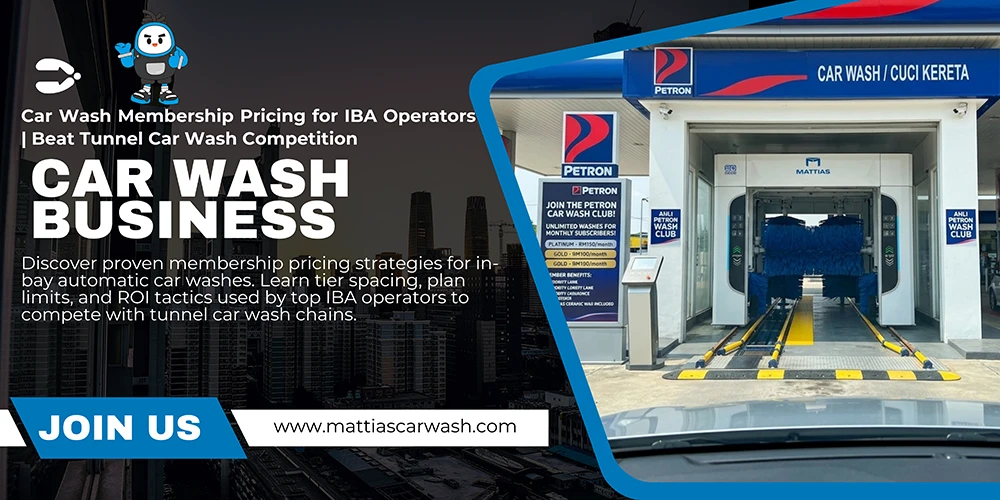

Discover proven membership pricing strategies for in-bay automatic car washes. Learn tier spacing, plan limits, and ROI tactics used by top IBA operators to compete with tunnel car wash chains.
The Challenge Every IBA Owner Faces Today
If you own or are investing in an in-bay automatic (IBA) car wash, you’ve probably felt the pressure. Tunnel car washes are expanding rapidly — sometimes multiple competitors appearing within a 2-mile radius — and nearly all of them are leading with aggressive monthly membership plans.
One operator on a major car wash industry forum described losing 40% of loyal customers in just 3.5 weeks after a tunnel wash opened nearby and launched membership pricing. That kind of disruption is exactly why IBA operators, gas station investors, and multi-site wash owners need a clear, data-backed membership strategy before the competition arrives — not after.
At Mattias Car Wash, we work closely with IBA operators around the world, and we’ve seen firsthand which membership structures hold up against tunnel competition and which ones create headaches. This guide distills real-world operator experience into a practical framework you can apply today.
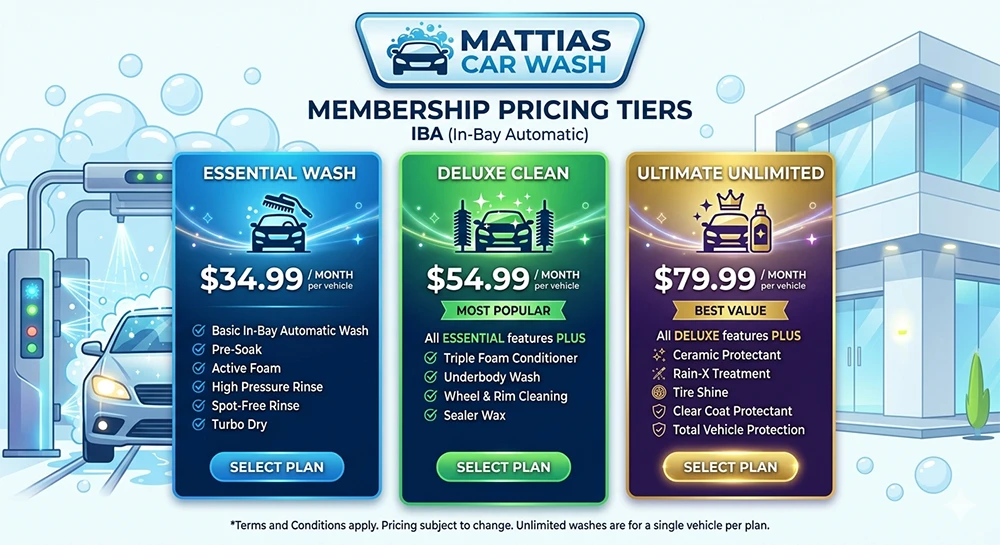
What Membership Pricing Actually Does for an IBA
A monthly unlimited or limited membership plan isn’t just a loyalty program — it’s a revenue stabilization mechanism. Here’s what seasoned IBA Car Wash Operators consistently report:
Predictable monthly recurring revenue. Instead of relying entirely on weather-dependent single-wash transactions, membership income arrives every billing cycle regardless of rain or season. Midwest operators note that unpredictable weather makes a predictable membership revenue base especially valuable.
Competitive insulation against tunnels. When a tunnel opens nearby advertising “wash every day if you want,” an IBA without a membership offering has no direct response. But with a well-priced tier system, your existing customers have a reason to stay loyal — they’ve already committed monthly.
Foot traffic multiplier effect. One operator who doubled gross revenue at a site using membership reported an unexpected bonus: the more members actively washing, the more single-wash cash customers were attracted to the site. Busy washes look legitimate and trustworthy.
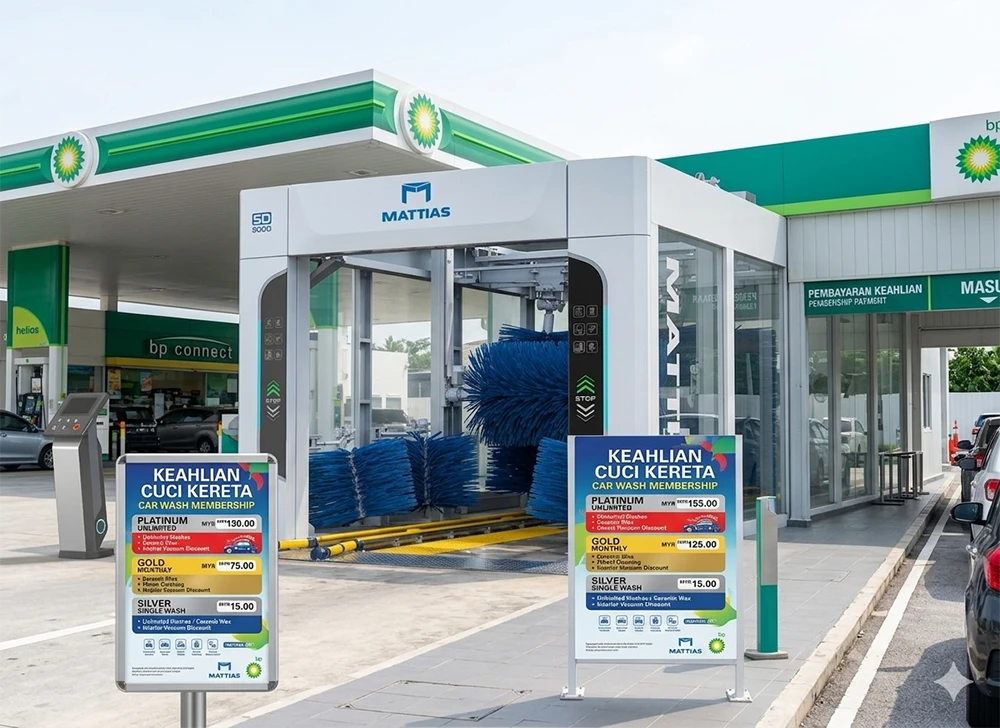
How to Structure Your Membership Tiers — The Numbers That Work
The most common question among IBA operators launching memberships is: What prices should I set?
Industry practitioners generally agree on a core formula: monthly plan price = 2x to 2.5x the single-wash price for the equivalent package. This multiplier holds across both IBA and tunnel formats, but here’s how it plays out for a typical dual-bay IBA:
Tier Spacing Is More Important Than Absolute Pricing
A key insight from experienced operators: the gap between tiers determines where members cluster. If your jump from the mid-tier to the top tier is too large — say $30 to $40 — most members will pile into the mid-tier, and your top-tier plan barely sells.
The strategy that works better is making the top tier feel like only a small premium over the middle tier, while the middle tier appears to offer dramatically better value than the bottom. This nudges members upward.
A pricing structure that reflects this principle for a dual-bay IBA might look like:
| Plan | Single Wash | Monthly Membership |
|---|---|---|
| Bronze | $10 | $24.99 |
| Silver | $12 | $29.99 |
| Gold | $14 | $36.99 |
| Platinum | $16 | $39.99 |
Note that the top two tiers are only $3 apart in monthly cost — a deliberate design choice to capture upgrades. Operators have also found success bumping the single Platinum wash price to $17–$18 while holding the monthly fee at $39.99, making the membership value proposition more visually compelling on signage.
The Monthly Ceiling Most Operators Respect
Across IBA and mid-size tunnel operations, experienced operators report that the psychological ceiling for most customers is around $40–$45 per month. Plans exceeding this threshold see a meaningful drop-off in signups unless the market is unusually affluent or the wash offers premium services that justify it.
That said, some premium tunnel chains in select markets have successfully pushed beyond this range — these tend to be exceptional cases rather than the norm for IBA operators.
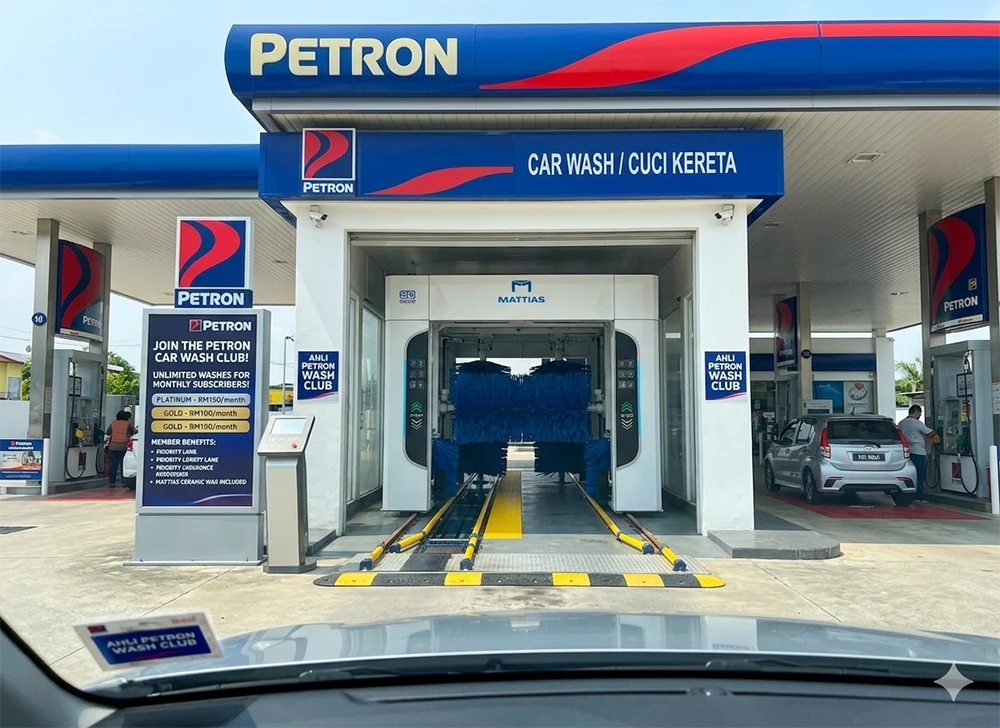
Unlimited vs. Limited — The Debate Every IBA Investor Must Settle
This is perhaps the most contested topic among IBA membership operators. Here is what real-world experience tells us:
Why Many IBA Operators Choose Limited Plans
Several operators who launched unlimited IBA memberships describe a consistent pattern: abuse spikes quickly. Some members wash daily or multiple times per week, which strains equipment cycles and distorts unit economics. One operator described the stress as significant enough that they eventually banned a repeat offender who was regularly bringing in non-member vehicles.
Unlimited IBA is a different animal from unlimited tunnel. In a tunnel with employees, abuse is easier to catch and manage. In an unstaffed or lightly staffed IBA, enforcement is much harder.
The most widely recommended approach among IBA operators: limit memberships to 5–6 washes per billing period. This is enough for customers who value the convenience of regular washes, while preventing the outlier abuse that tanks the economics of unlimited plans.
When Unlimited Makes Sense
The one scenario where unlimited IBA memberships draw more operator support: when a tunnel wash is actively competing for the same customer base and using unlimited as a key selling point. In that context, some IBA owners have launched unlimited as a defensive tactic — accepting some abuse risk in exchange for keeping their customer base from defecting entirely.
Even in these cases, technology platforms that show per-member wash frequency help operators monitor and flag unusual behavior.
Technology Platforms — What IBA Operators Are Actually Using
The right membership management platform makes or breaks the operator experience. The IBA operator community has experience with several options, and the consensus points to a few key considerations:
Ensure the platform supports wash count limits. Not all membership software was designed with IBA abuse prevention in mind. Confirm that your chosen platform can cap washes per billing cycle before committing.
RFID and LPR enforcement. For IBA sites, license plate recognition (LPR) or RFID sticker systems are the most reliable enforcement mechanisms. QR-code-based systems work but require more active monitoring since QR codes can be shared between vehicles.
Choose platforms with active support. Multiple operators report frustration with legacy paystation systems — bugs related to major platform changes (like app ecosystem updates) went unresolved for extended periods. Before selecting a membership platform, ask vendors specifically about their support response times and update cadence.
Consider newer paystation hardware. Older paystation models were not designed with membership integration in mind. Operators who have upgraded to newer paystation hardware report a smoother membership experience and fewer customer-facing technical issues.
At Mattias Car Wash, our equipment is designed with modern payment and membership system compatibility in mind — we can advise on how to configure your site’s technology stack to minimize friction.
Alternatives to Monthly Memberships — What Else Works for IBA
Not every IBA market is right for monthly memberships, particularly in lower-density or smaller population areas. Operators in these markets have found success with alternative loyalty approaches:
Prepaid wash cards and wash books. Fixed-value prepaid cards offer a discount incentive without the recurring billing complexity of a membership. Customers buy a $50 card and receive $60 in wash credits, for example. Simple to manage, no abuse risk.
Points-based loyalty programs. Some IBA operators have built loyal communities through app-based loyalty programs where every wash earns points redeemable for free washes. One operator with nearly 1,000 app members reported keeping the wash consistently busy without the management overhead of a monthly membership. Engagement features like birthday washes and double-points days drive participation.
Value-driving add-ons over price-based competition. Rather than competing on membership price, some operators differentiate by adding services — upgraded foam, ceramic coatings, tire shine, or enhanced drying. When the top single-wash reaches $22–$25 due to added services, the monthly value equation becomes compelling even without aggressive discounting.
ROI Considerations for Investors and Multi-Site Operators
If you’re evaluating car wash investment as a gas station operator or new entrant, the membership model is worth serious analysis beyond the per-unit price points.
Gross revenue impact can be significant. Site operators who have run membership programs for 12+ months report gross revenue doubling at competitive sites, driven by both membership recurring revenue and the additional single-wash customers attracted by a visibly busy wash.
Revenue per car stays surprisingly stable. Despite lower per-use pricing for members, average revenue per car tends to decline by less than a dollar when membership is well-managed — because the higher volume offsets the discount.
Timeline expectations. Experienced operators advise that membership revenue ramps over several months, not immediately. Digital signage and customer education are important drivers of membership adoption, particularly in the early months of a program launch.
Factor equipment wear rates. Higher wash volume from active members means more cycles on your equipment. This is particularly relevant for IBA operators since a single machine handles all volume — build this into your maintenance budget from the start.
Frequently Asked Questions
Q: Should a new IBA start with memberships immediately or wait?
Most experienced operators suggest waiting until the wash has established a single-wash customer base and collected some operational data. Launching memberships with no customer history makes pricing calibration difficult. A 3–6 month baseline period is a reasonable approach.
Q: How many tiers should an IBA membership program have?
Three to four tiers is the most common structure. Too few tiers leave money on the table from customers willing to pay more. Too many tiers create decision paralysis and slow signups. Four well-spaced tiers cover the range from value-focused to premium-seeking customers.
Q: What happens to my cash customers when I introduce memberships?
Counter-intuitively, some operators report more single-wash cash customers after launching memberships. Active membership usage keeps the wash visibly busy, which builds credibility and draws in customers who aren’t interested in a monthly commitment.
Q: How do I handle customers trying to use one membership for multiple vehicles?
LPR-equipped sites can restrict a membership to a single registered plate. For QR code-based systems, abuse is harder to prevent automatically — manual monitoring of high-frequency users is necessary. Setting a wash count limit (5–6 per month) also limits the damage from shared accounts.
Q: Is there a meaningful difference between managing memberships at an IBA vs. a tunnel?
Yes — staffing is the key variable. Tunnels with employees can handle membership issues in real time. Unstaffed or limited-staff IBA sites require technology-driven enforcement. This is why the IBA operator community generally recommends limited (not unlimited) plans and robust paystation hardware.
Q: What should I charge for free vacuums as a membership add-on?
This is a market-specific judgment call. Some operators include free vacuums in all membership tiers as a competitive differentiator. Others skip vacuums entirely to reduce operational complexity and stress. In highly competitive markets, vacuum inclusion can be a meaningful differentiator on signage.
Q: How do memberships perform against tunnels long-term?
Where operators have implemented well-managed limited membership programs with the right technology, they report retaining a meaningful share of customers even with tunnel competition within a mile. Price alone isn’t the deciding factor — convenience, trust, and the perceived value of the membership program all matter.
Summary: What Mattias Car Wash Recommends
For gas station investors and IBA operators evaluating membership pricing, the framework that consistently performs in competitive markets comes down to five decisions:
- Set tier spacing for upgrade behavior, not just coverage. Make the top tier feel like a small step from the middle tier.
- Start with limited plans (5–6 washes/month). Unlimited works for tunnels with staff — it requires extra vigilance at an IBA.
- Price within the $25–$45 monthly range based on your local market, with the 2x single-wash multiplier as your baseline.
- Invest in modern paystation hardware with reliable membership platform integration and active vendor support.
- Give it time. Membership revenue builds over months, and the compounding effect of member volume on overall site traffic is part of the long-term value.
Mattias Car Wash manufactures equipment designed for today’s competitive wash landscape — built for high cycle volumes, compatible with modern payment and membership systems, and engineered to make the member experience as smooth as the single-wash experience.
Ready to build a business case for your IBA site? [Contact us for a consultation and equipment quote.]