

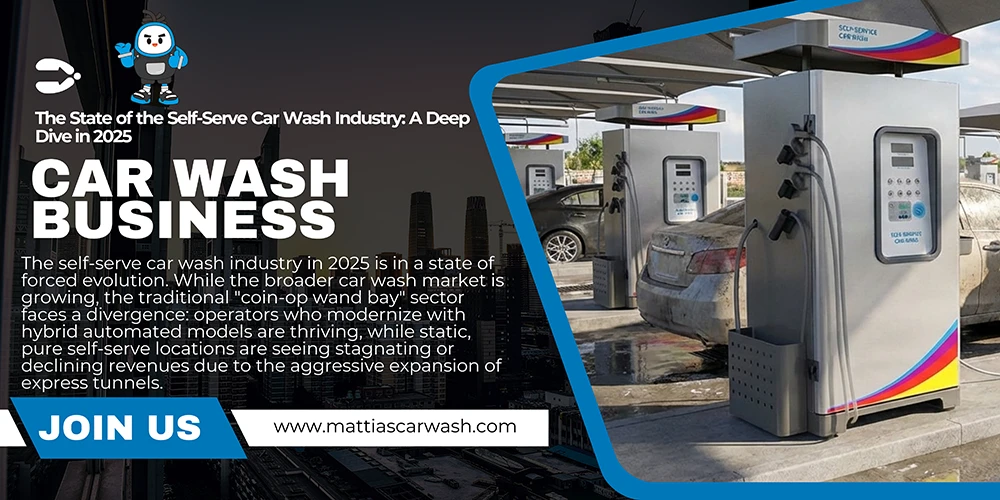

The self-serve car wash industry in 2025 is in a state of forced evolution. While the broader car wash market is growing, the traditional “coin-op wand bay” sector faces a divergence: operators who modernize with hybrid automated models are thriving, while static, pure self-serve locations are seeing stagnating or declining revenues due to the aggressive expansion of express tunnels car wash.
The following deep dive covers the financial state, technological shifts, and consumer behaviors defining the industry in 2025.
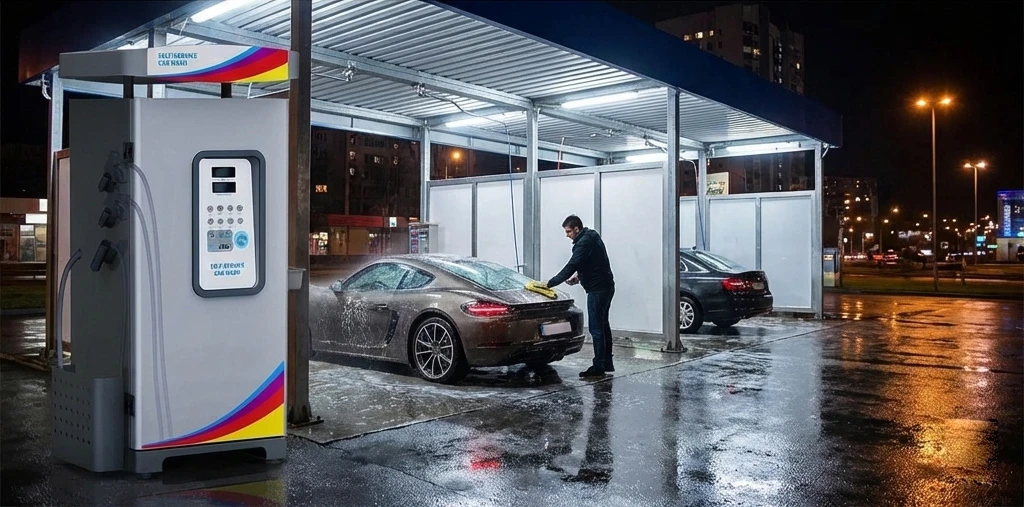
1. Executive Summary: The “Squeeze” and the Pivot
In 2025, the self-serve industry is defined by the “Do-It-For-Me” (DIFM) consumer shift. The romantic notion of a Sunday driveway wash is dead, but the desire to laboriously scrub a car in a self-serve bay is also waning in favor of speed and convenience.
-
Market Position: Pure self-serve bays (wand washing) are losing market share to Express Tunnels (conveyor belts) and In-Bay Automatics (rollover car wash machines).
-
The Survival Pivot: Successful self-serve sites in 2025 are rarely just self-serve. They are becoming “Hybrid Locations”—combining wand bays for enthusiasts/large vehicles with an unattended In-Bay Automatic (IBA) for convenience seekers.
2. Financial Health & Market Performance
The economics of the industry have shifted from “build and they will come” to “upgrade or die.”
-
Revenue Polarization: * According to 2025 industry surveys, only roughly 27% of self-serve operators reported increased revenue year-over-year.
-
Conversely, nearly 23% reported a drop in income, a sharp rise from previous years. This signals that older, unmaintained facilities are failing faster than before.
-
-
CapEx Surge: Despite stagnant cash flow for some, reinvestment is high. Over 50% of operators plan to purchase new equipment in 2025. The focus isn’t on new bays, but on upgrades (credit card readers, dryers, LED lighting) to compete with modern tunnels.
-
Market Size: The global self-service car wash system market is valued at approx. $4.8 billion, growing at a CAGR of ~6.6%. However, much of this “growth” comes from new equipment costs and retrofits rather than new site construction in developed markets like the US.
3. The Technology Stack of 2025
The days of “quarters only” are effectively over. In 2025, friction is the enemy.
-
Cashless is King: If a bay does not accept tap-to-pay (Apple Pay/Google Wallet), it is losing the under-40 demographic. Retrofitting bays with contactless readers is the #1 capital expenditure for operators this year.
-
Subscription Models: Express tunnels popularized the “Unlimited Wash Club” ($20/month). Self-serve operators are finally catching up by using app-based subscriptions that activate wand bays via QR codes, securing recurring revenue from loyal DIYers.
-
Connected Equipment (IoT): Operators are using smart monitoring to track soap levels and equipment health remotely. This is crucial for “unattended” business models, allowing owners to manage sites without being physically present 24/7.
4. Major Challenges
The Express Tunnel Threat
Express tunnels (conveyor washes) have saturated many urban markets. They offer a faster, drier, and often cheaper wash (via subscriptions) than a self-serve bay.
-
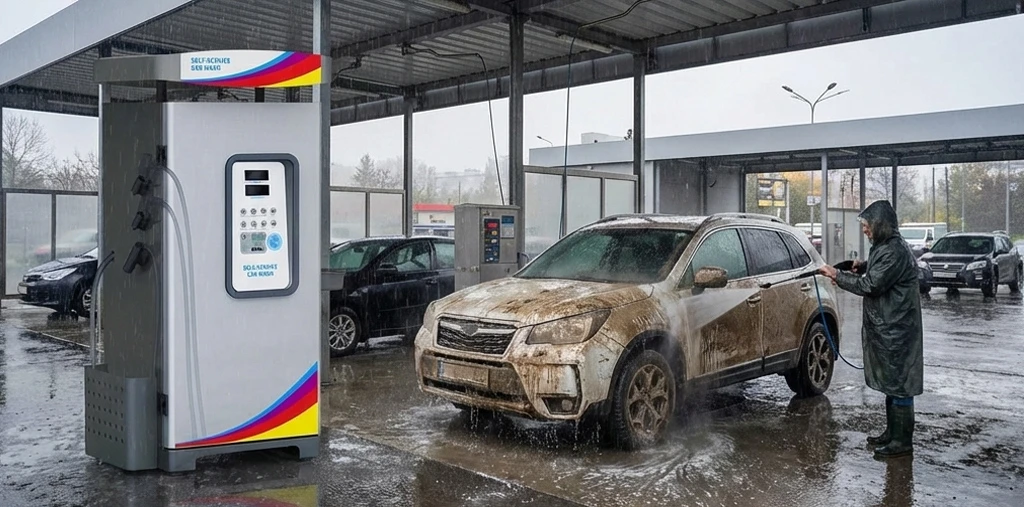
Impact: Self-serve washes are retreating to niches that tunnels cannot serve: Oversized vehicles (RVs, work trucks), mud-caked off-roaders, and detailing enthusiasts who refuse to let brushes touch their paint.
Labor & Maintenance
While “self-serve” implies low labor, the reality in 2025 is different.
-
The “Cleanliness” Standard: Customers now expect retail-level cleanliness. An unkept bay with mud on the floor or a broken hose leads to immediate 1-star reviews on Google.
-
Technician Shortage: finding qualified technicians to repair hydraulic pumps and water reclamation systems is becoming harder and more expensive.
Regulatory Pressure (Water)
Environmental regulations regarding water usage and wastewater disposal are tightening globally.
-
Water Reclamation: New sites are almost universally required to install expensive water reclamation systems (recycling 80%+ of water). Older sites are facing pressure to retrofit, a costly endeavor that is pushing some mom-and-pop operators to sell.
5. Consumer Trends: Who is Still Self-Washing?
The demographic has shifted. The “price-conscious” customer is now often served better by a cheap express tunnel subscription. The self-serve customer in 2025 is more specific:
| Customer Segment | Motivation | Value to Operator |
| The Enthusiast | Wants to control the wash to avoid “swirl marks” from machines. | High: Spends time and money on premium chemicals (tire shine, ceramic sprays). |
| The Fleet/Pro | Driving a work van, dually truck, or Uber that doesn’t fit in a tunnel. | Steady: Reliable, recurring revenue, often during off-peak hours. |
| The Mudder | Off-road vehicles that tunnels refuse to wash. | Niche: High mess, requires heavy bay maintenance (mud removal). |
6. Future Outlook: The “Automated Unattended” Model
The future of the self-serve industry lies in Hybrid Automation.
-
The Retrofit Trend: Investors are buying distressed self-serve washes and converting 1-2 bays into an In-Bay Automatic. This captures the convenience customer while keeping 2-3 wand bays for the enthusiasts.
-
“Mini-Tunnels”: Some operators are tearing down wand bays entirely to install “mini-tunnels” (short conveyor systems) that fit in smaller footprints, offering express speeds without the massive land requirements of full tunnels.
Bottom Line for 2025
The “passive income” dream of a coin-op car wash is largely a myth in 2025. It is now an active, technology-driven retail business. Success requires upgrading to cashless payments, integrating an automatic wash option, and aggressively targeting the “non-tunnelable” vehicle market.
Written at the end, Further reading
Executive Summary: The Financial Split
Retrofit (M-F761AX): Low entry cost, fast ROI (<6 months), but capped revenue potential. Best for high-traffic areas with price-sensitive customers (motorcycles/taxis).
Machine: M-F761AX Self-service Car Wash Machine Price: US$3,750 (RM ~16,687)
Product Overview
The M-F761AX is a compact “6-in-1” station designed for tight spaces. It integrates high-pressure washing, foam, vacuum, and ozone disinfection into a single cabinet.
-
Key Feature: “Smart Liquid Control” – reduces chemical waste by ~20%, crucial for low-margin self-serve ops.
-
Target: DIY enthusiasts and Grab/Taxi drivers.
Financial Analysis (Per Single Bay)
-
Startup Cost (Capex):
-
Machine Cost: RM 16,687
-
Installation (Plumbing/Electrical retrofit): RM 3,500
-
Total Capex: RM 20,187
-
-
Operating Cost (Opex) Per Car:
-
Water (60L) + Elec (0.5 kWh) + Chems: RM 1.20
-
-
Profitability:
-
Avg. Ticket: RM 6.00
-
Net Profit Per Car: RM 4.80
-
Volume: 30 cars/day
-
Monthly Net Profit: RM 4,320
-
-
ROI Timeline: ~4.7 Months