










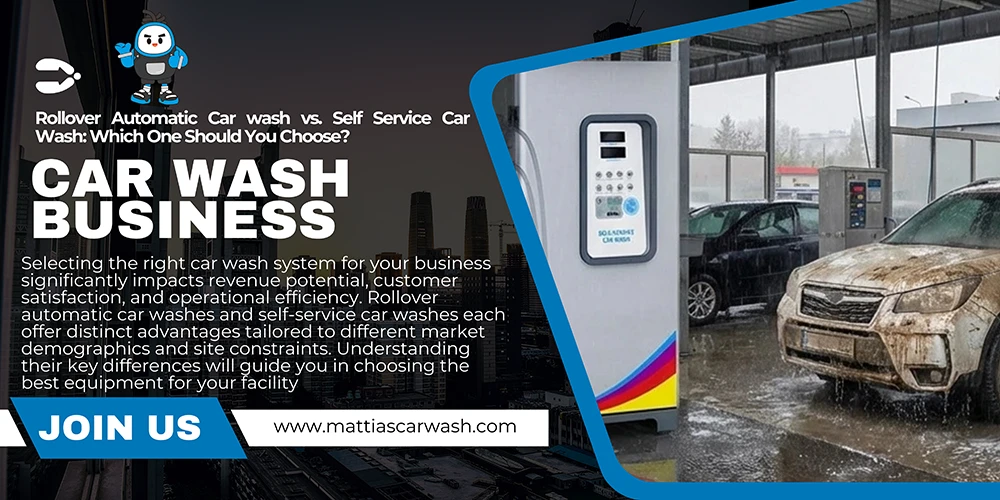

Selecting the right car wash system for your business significantly impacts revenue potential, customer satisfaction, and operational efficiency. Rollover automatic car washes and self-service car washes each offer distinct advantages tailored to different market demographics and site constraints. Understanding their key differences will guide you in choosing the best equipment for your facility.
Understanding Rollover Automatic Car Washes
Rollover automatic car washes employ a gantry system that moves back and forth over a stationary vehicle. These machines offer a convenient, hands-free experience, making them particularly beneficial for gas stations and convenience stores where speed and ease are prioritized. They are commonly utilized for standard exterior cleaning, waxing, and drying cycles. The rollover’s self-contained structure allows for installation in a single bay, maximizing throughput without requiring the extensive footprint of a tunnel system.
Understanding Self-Service Car Washes
Self-service car washes consist of open bays equipped with high-pressure wands, foaming brushes, and chemical applicators designed for customers to manually clean their vehicles. These systems provide extensive control over the cleaning process, ideal for automotive enthusiasts and budget-conscious drivers who prefer specific attention to wheels, wheel wells, and heavily soiled areas. Installation typically requires a multi-bay layout with a central equipment room, ensuring operational flexibility for multiple customers simultaneously.
Comparative Analysis: Rollover Automatic vs. Self-Service
Customer Experience and Convenience Rollover automatic washes require minimal customer effort and allow the driver to remain in the vehicle, providing optimal comfort. This feature makes them perfect for customers seeking a quick, standardized clean without physical exertion.
In contrast, self-service washes necessitate active customer participation. They are better suited for demographics that value detailed cleaning or have non-standard vehicles, such as motorcycles or ATVs, that automatic sensors might misread.
Throughput and Revenue Rollover automatics offer higher ticket prices per wash due to the convenience and added value services like undercarriage flushes and tricolor foams. However, the throughput is limited to one vehicle per cycle per machine.
Conversely, self-service washes generally command a lower price point but can handle multiple customers at once if multiple bays are installed. Revenue is driven by time usage rather than a fixed cycle, though the average ticket is typically lower.
Operational Requirements Rollover units provide straightforward, automated operation suited for sites with limited staffing. The machine manages the entire process, enhancing consistency.
Self-service bays offer greater reliability in terms of uptime; if one bay is down for maintenance, others can remain open. However, they often require more frequent site cleaning and monitoring to prevent vandalism or misuse of equipment.
| Feature | Rollover Automatic Car Wash | Self-Service Car Wash |
| User Convenience | High, fully automated | Low manual labor required |
| Ticket Price | High, premium pricing | Low, time-based pricing |
| Space Efficiency | High, single bay usage | Moderate, requires multiple bays |
| Vehicle Suitability | Standard passenger vehicles | All types, including oversized |
| Operational Staffing | Minimal supervision | Moderate supervision/cleaning |
When to Select a Rollover Automatic Wash
Investors prioritizing high margins, convenience, and compact footprints should consider a rollover automatic wash. These systems are excellent for locations with high traffic flow where customers value speed, such as filling stations or shopping centers. Sites with limited space for queuing or multiple bays benefit greatly from this wash type’s efficiency.
For reliable and efficient wash systems, Mattias’ Gantry Series provides robust options, featuring advanced contouring technology and essential operational accessories designed to improve wash quality and speed.
When to Select a Self-Service Wash
Facilities targeting residential neighborhoods, apartments without hose access, or automotive enthusiasts will find self-service washes advantageous. Ideal for customers who want to remove heavy mud, road salt, or specific grime manually, these bays offer exceptional flexibility. Locations with larger plots of land capable of supporting 3 to 5 bays benefit from the cumulative volume of self-service models.
Maintenance Considerations
Regular inspections and preventive maintenance are critical for both wash types. Rollover automatics require checks on gantry sensors, brush condition, and chemical metering pumps. Similarly, self-service washes demand thorough inspections of high-pressure hoses, coin acceptors, trigger guns, and weep systems to prevent freezing or failure.
Owner training is crucial for both systems, emphasizing rapid troubleshooting, proper chemical handling, and emergency shutdown protocols to ensure customer safety.
Conclusion
Choosing between rollover automatic car washes and self-service car washes depends on specific business goals, including target demographics, available land, and desired price points. Rollover automatics offer excellent revenue per car, ease of use, and suitability for high-traffic retail environments. In contrast, self-service washes provide comprehensive cleaning control, supporting a loyal base of hands-on customers and accommodating a wider variety of vehicle types.
Evaluating these aspects carefully will ensure optimal equipment selection, enhancing your facility’s profitability, customer retention, and service capabilities. Mattias’ Gantry Series car washes exemplify robust, efficient, and reliable wash solutions, providing exceptional value to car wash operators seeking quality and performance.
Frequently Asked Questions (FAQs)
Which wash type is better for a limited space?
Rollover automatic washes are optimal for space-limited sites as they require only a single bay and a small equipment room to operate effectively.
Can self-service washes handle credit cards?
Yes, modern self-service bays equipped with updated payment systems can accept credit cards, mobile payments, and coins, offering precise revenue tracking.
What are the utility requirements for rollover washes?
Rollover washes require significant water pressure and specific electrical phases, typically 3-phase power, ensuring sufficient energy for dryers and high-pressure pumps.
Which wash type provides a safer wash for paint?
Modern soft-touch rollover automatics are designed to be safe for paint, but touchless rollovers or self-service wands (when used correctly) offer the lowest risk of friction-related marking.
Are rollover washes suitable for dually trucks?
Standard rollover car washes may struggle with the width of dually trucks. “Touchless” rollovers or self-service bays are typically more suitable for wider or modified vehicles.