











Written by Engineer Matthias, a former multi-unit car wash manager
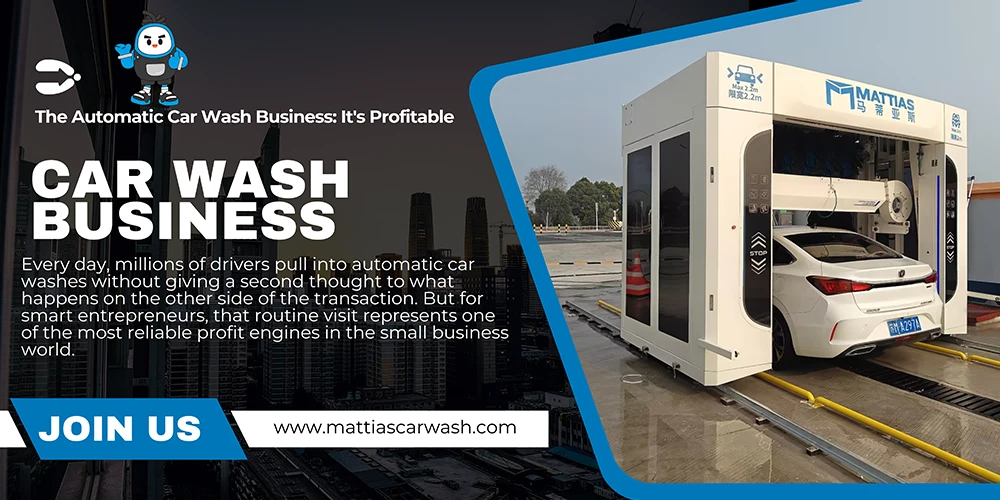
Every day, millions of drivers pull into automatic car washes without giving a second thought to what happens on the other side of the transaction. But for smart entrepreneurs, that routine visit represents one of the most reliable profit engines in the small business world. You don’t need a flashy product, a complex supply chain, or a massive team — just the right location, the right equipment, and a clear understanding of the numbers.
So, just how profitable is an automatic car wash business? Let’s dig into the data.
A Market That Never Stops Growing
The U.S. car wash industry is bigger than most people realize. As of 2024, the industry generates roughly $14–15 billion in annual revenue and employs nearly 200,000 workers nationwide. Growth is steady, with analysts projecting the market to expand to $16–18 billion by 2029 at a modest 1.5–3% annual rate.
The foundation of that demand is simple: there are over 290 million registered vehicles in the U.S., and every single one needs to be washed. Consumer preferences have also shifted sharply toward convenience. Automatic car washes — where machines do all the work — sit squarely in that sweet spot. People want their car clean without the effort, and they’re willing to pay for it.
The Real Numbers: What Does an Automatic Car Wash Actually Make?
This is where it gets interesting. Earnings vary by format and location, but the ranges are consistently attractive:
- In-bay automatic washes (the standard drive-through machine) typically generate $80,000–$200,000 in annual revenue per location.
- High-traffic locations can push annual profits to $250,000 or more.
- Large multi-bay facilities in major markets can produce $500,000+ in annual revenue.
From a profit margin perspective, automatic car washes are particularly strong. According to data from 235 car wash franchise businesses, the average operating profit margin falls between 14% and 26% — before interest and taxes. Some well-run operations do even better, with net margins reaching 25–35% after expenses.
For context: the average U.S. small business operates at a net margin of around 10%. Automatic car washes routinely double or triple that.
Why Automatic Car Washes Are So Profitable
Several factors combine to make this business model unusually efficient.
1. Low Variable Costs Per Wash
Once the equipment is installed, each additional car washed adds revenue at very little incremental cost. Water, electricity, and chemicals — the direct costs of each wash — are minimal. Industry data puts gross profit margins (revenue minus direct wash costs) at roughly 80% for the industry overall. That’s an exceptionally high number for any business.
2. Minimal Labor Requirements
Unlike a restaurant or retail store, an automatic car wash doesn’t require a large workforce. The machines do the heavy lifting. This keeps labor costs lean and predictable, which protects margins even as wages rise.
3. Recurring, Loyal Customers
Car washing isn’t a one-time purchase — it’s a habit. Once customers have a positive experience at your location, they tend to return again and again. This repeat-customer dynamic is one of the most valuable characteristics any business can have, and car washes benefit from it naturally.
4. Subscription Models Are a Game-Changer
More operators are now offering monthly unlimited wash memberships, and the results are dramatic. Subscription programs create predictable monthly income, reduce revenue volatility, and make customers far less likely to switch to a competitor. This model has become one of the fastest-growing trends in the industry.
5. Add-On Services Multiply Revenue
A basic wash is just the start. Premium packages featuring waxing, undercarriage cleaning, tire shine, and interior detailing can significantly increase the average ticket value — and these add-ons often carry even higher margins than the base wash.
“The numbers look even more compelling when you put them against a real operation.”
Real-World Example: A Vietnamese Auto Repair Workshop Adds Automatic Washing
When a mid-size automotive repair workshop in Hanoi integrated an M-LM535 rollover automatic car wash machine into its existing operation, the goal was straightforward: convert idle bay time into a second revenue stream without significantly expanding headcount.
The facility already handled steady repair traffic. Adding automatic washing required approximately 100–120 m² of floor space — enough to accommodate the M-LM535’s wash tunnel and a small vehicle queuing lane. With 1–2 technicians monitoring operations, the machine handles the full wash cycle: high-pressure pre-rinse, foam application, rotating brush cleaning, wax coating, and forced-air drying — each car in 5 to 7 minutes.
Volume and revenue. The workshop processes 65–80 cars per day. Using a tiered pricing model consistent with current Vietnamese market rates — 60,000 VND for a basic exterior wash and up to 120,000–150,000 VND for a premium package including undercarriage spray, foam wax, and interior wipe-down — the revenue breakdown works as follows:
| Service tier | Price (VND) | Mix (est.) | Daily cars | Daily revenue |
|---|---|---|---|---|
| Basic exterior wash | 60,000 | 50% | 36 | 2,160,000 |
| Standard (exterior + gầm) | 90,000 | 35% | 26 | 2,340,000 |
| Premium (full package) | 130,000 | 15% | 11 | 1,430,000 |
| Total (72-car average) | — | — | 73 | ~5,930,000 |
At this daily average, the operation generates approximately 5.5–6.5 million VND per day, or roughly 165–195 million VND per month (~$6,500–$7,700 USD at current exchange rates). Direct variable costs — water, chemicals, electricity — run approximately 8,000–15,000 VND per vehicle based on Vietnamese operator benchmarks, keeping gross margins above 80%.
The integration advantage. Because the workshop already had repair customers, wash adoption was immediate — existing clients began adding washes to routine service visits rather than seeking out a separate facility. Within the first several months, walk-in wash customers unconnected to repair work represented a growing share of daily volume, effectively monetizing foot traffic the garage had always received but never captured.
For a workshop or repair facility already operating at capacity on the service side, an automatic car wash machine functions less like a new business and more like a high-margin add-on with a relatively short payback window. At the Vietnamese market pricing and this volume level, payback on the machine and installation investment is typically achievable within 12–18 months, faster if the facility is located on a high-traffic urban corridor.
What Does It Cost to Get Started?
Starting an automatic car wash business is a capital-intensive undertaking, but the investment is well-calibrated to the return potential.
Standard automatic car wash:
- Estimated startup cost: ~$250,000
- High-quality automated equipment alone ranges from $100,000 to $300,000
- Site preparation and construction can add another $200,000–$500,000 for larger builds
High-traffic location setup:
- Total investment estimate: ~$500,000
- Monthly labor costs (for high-volume locations): ~$20,000
- Monthly supplies: ~$2,000
- Expected annual profit at a prime location: up to $250,000
Most owners reach break-even within 2 to 4 years, though buyers of existing, established operations often shorten that timeline considerably.
Key Factors That Determine Your Success
Not all car washes are created equal. The difference between a good investment and a great one often comes down to these variables:
Location is the single most critical factor. High-traffic corridors near shopping centers, busy commuter routes, or dense suburban areas drive significantly higher customer volume and faster ROI.
Pricing strategy matters more than most new owners expect. Tiered wash packages — from basic to premium — encourage customers to upgrade while preserving volume at the entry level.
Operational efficiency directly protects your bottom line. Equipment downtime is expensive; experienced operators reinvest roughly 3–5% of annual revenue into preventive maintenance to avoid it.
Marketing and visibility are increasingly important. In today’s environment, local search visibility is essential. Customers looking for a car wash nearby will find you on Google before they ever see your sign.
The Competitive Landscape
The car wash industry is competitive, but it rewards operators who execute well. The market has also seen significant private equity consolidation in recent years — major groups have been acquiring car wash chains at a rapid pace, which speaks to just how attractive the underlying economics are to sophisticated investors.
For independent operators, the good news is that economies of scale are limited. A well-run single location with an excellent location and reliable service can compete effectively against a chain. Your advantages are local knowledge, community relationships, and the ability to move quickly.
The Risks Honest Operators Will Tell You About
The profitability data is real — but so are the challenges that don’t appear in the headline numbers. Operators who have run these businesses for several years consistently point to the same vulnerabilities.
Equipment downtime is your most dangerous cost. An automatic car wash machine that is offline for even three days during a busy week can erase a meaningful portion of the month’s profit. Conveyor systems, brush assemblies, drying fans, and chemical dispensing mechanisms all require regular maintenance — and when a component fails, emergency repair or parts procurement can cost thousands of dollars and take days or longer if specialized parts are involved. Experienced operators budget 3–5% of annual revenue for preventive maintenance specifically to avoid these disruptions. Skipping that investment to protect short-term cash flow tends to generate much larger repair bills later.
Location is irreversible. Unlike most retail businesses, you cannot pivot your location if traffic patterns change. A new road, a rerouted commute corridor, or a large competitor opening nearby can materially alter daily volume — and your lease and equipment installation are not portable. Site selection deserves more due diligence than most first-time buyers allocate to it: pull actual traffic counts, not just visual estimates, and model your revenue projections at 60% of expected capacity, not 100%.
Competition is intensifying. Private equity consolidation in the car wash industry has accelerated sharply over the past several years, and chains now have the capital to open high-volume express wash locations in markets that once sustained independent operators comfortably. In suburban corridors where two or three independent washes once coexisted, a chain-operated facility with a $10/month unlimited membership offer can rapidly shift the customer base. Independent operators who compete on price alone rarely win this battle — those who succeed typically do so by differentiating on service quality, community presence, or add-on services that chains do not offer.
Financing terms matter more than purchase price. Many first-time buyers focus on negotiating equipment cost while underestimating the total capital required: site preparation, permitting, utility connections, initial chemical inventory, and three to six months of operating reserves add substantially to the investment figure. High leverage — borrowed capital financing the majority of startup costs — compresses the payback window and reduces resilience during slower months or unexpected repair periods. Operators who have navigated difficult stretches consistently cite adequate cash reserves as the variable that determined whether they survived or had to sell.
Seasonal and weather sensitivity is real. Automatic car washes in most markets experience significant revenue variation by season and weather. Extended rain can suppress volume (fewer dirty cars), while extreme cold in northern climates creates operational challenges and can damage equipment if winterization is not properly managed. Building seasonal patterns into your financial model — rather than annualizing a peak month — produces a far more accurate picture of what the business will actually return.
Is an Automatic Car Wash Business Right for You?
The data make a compelling case. Gross margins pushing 80%, net margins that beat most small businesses, a customer base that never shrinks, and a subscription model that delivers recurring revenue — it’s a rare combination.
That said, this is not a passive investment. Success requires strategic site selection, sound financial planning, consistent equipment maintenance, and genuine attention to customer experience. The operators who treat this as a business — not just a machine to plug in — are the ones who reach and sustain those top-line numbers.
If you’re willing to do the work up front, the automatic car wash business can be one of the most durable, cash-generating enterprises available to a small business owner today.
FAQs
1: How much does an automatic car wash make per year?
Annual revenue for an automatic car wash varies significantly by format and location. A standard in-bay automatic wash typically generates $80,000–$200,000 per year, while high-traffic locations can exceed $250,000 in annual profit alone. Large multi-bay facilities in major markets can reach $500,000 or more in annual revenue. What makes these figures particularly attractive is the profit margin: well-run operations report net margins of 25–35% after expenses, two to three times the average U.S. small business net margin of around 10%.
2: Is an automatic car wash a good investment?
For the right operator in the right location, an automatic car wash can be one of the most capital-efficient small businesses available. Gross profit margins run approximately 80% — meaning for every dollar of revenue, 80 cents remains after direct wash costs — because water, electricity, and chemicals represent minimal variable costs per vehicle. Most owners reach break-even within 2–4 years, though buyers of established operations with existing customer bases often shorten that window considerably. The key risks to weigh honestly include irreversible location commitment, equipment downtime costs (experienced operators budget 3–5% of annual revenue for preventive maintenance), and intensifying competition from private equity-backed chains offering aggressive membership pricing.
3: How much does it cost to open an automatic car wash?
Startup costs depend heavily on scale and site conditions. A standard single-bay automatic car wash requires approximately $250,000 to get operational, with high-quality automated equipment alone ranging from $100,000 to $300,000. Site preparation and construction add another $200,000–$500,000 for larger builds. A high-traffic location setup — including equipment, buildout, and initial working capital — typically totals around $500,000. First-time buyers frequently underestimate ancillary costs: permitting, utility connections, initial chemical inventory, and three to six months of operating reserves can add substantially to these figures, and undercapitalization is one of the most common reasons early-stage operations struggle.
4: What profit margin does an automatic car wash make?
Automatic car washes operate at unusually high margins for a small business. Industry data from over 235 car wash franchise businesses puts average operating profit margins between 14% and 26% before interest and taxes, with well-run locations reaching net margins of 25–35%. The underlying reason is the cost structure: direct wash costs — water, chemicals, electricity — run as low as $0.50–$1.50 per vehicle in optimized operations, producing gross margins around 80%. Operators who layer in a monthly unlimited wash subscription model improve these numbers further, since memberships generate predictable recurring revenue that smooths out weather-driven and seasonal volume swings.
5: Can I add an automatic car wash to an existing auto repair shop or garage?
Yes, and this integration model is increasingly common — particularly in markets like Vietnam, where automotive repair workshops have begun installing rollover fully automatic machines such as the M-LM535 to monetize existing customer foot traffic. A facility processing 65–80 cars per day using a tiered pricing structure (basic exterior wash at the low end, premium packages with undercarriage spray and interior service at the high end) can generate the equivalent of $6,500–$7,700 USD per month in gross wash revenue, with direct variable costs remaining below 20% of that figure. The key advantage for an existing garage is immediate customer adoption — repair clients begin adding washes to routine service visits without requiring a separate marketing effort — which substantially shortens the payback period compared to a standalone wash-only location.