










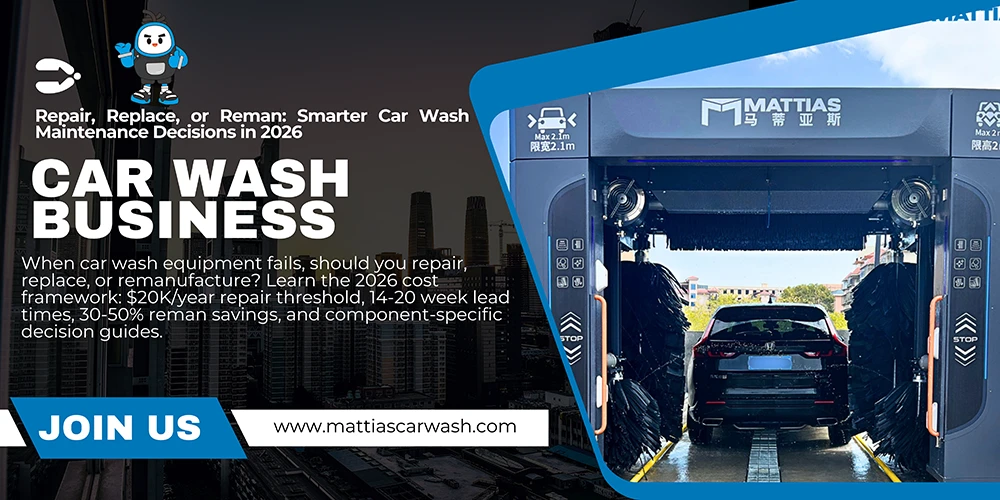

When a critical piece of car wash equipment fails — a controller board, a motor, a PLC, a high-pressure pump — the clock starts immediately. Every hour of downtime during peak periods costs $200 to $500+ in lost revenue. The question is not just how fast you can fix it, but whether fixing it is even the right call.
Most operators default to one of two responses: call a technician to repair what is broken, or order a replacement part. But there is a third option that many overlook: remanufacturing — sending the failed component to a specialized facility where it is fully disassembled, cleaned, inspected, rebuilt with new or upgraded parts, and tested under simulated operating conditions before being returned to service.
Each path has distinct cost, lead time, reliability, and warranty implications. And in 2026, with equipment lead times stretching to 14-20 weeks for custom-fabricated components and skilled installation teams booked 8-16 weeks in advance during peak season, the decision you make in the heat of a breakdown can determine whether your site is down for two days or two months.
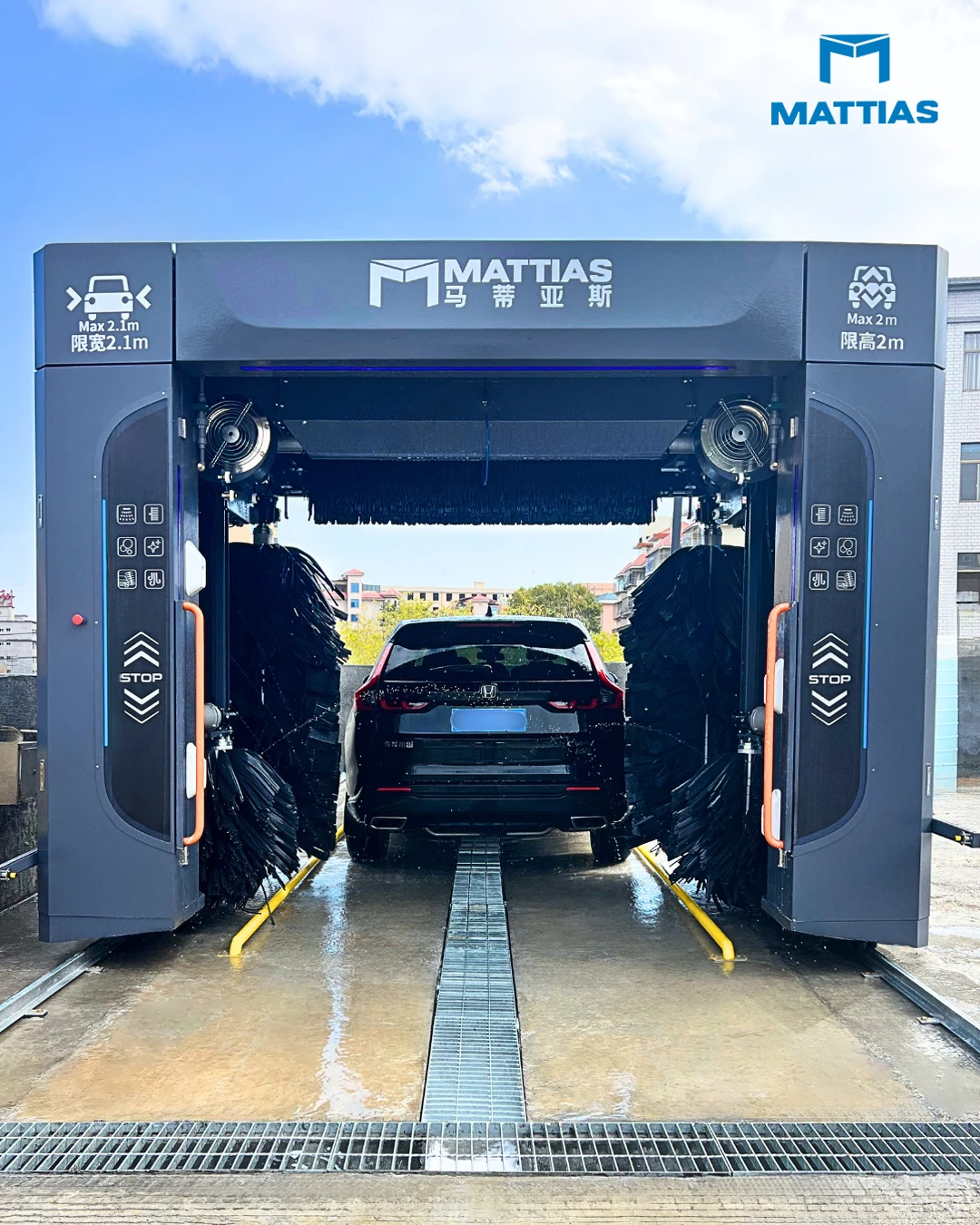
This article breaks down all three options with 2026 cost data, a component-specific decision framework, and practical guidance for gas stations, fleet operators, car dealerships, and multi-site investors.
The Three Options: What Each Actually Means
| Option | What Happens | Typical Cost (vs. New) | Typical Turnaround | Warranty |
|---|---|---|---|---|
| Repair | On-site technician diagnoses the failure, replaces the specific failed sub-component (relay, fuse, seal, bearing), and returns the unit to service | 10-30% of new unit cost | Same day to 48 hours | Limited — typically 30-90 days on the specific repair only |
| Remanufacture | Failed unit shipped to a qualified facility; fully disassembled, cleaned, inspected, rebuilt with new/upgraded components, and tested under simulated load conditions | 30-50% less than new | 3-10 business days (rush options and advance exchange available) | Often equal to or better than new — typically 6-18 months |
| Replace (New) | Purchase a brand-new unit from OEM or distributor; old unit may be returned as “core” for credit | 100% of new unit cost (minus any core credit) | Days to weeks (if in stock); 14-20 weeks for custom-fabricated components | Full OEM warranty — typically 1-5 years depending on component |
The key distinction: A repair fixes what is broken. A remanufacture restores the entire unit to like-new (or better) condition. A replacement starts fresh. The right choice depends on the component, its failure history, its age, and the opportunity cost of downtime.
When Repair Is the Right Call
Not every failure requires a reman or replacement. Many breakdowns are caused by a single failed sub-component — a blown fuse, a stuck relay, a worn seal, a tripped breaker — and a field repair gets the system back online within hours. Jordan Rowe, writing for RDM Industrial Electronics, notes that this kind of repair is exactly what you need when speed matters most: “If your tech can pop the panel, swap a part, and get it running again, great! That kind of repair keeps the line moving and buys you time.”
Repair is the right call when:
- It is the first or second failure of this specific component, and the root cause is clearly identifiable (e.g., debris in a valve, a loose connection, a single worn bearing)
- The component is relatively new (within the first 3-5 years of service) and the rest of the unit is in good condition
- The failure is isolated — one nozzle, one sensor, one seal — not a systemic issue affecting multiple sub-components
- OEM warranty is still active — always check warranty status first; a covered repair costs nothing
- Downtime cost exceeds repair cost immediately — if the site is losing $500/hour and the repair takes 2 hours and costs $300, the math is obvious
The Warning Signs That Repair Is No Longer Enough
Rowe offers a critical caution: “Just because a unit powers back on doesn’t mean it’s out of the woods.” The pattern that should trigger a shift from repair to reman or replace is repetition. If you have replaced the same relay three times in six months, or if the same controller board keeps producing intermittent faults despite multiple repairs, you are no longer fixing the problem — you are managing its symptoms.
Industry benchmarks from equipment service providers suggest the following thresholds:
| Indicator | Repair Is Appropriate | Shift to Reman or Replace |
|---|---|---|
| Frequency of same-component failures | 1-2 times in 12 months | 3+ times in 12 months |
| Annual repair spending on a single component | Under $2,000 | Over $5,000 (or approaching 30% of replacement cost) |
| Downtime attributed to one component | Under 8 hours/year | Over 24 hours/year (or 1+ full day per quarter) |
| Component age | Under 7 years | Over 10 years (or manufacturer has discontinued the product line) |
| Parts availability for repair | OEM parts readily available | Parts on backorder, surplus-only, or remanufactured-only sourcing required |
Broadway Equipment’s rule of thumb: If you are spending more than $20,000 per year in repairs on a single system, or losing more than one day per quarter to that system’s downtime, replacement is the financially correct decision — not repair, and not reman.
When Remanufacturing Makes the Most Sense
Remanufacturing occupies the middle ground between a field repair and a full replacement. It is not a patch — it is a comprehensive restoration. The failed unit is sent to a facility where it is fully disassembled, cleaned, inspected for wear across all components (not just the one that failed), rebuilt with new or upgraded parts, and tested under simulated working conditions.
This process is well-established in aviation and automotive industries, where safety-critical components are routinely remanufactured rather than replaced. It is gaining traction in car wash operations for several reasons:
Cost Savings: 30-50% Less Than New
Because remanufacturing reuses the housing, frame, and non-wear components of your original unit, the cost is typically 30-50% below a brand-new replacement. For a $4,000 controller board, that is $1,200-$2,000 in savings. For a $12,000 conveyor motor, it is $3,600-$6,000.
Faster Than Waiting for New
In 2026, custom-fabricated tunnel components have lead times of 14-20 weeks — up from 8-12 weeks in 2019. Skilled installation and commissioning teams are booked 8-16 weeks in advance during peak construction season. Remanufacturing facilities typically turn around components in 3-10 business days, with rush options and advance exchange programs that can get you a rebuilt unit in 24-72 hours.
Real-world example (from original article)
A tunnel operator in the Southeast sent a failed conveyor motor to a reman facility and had it back — rebuilt and tested — in under 72 hours, at less than half the cost of a new motor. Given that a new motor with current lead times could have meant weeks of downtime, the reman saved not just 50% on the component cost but potentially $20,000-$50,000 in lost revenue.
Reliability: Often Better Than Original
Reputable remanufacturers do not just replace the failed component — they replace all wear components and often upgrade to higher-quality parts than the original build. A controller board that originally used standard capacitors may be rebuilt with high-temperature, long-life capacitors. A motor that shipped with standard bearings may be rebuilt with sealed, corrosion-resistant bearings better suited to the car wash environment.
Warranty Coverage
Many remanufactured parts come with warranties equal to or better than new OEM warranties — typically 6-18 months. This is because the remanufacturer has inspected every component, not just the one that failed, and can stand behind the unit with confidence.
Sustainability and Core Value Recovery
Remanufacturing keeps usable materials in service rather than sending them to landfills. It also creates a market for “core” returns — when you do choose to buy new, your old unit can often be sent to a remanufacturer for credit, recovering 10-25% of the new purchase price.
When Replacement Is the Right Call
Despite the advantages of remanufacturing, there are scenarios where buying new is the financially correct decision:
- The component has been remanufactured before. A unit that has already been rebuilt once or twice has diminishing returns. The housing may be fatigued, mounting points may be worn, and the cost of the next reman approaches the cost of new — without the benefit of current-generation technology.
- The OEM has discontinued the product line. If the manufacturer no longer supports the model, remanufactured parts become increasingly difficult to source, and firmware may be incompatible with newer system components. This is particularly critical for control systems and PLCs, where discontinued boards represent the highest single trapped-cost risk in a car wash operation.
- Technology has moved forward. Newer equipment may offer connectivity, remote monitoring, improved energy efficiency, or water recycling capabilities that older systems cannot match. If your current system predates IoT integration, the operational savings from upgrading can exceed the cost premium of new equipment within 12-24 months.
- The failure is part of a broader system issue. If you are already planning a site upgrade — converting from an in-bay automatic to a tunnel system, or upgrading your water treatment system — replacing a failed component with new equipment that fits the upgrade plan is more logical than remanufacturing a unit you will soon retire.
- The component is a high-wear consumable. Nozzles, brushes, filters, and seals are designed to be replaced, not remanufactured. The cost of reman would exceed the cost of new for these items.
OEM Warranty: Always Check First
Before considering any option, check whether the failed component is still under OEM warranty. Many car wash equipment warranties cover 1-5 years depending on the component type:
| Equipment Type | Average Purchase Price | Typical Warranty Period | Average Annual Repair Cost | Typical Lifespan |
|---|---|---|---|---|
| Touchless car wash system | $30,000 | 5 years | $1,200 | 10 years |
| Soft cloth car wash system | $25,000 | 3 years | $900 | 8 years |
| Self-service car wash system | $15,000 | 2 years | $600 | 6 years |
| Commercial/fleet wash system | $50,000-$150,000+ | 2-5 years (varies by component) | $2,000-$5,000 | 12-15 years |
If the equipment is under warranty, the OEM may provide a no-cost repair or replacement — including, in some cases, a remanufactured unit as the warranty fulfillment option.
Component-Specific Decision Guide
Different components fail differently, and the repair-reman-replace decision varies by component type. Here is a practical guide for the most common failure points:
| Component | Typical Failure Mode | Best First Option | When to Escalate | Notes |
|---|---|---|---|---|
| Controller boards / PLCs | Intermittent faults, communication errors, complete failure | Reman — if OEM still supports the model | Replace if model discontinued, or if firmware incompatible with current system | Highest single trapped-cost risk. Keep one spare remanufactured board on hand for immediate swap |
| Conveyor motors | Bearing seizure, winding failure, overheating | Reman — for motors under 10 years old | Replace if motor is 10+ years old, or if repeated bearing failures indicate shaft fatigue | Reman typically saves 40-50% vs. new; 72-hour turnaround is common with rush service |
| High-pressure pumps | Seal failure, valve wear, pressure drop | Repair — first failure; replace seals and valves | Reman after 2nd failure; Replace if pump housing shows corrosion or cracking | Pump seals and valves are consumables; housing integrity determines repair vs. replace |
| VFDs (Variable Frequency Drives) | Complete failure, overheating, output instability | Reman — if unit is under 7 years old | Replace if OEM has discontinued the model, or if new VFDs offer significant energy savings | VFD technology advances rapidly; a 7-year-old VFD may be 15-20% less efficient than current models |
| Spray nozzles | Mineral buildup, orifice wear, pattern distortion | Replace — always | N/A — nozzles are consumables, not candidates for repair or reman | Cost: $5-$20 each. Quarterly replacement assessment recommended |
| Brush foam sections | Compression, tearing, contamination | Replace — always | N/A — brush foam is a consumable | Cost: $100-$200 per section. Daily visual inspection; monthly height measurement |
| Sensors (photo-eyes, proximity) | Misalignment, lens contamination, electronic failure | Repair — clean and realign first | Replace if electronic failure confirmed (no response after cleaning/realignment) | Cost: $30-$100 each. Keep 1-2 spares on site for immediate swap |
| Display boards / HMI panels | Dead pixels, backlight failure, touch unresponsiveness | Reman — if display is still functional but degraded | Replace if display technology is obsolete or no longer supported | A Midwest soft-touch wash ran an entire season on remanufactured display boards with no issues |
| Chemical dosing pumps | Seal wear, calibration drift, motor failure | Repair — replace seals and recalibrate | Replace entire pump if motor fails or if dosing accuracy cannot be restored | Precision dosing is critical for wash quality and chemical cost control |
| Bearings (all types) | Wear, corrosion, seizure | Replace — always | N/A — bearings are consumables | Cost: $15-$50 each. 32% of downtime attributed to bearing issues — inspect weekly |
The Spare Parts Strategy: Don’t Wait for Failure
One of the most effective strategies described in Rowe’s article is the practice of keeping remanufactured spares on hand — particularly for critical, long-lead-time components like controller boards and VFDs. An in-bay operator keeps a set of spare remanufactured boards, rotating them in when needed and sending the failed ones out for rebuild. This creates a continuous, cost-effective parts cycle that eliminates the downtime associated with waiting for a repair or replacement.
For sites where downtime costs $200-$500+ per hour, the economics of carrying spares are straightforward:
| Spare Component | Cost of Reman Spare | Downtime Avoided (per failure) | Break-Even (failures per year) |
|---|---|---|---|
| Controller board (critical) | $1,500-$2,500 | 3-10 days (waiting for reman or replacement) | 1 failure = break-even (at $500/day lost revenue × 5 days = $2,500) |
| VFD (critical) | $1,000-$2,000 | 5-14 days (OEM lead time for new unit) | 1 failure = break-even (at $500/day × 5 days = $2,500) |
| Conveyor motor (critical for tunnel) | $3,000-$5,000 (reman) | 3-14 days (reman rush or new purchase + install) | 1 failure = break-even (at $500/day × 10 days = $5,000) |
| Sensor set (non-critical but frequent) | $100-$200 | 2-4 hours (vs. waiting for service call) | 5-10 failures per year = break-even (at $50 service call each) |
The advance exchange model: Many reman facilities offer advance exchange programs — they ship you a remanufactured unit immediately, and you return your failed unit as the core. This eliminates downtime entirely for components where a spare is not already on site, typically at a premium of 15-25% over standard reman pricing.
Supply Chain Realities in 2026
The decision between repair, reman, and replace is heavily influenced by supply chain conditions — and 2026 has introduced new constraints that operators need to understand.
| Supply Chain Factor | 2026 Reality | Impact on Decision |
|---|---|---|
| Custom-fabricated tunnel components | 14-20 week lead times (up from 8-12 weeks in 2019) | Reman or repair becomes default; replacement only if lead time is tolerable |
| Installation/commissioning teams | Booked 8-16 weeks ahead during peak season | Plan replacements well in advance; do not wait for failure to schedule |
| Stainless steel (316L) | Surcharges fluctuating 10-20% year-over-year | New equipment pricing is volatile; remanufacturing (which reuses existing metal) insulates from material cost spikes |
| High-pressure pumps and precision nozzles | Predominantly sourced from Germany and Italy; long lead times | Repair seals and valves first; only replace when housing integrity is compromised |
| Controller boards and electronics | Rapid obsolescence cycles; discontinued models create surplus-only parts pipeline | Keep spares; reman while OEM still supports the model; replace proactively before discontinuation |
| Chinese-imported components | 30-50% cheaper than European/domestic; growing 10-15% annually; Section 301 tariffs 7.5-25% | Viable for entry-level and mid-range systems; verify quality certifications and after-sales support |
By Buyer Type: What Each Operator Should Prioritize
Gas Stations and Convenience Stores
Gas station car washes typically operate touchless in-bay automatics with limited technical staff on site. The repair-reman-replace decision is complicated by the fact that gas station employees are rarely wash equipment specialists.
- Default to service contracts: Gas stations benefit from preventive maintenance contracts that include priority response. The service provider makes the repair-reman-replace call, not the gas station manager
- Keep one spare of each critical board: Controller boards and VFDs are the most common failure points and the longest lead-time items. A remanufactured spare ($1,500-$2,500) that avoids a 5-day shutdown pays for itself in a single use
- Replace consumables proactively: Nozzles, filters, and chemical pump seals should be on a scheduled replacement calendar — not repaired when they fail. Quarterly nozzle assessment and annual seal replacement prevent the cascade of secondary failures
- Water softener components: Gas station touchless systems are particularly sensitive to hard water. Valve and resin replacement in your water softener should follow manufacturer intervals — not be deferred until wash quality drops
Fleet Operators
Fleet washes run commercial vehicle wash systems at high volume with heavy soil loads. Component wear is accelerated, and the repair-reman-replace threshold is reached faster.
- Lower the replacement threshold: Fleet wash components that would last 10 years in a passenger car wash may need replacement in 5-7 years. If annual repair costs exceed $5,000 on a single component, replacement is likely the better call
- Motors and pumps are the primary failure points: High-pressure pumps and conveyor motors in fleet washes should be candidates for reman at the first major failure — not the second or third. The heavy-duty operating environment means a repaired component is more likely to fail again quickly
- Keep a complete spare parts kit: Fleet operators should maintain an on-site inventory of nozzles, bearings, seals, sensors, and at least one remanufactured critical board. The cost of this inventory ($3,000-$8,000) is trivial compared to a single day of fleet wash downtime
- Document everything for warranty: Fleet wash warranties often have usage-based limits. Track wash cycles, not just calendar time, and file warranty claims before the cycle threshold is exceeded
Car Dealerships
Dealerships use gantry/rollover systems for new vehicle prep and customer service washes. The risk profile is different: equipment failure can delay vehicle delivery and damage the dealership’s brand experience.
- Paint safety overrides cost optimization: If a brush component shows any sign of wear that could scratch a vehicle, replace it immediately — do not repair, do not reman. A single paint claim on a $50,000 vehicle exceeds the cost of a full brush replacement set
- Controller boards: reman is ideal: Dealership gantry systems use sophisticated controllers for precise brush positioning. Remanufactured boards restore original precision at 30-50% savings, with no compatibility issues
- Plan replacements around inventory cycles: Dealership wash volume fluctuates with sales cycles. Schedule major component replacements during low-inventory periods (typically late December/January and mid-summer) to minimize operational disruption
- Upgrade timing: If your dealership is transitioning to EV sales, evaluate whether your current wash system is EV-safe before investing in reman or repair. Upgrading to a touchless system may be more cost-effective than maintaining aging friction equipment that cannot safely wash EVs
Investors and Multi-Site Operators
For investors, the repair-reman-replace decision is fundamentally an asset management decision — one that affects both operating cash flow and terminal valuation.
- Standardize the decision framework across all sites: Every location should use the same repair-reman-replace thresholds (frequency, cost, downtime, age). This enables benchmarking: if one site’s repair spending is 2x the portfolio average, you know where to investigate
- Maintain a portfolio-level spare parts pool: Rather than each site carrying its own spares, a centralized inventory for critical components (controller boards, VFDs, motors) shared across nearby sites reduces total inventory cost while maintaining rapid response capability
- Document every decision for due diligence: When you eventually sell, buyers will want to see not just maintenance records but the reasoning behind repair-reman-replace decisions. A site that shows disciplined component lifecycle management — replacing at the right time, not too early or too late — commands a higher valuation multiple
- Watch for OEM discontinuation signals: If an equipment manufacturer signals that a product line will be discontinued within 12-24 months, proactively reman or replace critical components before the parts pipeline shifts to surplus-only. The cost of acting early is always lower than the cost of scrambling after discontinuation
- Core credit recovery: Track the core value of every replaced component. A portfolio of 10 sites replacing 5-10 components per year can recover $5,000-$15,000 annually through core returns — money that is often left on the table
The Decision Framework: A Step-by-Step Guide
When a component fails, work through this sequence before making a call:
- Check warranty status. If the component is under OEM warranty, contact the manufacturer first. This may result in a free repair, replacement, or remanufactured unit at no cost.
- Assess the failure. Is this the first failure of this component, or is it a repeat? Is the root cause clearly identifiable (debris, loose connection, single worn part), or is it intermittent and difficult to diagnose?
- Calculate the downtime cost. At $200-$500+/hour during peak, how much is each day of delay costing you? This determines whether speed (repair) or thoroughness (reman/replace) is the priority.
- Check parts availability. Is the OEM still supporting this product line? Are repair parts in stock, on backorder, or surplus-only? If parts are scarce, reman or replace becomes more attractive than repair.
- Compare total costs.
- Repair cost = parts + labor + downtime
- Reman cost = reman price + shipping + downtime (typically 3-10 days, or 24-72 hours with advance exchange)
- Replace cost = new unit price – core credit + installation + downtime (days to weeks depending on lead time)
- Consider the component’s remaining useful life. If the component is near the end of its expected lifespan (see the equipment lifespan table above), investing in repair or reman may not be cost-effective.
- Factor in technology gaps. Would a new unit offer energy savings, improved wash quality, or connectivity that the current unit cannot provide? If so, the long-term operational savings may justify the higher upfront cost of replacement.
- Make the call. If the component is under warranty → OEM service. If it is a first failure with a clear root cause → repair. If it is a repeat failure or a critical component under 10 years old → reman. If it is 10+ years old, discontinued, or technologically obsolete → replace.
The most expensive decision is indecision. Every hour spent deliberating while the equipment is down is an hour of lost revenue. Build the decision framework into your maintenance protocol before a failure occurs, so that when it does, the response is automatic — not improvised.
Conclusion: Smarter Maintenance Is Planned Maintenance
As Rowe notes in her original article, “There’s no one-size-fits-all answer when it comes to maintaining your wash. But the more you understand the options, the better you can plan — not just for emergency fixes, but for long-term reliability and cost control.”
The data supports this. Operators who maintain a structured repair-reman-replace protocol — with predefined thresholds, spare parts inventories, and documented decision rationale — consistently outperform those who make ad-hoc decisions under pressure. The 3x-10x cost difference between preventive and reactive maintenance applies here too: a planned reman that costs $2,000 and takes 5 days is always cheaper than an emergency replacement that costs $6,000 and takes 5 weeks.
For operators evaluating new equipment, the maintainability of the system should be a purchasing criterion — not just the purchase price. Manufacturers like Mattias Car Wash Systems and others design systems with serviceability in mind, from gantry systems with accessible component layout to commercial wash equipment with standardized parts across model lines. The right equipment makes the repair-reman-replace decision easier — but no equipment eliminates the need for the framework.
The operators who win are not the ones who never have equipment failures. They are the ones who have already decided what to do when failure happens.