












Setting your car wash pricing strategy – much like building any successful business foundation – requires both art and science. Set prices without a strategy and you’ll either hemorrhage customers to savvy competitors or leave profits sitting on the table. Worse yet, inconsistent pricing confuses customers and undermines your brand’s credibility.
That’s why you need a systematic approach to car wash pricing that balances profitability with market appeal.
7 Essential Steps to Develop Your Car Wash Pricing Strategy
The car wash market has evolved dramatically, with customers now expecting transparent, value-driven pricing across all service levels. Whether you’re launching a new facility or revamping an existing operation, smart pricing isn’t optional – it’s survival. Multiple variables, from regional demographics to seasonal patterns, influence optimal pricing structures. While no universal pricing formula exists for every car wash, you can follow these seven strategic steps to build a pricing framework that drives both traffic and margins.
1. Calculate Your True Operating Costs
Understanding your cost structure forms the foundation of any sustainable pricing strategy. You need to know exactly what it costs to service each customer before you can determine profitable price points. Calculate your fully loaded cost per vehicle by adding fixed costs (rent, insurance, equipment financing) to variable costs (chemicals, utilities, labor) and dividing by monthly vehicle count.
Don’t guess at these numbers. Engage a qualified accountant to ensure your cost calculations capture every expense category. This precision is non-negotiable because the cost per car directly impacts every pricing decision you’ll make going forward.
Once you know your true costs, you can explore multiple paths to profitability. Maybe raising prices isn’t the answer – perhaps operational improvements could reduce your cost base instead. Look for opportunities to optimize chemical usage, streamline labor scheduling, or negotiate better supplier terms.
2. Analyze Your Competitive Landscape
Unless you operate in a geographic vacuum, competitor pricing will influence your strategy whether you acknowledge it or not. Comprehensive market analysis reveals not just what competitors charge, but how they position their services and what customers value in your market.
Start with primary research – visit every competitor within your trade area and document their complete service menu, pricing tiers, and value propositions. Don’t stop at posted prices. Observe customer flow, ask about popular packages, and note any promotional offers or membership programs.
Understanding Local Market Dynamics
Effective market research reveals customer behavior patterns unique to your area. Economic conditions, average household incomes, and cultural preferences all shape what customers will pay for car wash services. Your historical transaction data provides the clearest picture of local preferences – which services sell, which don’t, and at what price points customers resist.
Competitive Positioning Analysis
Study how each competitor positions itself in the market. The discount leader uses different strategies than the premium service provider. Some competitors may bundle services you charge extra for, justifying their higher base prices. Others might offer bare-bones basics at rock-bottom prices. Understanding these positioning strategies helps you find profitable gaps in the market.
3. Design Strategic Service Tiers
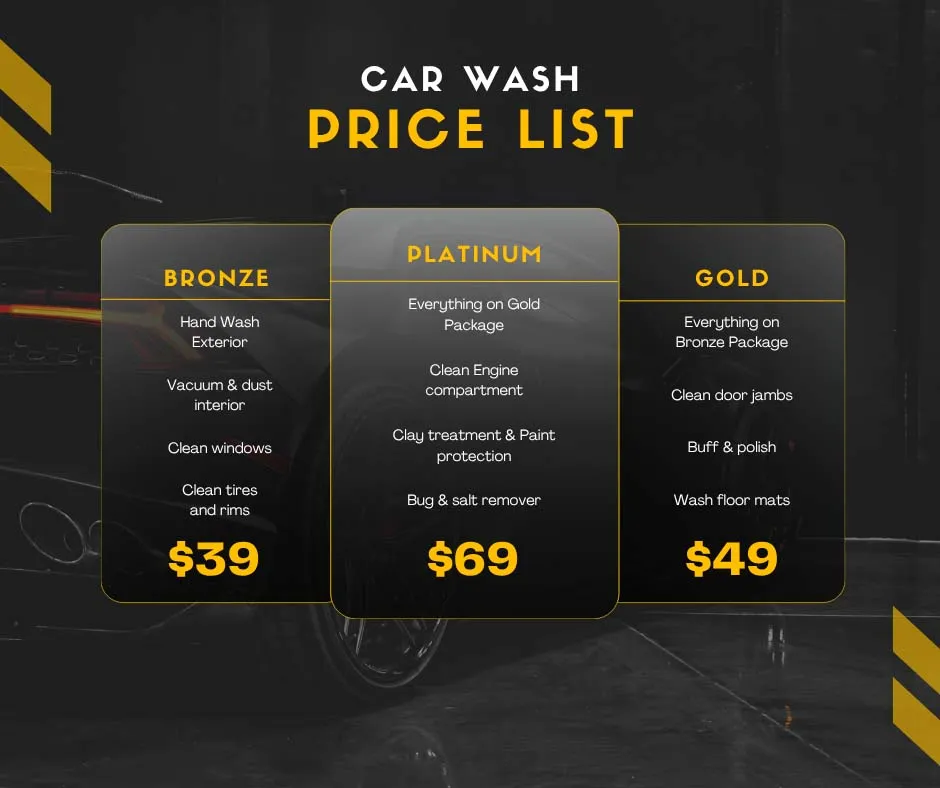
Tiered pricing remains one of the most effective strategies for maximizing revenue per customer while serving diverse market segments. Smart tier design gives every customer a compelling option while encouraging profitable upsells through strategic price anchoring.
Psychology drives much of consumer pricing behavior. Customers often avoid the cheapest option (quality concerns) and the most expensive (sticker shock), gravitating toward middle tiers that feel like smart compromises. Your pricing structure should guide customers toward your most profitable packages while ensuring each tier delivers clear value.
Consider your brand positioning when designing tiers. Premium brands can support higher price points across all tiers, while value brands must compete more aggressively on price. Everything from your facility’s appearance to service quality should align with your pricing strategy for maximum effectiveness.
Basic to Premium Package Development
Your entry-level package attracts price-sensitive customers and introduces them to your service quality. Price this tier competitively, but not so low that you devalue your entire offering or train customers to expect unrealistic pricing. Remember, some customers will never trade up regardless of the value proposition.
Premium tiers should build logically on your base services, adding valuable extras like wheel treatments, undercarriage cleaning, or protective coatings. Each upgrade tier must deliver perceivable value that justifies the price increase. The key is making each tier feel like a smart choice for different customer segments.

4. Implement Flexible Pricing Technology
Modern pricing strategies require modern tools. Dynamic pricing systems let you adjust rates based on real-time demand, weather conditions, seasonal patterns, or competitive changes. These AI-powered platforms analyze multiple data streams to suggest optimal pricing that maximizes revenue without sacrificing customer satisfaction.
Successful dynamic pricing requires accurate data inputs tailored to your specific market. If the weather doesn’t significantly impact your business, don’t let the system weigh weather data heavily in pricing decisions. Start with suggested prices as benchmarks while you fine-tune the system to reflect your actual business patterns.
5. Develop Membership Program Pricing
Recurring revenue through unlimited wash programs has become essential for most successful car wash operations. However, membership pricing requires careful consideration since mid-program price changes can damage customer relationships and increase churn rates.
Price memberships to create obvious value compared to pay-per-wash options while ensuring the program remains profitable as usage patterns emerge. Consider introductory pricing to reduce the barrier to membership, but plan for eventual price normalization as customers experience your service quality.
6. Establish Performance Monitoring Systems
Pricing strategy isn’t a set-it-and-forget-it decision. Regular analysis of key performance indicators reveals how well your pricing achieves business objectives and where adjustments might improve results.
Track metrics like average transaction value, service mix percentages, customer retention rates, and profit margins by service tier. If premium services consistently underperform, consider price adjustments or value enhancements. If basic services dominate sales but generate thin margins, explore ways to encourage profitable upsells.
7. Test and Refine Continuously
Market conditions evolve constantly, making pricing strategy an ongoing process rather than a one-time decision. Regular testing of price adjustments, promotional offers, and package modifications keeps your strategy aligned with market realities.
Small, measured changes allow you to gauge customer response without risking major revenue disruptions. Test price increases on specific services, experiment with limited-time offers, or pilot new package combinations to identify optimization opportunities.
Building Long-Term Success Through Strategic Pricing
Even the most sophisticated pricing strategy means nothing without exceptional service delivery and consistent quality. Customers will pay premium prices for premium experiences, but they’ll quickly abandon overpriced mediocrity. Your pricing strategy must support and reflect your overall service promise to build lasting customer relationships and sustainable profitability.