


The marriage of convenience retail and car washing is not new. What is new in 2026 is the sophistication with which operators are integrating the two profit centers — and the scale of capital flowing into the combination.
A Houlihan Lokey industry report noted that the U.S. convenience store count exceeds 150,000 locations, with approximately two-thirds operated by independent owners. The car wash market comprises roughly 60,000 units generating $19.8 billion in annual revenue, with over 80% operated by owners with fewer than five sites. The overlap — convenience stores with attached car wash capacity — represents one of the most underleveraged profit engines in retail fuel.
But the landscape has shifted dramatically. Private equity capital, while slower than the 2021–2022 peak, continues to deploy into car wash — increasingly through greenfield development rather than acquisition. C-store operators are building standalone tunnel brands, upgrading aging in-bay automatics, and integrating wash subscriptions with fuel loyalty programs. The question is no longer whether to combine fuel and wash, but how to do it profitably.
This article examines the five forces reshaping the c-store car wash combination in 2026, the three strategic roles a wash plays at a fuel site, the operational decisions that determine success, and what each type of buyer — gas station operators, fleet managers, auto dealers, and investors — should prioritize.
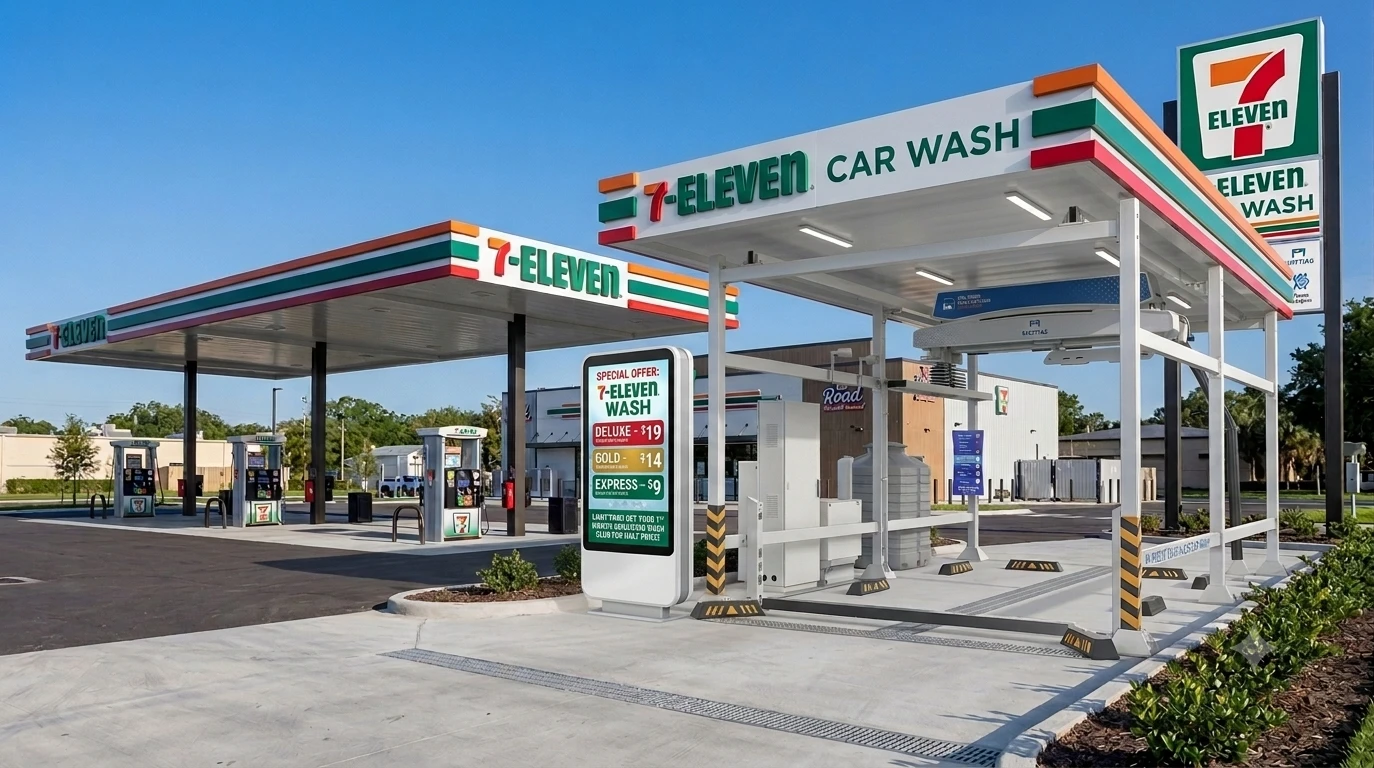
Five Forces Reshaping the C-Store Car Wash Combination
1. The “Do-It-For-Me” Shift
Consumer behavior has decisively shifted from home car washing to professional washing. As Eric Wulf, CEO of the International Carwash Association, noted at CSP’s Forecourt Forum: finding someone hand-washing their vehicle in a driveway is now like finding a rerun of an old TV show — the behavior has largely disappeared. This shift has pushed demand firmly toward professional wash sites and created a growing customer base that c-store operators can capture with the right equipment and marketing.
For c-stores, this means the car wash is no longer a peripheral amenity. It is a traffic driver — a reason for customers to choose one fuel stop over another. Approximately half of consumers say they would switch stations for a better experience, and a modern car wash is increasingly part of that calculation.
2. Express Exterior Adoption and Labor Reduction
The express exterior model has transformed wash operations. What once required a dozen or more employees on a busy Saturday now operates with fewer than four staff members. Advances in detergents, wash materials, and equipment have eliminated most manual prep and towel-drying.
For c-stores, this matters because labor is the single biggest operational challenge. An express tunnel or modern touchless in-bay automatic can operate with minimal staffing — sometimes zero dedicated wash attendants — because payment kiosks, automated activation, and remote monitoring handle the workflow. The wash becomes a profit center that does not compete with the c-store for labor.
| Wash Format | Labor Requirement | Throughput | Typical C-Store Fit |
|---|---|---|---|
| In-Bay Automatic (IBA) | 0 dedicated staff (kiosk-activated) | 12–15 cars/hour | Most common at c-stores; lowest capital entry |
| Express Mini-Tunnel | 1–2 staff (can share with c-store) | 80–100 cars/hour | Growing trend — IBA-to-tunnel conversions |
| Full Express Tunnel | 2–4 dedicated staff | 100–140 cars/hour | Standalone or high-volume c-store sites |
| Self-Service Bays | 0 dedicated staff (coin/card operated) | 1 car per bay, 4–6 bays | Rural or lower-volume c-store locations |
The IBA-to-tunnel conversion trend is particularly relevant. In many cases, the tunnel footprint is similar to the IBA bay, but a belt conveyor replaces the stationary wash — transforming a 12-car-per-hour bottleneck into a 100-car-per-hour throughput engine. Operators evaluating this conversion should consider tunnel car wash systems that offer modular configurations fitting existing bay dimensions.
3. Subscription Models and Predictable Revenue
The subscription model has reshaped car wash revenue predictability — and c-store operators are uniquely positioned to leverage it. Unlike standalone wash operators who must attract customers from scratch, c-stores have a built-in customer base flowing through the forecourt every day. Every fuel customer is a potential wash subscriber.
The numbers are compelling. Weigel’s, a Tennessee c-store chain, launched its Auto Spa concept in July 2025 and signed nearly 1,000 monthly subscribers in the first six weeks — at a single location 20 minutes from downtown Knoxville. That kind of rapid membership adoption is virtually impossible for a standalone wash without the fuel-traffic advantage.
But the real opportunity is cross-category monetization. As Saurabh Swarup of Liquid Barcodes explained: “Members aren’t just coming for a wash — they’re also fueling up and going inside the store, which is driving cross-category sales.” The wash subscription becomes the anchor that increases visit frequency, fuel volume, and in-store spend simultaneously.
| Subscription Integration Level | How It Works | Real-World Example (2026) |
|---|---|---|
| Basic: Wash-only subscription | Monthly fee for unlimited washes; no fuel or c-store tie-in | Common at standalone washes; baseline for c-stores |
| Intermediate: Fuel discount for wash members | Wash subscribers receive per-gallon fuel discount (10¢–30¢) | Tiger Fuel: Ceramic members get 30¢/gal, Tiger Wax 20¢, Wheel Deal 10¢ (up to 50 gal/month) |
| Advanced: Unified loyalty platform | Wash, fuel, and c-store purchases all earn and redeem points in one system | Weigel’s: MyWeigel’s Rewards — 20 points per $1 spend across all categories; 50%+ of washes rewarded through loyalty |
| Premium: App-driven ecosystem | Dedicated mobile app manages subscriptions, sends behavior-shaping push notifications, captures customer data | MAPCO: Standalone car wash app with subscriptions, games, store locator; Loop Neighborhood: fully digital, app-only subscriptions |
4. Technology: LPR, Remote Monitoring, and Data Integration
Modern car wash technology has become a competitive differentiator for c-store operators. The key technologies reshaping the combination in 2026 include:
- License Plate Recognition (LPR): Identifies customers as they enter — whether loyalty members, subscribers, or first-time visitors — enabling frictionless entry and personalized service. Weigel’s Auto Spa debuted with LPR at launch.
- Automated POS and Kiosks: Cashless payment kiosks capture the impulse wash customer who needs a wash in the moment. Even when a mobile app is available, kiosks remain essential — not every customer uses apps.
- Remote Monitoring and Predictive Maintenance: Operators can monitor wash performance, chemical levels, and equipment health from a phone — critical for multi-site c-store operators who cannot be physically present at every wash.
- CRM-Loyalty Integration: Connecting car wash CRM (e.g., Rinsed) with c-store loyalty platforms (e.g., Paytronix, PDI) enables cross-category data sharing. Tiger Fuel’s integration between TigerWash and Market Rewards is a 2026 benchmark.
5. Institutional Capital and Greenfield Development
Private equity continues to deploy capital into car wash, though at a measured pace compared to 2021–2022. The preferred approach has shifted from M&A to greenfield development — building new sites in markets where the investor can select locations, build density around a core market, maintain branding, and control build-out economics.
For c-store operators, this creates both opportunity and threat. The opportunity: PE-backed platforms are actively seeking c-store sites with wash potential, creating acquisition or partnership pathways. The threat: standalone express tunnel brands — like Circle K’s Clean Freak and Rainstorm — are being built in markets where c-stores have traditionally captured wash demand, potentially siphoning fuel customers who might otherwise wash at the c-store.
Circle K’s parent company, Alimentation Couche-Tard, operates two dedicated car wash brands (Clean Freak in Arizona, Texas, Florida; Rainstorm in the Northwest) that function as full-service washes with subscriptions, unlimited vacuums, carpet beaters, and on-site towels. These are not basic wash-and-go setups — they are competitive wash destinations that happen to be owned by a fuel retailer.
The Three Strategic Roles of a Car Wash at a C-Store
GSP Retail Marketing identified three roles that a car wash plays at a convenience store. Understanding which role your wash is meant to fill determines every subsequent decision — from equipment selection to pricing to marketing.
| Role | What It Means | Key Metrics | Investment Priority |
|---|---|---|---|
| Traffic Driver | The wash attracts customers who then buy fuel and in-store items | Wash-to-fuel conversion rate; new customer acquisition | Visibility, signage, competitive pricing |
| Revenue Multiplier | Existing fuel/store customers add a wash, increasing basket size | Attachment rate (% of fuel customers who also wash) | Speed, quality, convenience, pump-to-wash flow |
| Promotional Platform | The wash serves as a promotional vehicle for fuel and c-store offers | Cross-category redemption; subscription-to-store visit frequency | Loyalty integration, app connectivity, data capture |
The most successful c-store operators align all three roles. As GSP noted: “The strategy can’t live solely inside an app or depend only on subscriptions. The offer needs to be visible across the entire customer journey — on the street, at the forecourt, and inside the store.”
The Attachment Rate: The Single Most Important Metric
If there is one number c-store operators should track obsessively, it is the wash attachment rate — the percentage of fuel customers who also purchase a wash. Industry benchmarks suggest:
| Attachment Rate | Performance Level | What Drives It |
|---|---|---|
| < 3% | Underperforming | Poor visibility, outdated equipment, no promotion, no subscription option |
| 3% – 7% | Industry average | Basic IBA, some pump promotion, no loyalty integration |
| 7% – 12% | Strong | Modern equipment, subscription option, loyalty tie-in, visible signage |
| 12%+ | Best-in-class | Express tunnel or high-quality IBA, integrated loyalty, fuel discount for members, app-driven engagement |
Improving attachment rate from 3% to 7% on a site pumping 100,000 gallons/month (approximately 2,500 fueling events) means an additional 100 washes/month — at $12/wash, that is $14,400/year in incremental wash revenue, plus the associated in-store purchases those additional wash visits generate.
Equipment Decisions: What C-Store Operators Are Choosing in 2026
Touchless IBA: The Default Choice
For most c-store operators, the touchless in-bay automatic remains the default choice. It requires the least capital ($80,000–$250,000 installed), operates without an attendant, and minimizes vehicle damage liability — a critical concern for c-stores where customers are already buying fuel and may blame the wash for any paint issues.
Touchless systems are particularly well-suited for c-stores because:
- No brush contact eliminates the most common damage claim source
- Kiosk activation means zero dedicated labor
- Compact footprint fits existing bay dimensions
- Low maintenance burden compared to friction systems
- EV-safe operation — increasingly important as electric vehicle adoption grows. For more on this, see which wash method is actually safe for electric vehicles
IBA-to-Tunnel Conversion: The Growth Play
When a c-store site has sufficient volume (typically 80,000+ gallons/month fuel throughput), converting an IBA bay to an express mini-tunnel can transform wash economics. The conversion typically costs $300,000–$600,000 (equipment + modifications) but can increase throughput from 12–15 cars/hour to 80–100 cars/hour.
“We are seeing a lot of conversions when possible,” said Paul Dadgar of Brink Results. “In some cases, the tunnel is the same size as the in-bay automatic, but they put in the belt conveyor.” The key question is whether the existing bay can accommodate a conveyor — and whether the site has the queueing space to handle higher volume.
Self-Service: The Low-Capital Entry
For c-stores in rural or lower-volume locations, self-service car wash systems offer the lowest capital entry point ($15,000–$40,000 per bay) and require zero labor. While the revenue ceiling is lower, the ROI can be attractive when the site already has water, sewer, and electrical infrastructure from the fuel operation.
In China, shared self-service wash machines at gas stations are generating approximately ¥8,000–¥15,000/month ($1,100–$2,100) per station, with a 14-month payback period — driven by the 5–8 minute fueling dwell time that creates a natural wash opportunity.
Standalone Tunnel: The Premium Play
For c-store chains with significant market presence, building a standalone express tunnel near (but not attached to) the fuel site is the highest-investment, highest-return strategy. Circle K’s Clean Freak and Weigel’s Auto Spa are the 2026 benchmarks. These sites offer subscriptions, unlimited vacuums, and a branded experience that competes directly with national car wash chains.
The investment is significant ($1.5M–$3M+ for a full express tunnel), but the payoff is a wash that can generate $500,000–$1,500,000 in annual revenue — compared to $80,000–$250,000 for a typical IBA.
Water Treatment: The Compliance Foundation
C-store operators adding or upgrading wash capacity cannot afford to overlook water treatment. Municipal regulations on water discharge and reclaim percentages are tightening nationwide. In many jurisdictions, a car wash without a compliant water treatment and recycling system will not receive permitting — period.
Modern water reclamation systems recycle 80–90% of wash water, reducing both utility costs and environmental impact. For c-stores, this is particularly important because the fuel operation already has significant water and sewer infrastructure — adding a non-compliant wash can trigger regulatory scrutiny of the entire site.
By Buyer Type: What Each Stakeholder Should Focus On
Gas Station / C-Store Operators
- Prioritize attachment rate: Track the percentage of fuel customers who also wash. Even a 2% improvement generates meaningful incremental revenue.
- Choose touchless for liability protection: At a fuel site, customers are already in a transactional mindset — a paint damage claim can poison the entire customer relationship. Touchless systems eliminate the most common damage source.
- Integrate loyalty before equipment: Confirm that your wash equipment’s POS/CRM can integrate with your existing c-store loyalty platform before purchase. Retrofitting integration is expensive and manual.
- Test subscription pricing: Start with a simple fuel-discount-for-members offer (like Tiger Fuel’s 10¢–30¢/gallon tiers) before building a full app ecosystem.
- Plan for conversion: If your site has the volume, design the IBA installation so it can be converted to a mini-tunnel later — same bay footprint, belt conveyor addition.
Fleet Operators
- Use the c-store as a wash access point: Fleet drivers already stop for fuel — adding wash capacity at fleet-fueling c-stores creates a natural maintenance loop.
- Choose equipment rated for commercial vehicles: Standard passenger car washes may not accommodate fleet vehicles. Commercial vehicle wash systems handle larger vehicles, higher frequency, and heavier soil loads.
- Negotiate fleet subscription rates: C-store operators are motivated to secure fleet accounts — recurring revenue at guaranteed volume. Negotiate per-vehicle monthly rates rather than per-wash pricing.
- Track wash frequency vs. maintenance cost: Fleet vehicles washed regularly require less expensive maintenance (brake dust, salt, road grime removal extends component life). Quantify this ROI to justify the wash investment.
Auto Dealers
- Use the wash as a customer-retention anchor: Free washes with service visits drive repeat service business. A c-store-adjacent wash can serve both dealer inventory prep and customer loyalty.
- Insist on paint-safe equipment: Dealers cannot risk damaging customer vehicles or new inventory. Touchless systems are the standard for new and electric vehicle inventory where any brush contact is a liability.
- Value the data: Wash frequency data tells you which customers are engaged with the dealership — and which are at risk of churn. Integrate wash data into your CRM.
- Consider co-branding: Partner with a c-store operator to share wash infrastructure — dealer uses it for inventory prep during off-peak hours; c-store sells washes to fuel customers during peak hours.
Investors and Multi-Site Operators
- Evaluate c-store wash potential at acquisition: When acquiring c-store portfolios, assess each site’s wash attachment rate and upgrade potential. An underperforming IBA at a high-volume fuel site is a value-creation opportunity.
- Consider standalone tunnel brands: Circle K’s Clean Freak model demonstrates that fuel retailers can build competitive standalone wash brands. Evaluate whether your market density supports a standalone tunnel.
- Integrate before scaling: Build the loyalty-wash integration at one site, document the process, then replicate. Weigel’s spent significant effort on a single-site integration before planning multi-site rollout.
- Watch moratoria: Track local zoning and car wash count caps. Markets with existing moratoria (northeast Ohio, others) limit both new development and acquisition-based growth.
- Review successful car wash installations to understand equipment configurations that perform in real-world deployments before committing capital.
The Economics: Revenue Models and ROI
Understanding the financial picture is essential before investing. The table below outlines typical revenue and cost ranges for c-store car wash configurations in 2026.
| Configuration | Equipment Cost | Annual Wash Revenue | Annual Operating Cost | Typical Payback |
|---|---|---|---|---|
| Touchless IBA (existing bay) | $80K – $250K | $60K – $200K | $15K – $40K (chemicals, utilities, maintenance) | 12 – 24 months |
| IBA-to-tunnel conversion | $300K – $600K | $200K – $500K | $40K – $80K | 18 – 36 months |
| Standalone express tunnel | $1.5M – $3M+ | $500K – $1.5M+ | $120K – $300K | 3 – 5 years |
| Self-service (4 bays + vacuums) | $60K – $160K | $40K – $120K | $10K – $25K | 18 – 30 months |
These ranges vary significantly by location, traffic counts, pricing strategy, and competitive environment. Operators should conduct site-specific feasibility analysis before committing capital. For a structured approach to evaluating whether a car wash investment makes sense at your location, see this data-driven ROI analysis comparing wash types.
Common Mistakes C-Store Operators Make with Car Wash
- Treating the wash as an afterthought. The most common mistake is installing a wash and then doing nothing to promote it. “When we look out in the field and see how c-stores promote their car washes, it’s usually very static,” noted Tino Feczko of GSP Retail Marketing. “The on-site signage often looks weathered and worn. That seems odd since a car wash is supposed to help your car look new.”
- Not offering subscriptions. In 2026, a wash without a subscription option is leaving recurring revenue on the table. Subscriptions have evolved from a nice-to-have into a competitive necessity.
- Ignoring loyalty integration. A wash subscription that is not connected to the fuel and c-store loyalty program is a missed cross-category opportunity. The integration is technically challenging but financially essential.
- Underinvesting in equipment quality. A cheap, aging IBA that produces poor wash quality damages the c-store brand. Customers who get a bad wash blame the entire site, not just the wash.
- Not tracking attachment rate. If you do not measure the percentage of fuel customers who also wash, you cannot manage it. This is the single most important wash metric for a c-store.
- Neglecting water treatment. An outdated water system increases utility costs, risks regulatory violations, and reduces wash quality. Modern water treatment systems pay for themselves through reduced water bills and avoided compliance issues.
- Overlooking impulse capture. Not every customer uses a mobile app. Kiosks at the wash bay and wash-code sales at the pump and in-store POS capture the impulse buyer who needs a wash right now.
The Future: Where the Combination Is Heading
Several trends will shape the next phase of c-store car wash evolution:
- Standalone wash brands from fuel retailers: Circle K’s Clean Freak and Rainstorm model will be replicated by other large c-store chains. The standalone wash brand allows fuel retailers to compete directly with national car wash operators while leveraging their loyalty ecosystem.
- Themed wash experiences: Weigel’s Ellie the Cow themed tunnel — with animated scenes, holograms, and seasonal customization — demonstrates that the wash itself can be a brand-building experience, not just a utility. This is particularly effective for family demographics.
- API-driven loyalty integration: The technical barrier between car wash CRM and c-store loyalty platforms is falling. Paytronix-Rinsed integration (as deployed by Tiger Fuel) and PDI API certification (as used by Weigel’s) are becoming standardized pathways.
- EV charging integration: As EV adoption grows, c-store forecourts are adding charging stations. The 20–40 minute charging dwell time creates a natural window for car wash and in-store purchases — potentially more powerful than the traditional 3–5 minute fueling window.
- Market saturation and moratoria: The rapid growth of express tunnels has led several jurisdictions to cap car wash counts. C-store operators should monitor local zoning changes and secure permits before competitors fill the available capacity.
Conclusion: The Combination Is No Longer Optional
The Houlihan Lokey report suggested that analysts view in-bay automatics at c-stores as having “little potential for growth.” That assessment may have been accurate for aging, unpromoted, loyalty-disconnected IBAs — but it misses the broader transformation happening in 2026.
C-store operators who invest in modern wash equipment, integrate subscriptions with fuel loyalty, track attachment rates, and treat the wash as a strategic profit center — not a peripheral amenity — are capturing revenue that standalone wash operators cannot match. The built-in fuel traffic, the cross-category loyalty ecosystem, and the multiple customer touchpoints (pump, kiosk, app, in-store) give c-stores structural advantages that no standalone wash can replicate.
The combination of convenience retail and car wash is not just evolving — it is accelerating. For gas station operators, fleet managers, dealers, and investors, the question is no longer whether to participate, but whether to lead or follow. For those exploring car wash business opportunities, understanding the c-store integration model — and choosing equipment that supports loyalty connectivity, subscription management, and future conversion — is essential.
Operators in emerging markets should also consider region-specific factors; for example, those evaluating car wash opportunities in Saudi Arabia face different regulatory environments and consumer behavior patterns that affect the c-store wash model. For a broader overview of Mattias Car Wash Systems and their approach to integrated wash solutions, visit the about page.