

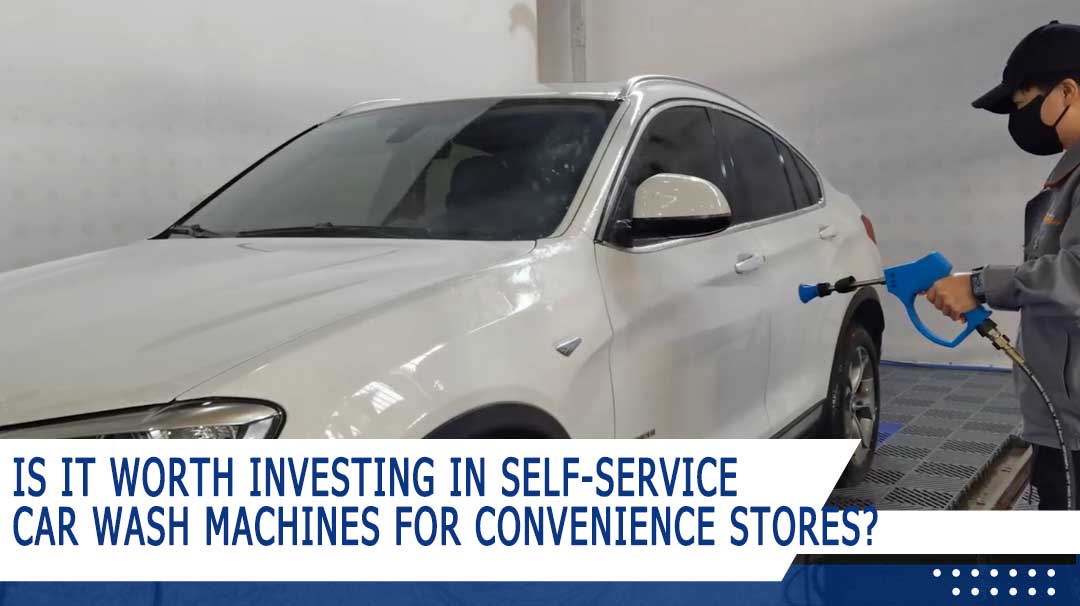

Self-Service Car Wash Machines, also known as do-it-yourself or wand washing, the motorist pulls into the bay, gets out of the vehicle, activates the system using either cash or credit card, and washes his or her own car. The number of washbays, vacuums, and vending machines placed on the site will depend on space availability and traffic volume.
With car washing, equipment is a site’s bread and butter. Buying the cheapest equipment available leads many investors to costly maintenance and downtime. Your primary consideration should always lean toward value over cost. Dependability, warranty, output capabilities, cleaning power, and durability are primary factors to keep in mind when considering the value of equipment.
With all the different manufacturers and types of equipment on the market, knowing what to buy can be difficult. Understanding the basic differences can help narrow your choices.
Self-Service Car Wash Machines
Self-service refers to equipment customers use to perform the act of washing cars themselves, typically a high-pressure wand and a brush. Many car washes consist entirely of self-service equipment, while others use a combination of self-service bays and automatic bays.
Self-service washes tend to be a planned destination for consumers, whereas using automatics is usually an impulse decision. Though not as convenient for many consumers, self-service equipment can be a good investment in small towns that do not have the population or traffic to support an automatic, or when used to diversify washing options at a site that does have an automatic.
Choosing Self-Service Car Wash Equipment
Factors to seek when choosing self-service equipment include:
- Technological Superiority – The electronics and computers that control the self-serve system should be modern and easy to operate, and the mechanical components should be efficient yet powerful.
- Simple to Maintain – Easy maintenance and accessibility are crucial to eliminating downtime and staying profitable.
- Flexibility – A self-serve system should offer multiple products and service options to encourage the customer to spend more time in the bay. Furthermore, operators should have the ability to automatically change price/time options to promote sales during slow periods of the week.
- Expandability – The ability to add more options and expand the output capability of the unit should exist, and the unit should be easy to update as newer technology becomes available.
- Streamlined Engineering – A self-serve unit should be designed to be self-contained and compact enough to save space in a control room while maximizing performance capabilities.
- Durability – As with all car wash equipment, self-serve units should be able to withstand years of heavy usage with minimal maintenance.
Self-service car washing is profitable while maintaining a lower overhead. Innovative equipment advances have created more reliable operation and improved incomes for new car washes. Generally, self-service car washes require a lower investment with lower risks. It is because of this that Inventive business plans favor these washes.
The investment threshold to refur-bish self-service bays is much lower than other forms of wash facilities. In many urban settings, the financial return indi-cates that stand alone self-service carwashes do not cash-flow for the short term. It is important to visualize Self-service car washes as a long term investment and self-service should always be considered as part of any car wash offering.
Self-service car wash equipment outlasts other car washing variations, requiring fewer equipment replacement cycles. Self-service car washes provide a solid income source with less maintenance and fewer employees.
Advantages of M-F761AX Self-Service Car Wash Machines
The following in-bay services should be offered:
- Display Timers
Display timers provide an audio/visual warning one minute prior to the time expiring. Although some customers will react to the warning by rushing, most will add more money. Customers greatly appreciate this feature. - Pre-soak
Pre-soak is a concentrated detergent that is dispensed through the wash wand at low pressure. It is necessary to break down the road film prior to using the high-pressure wash. - Tire & Engine Cleaner
Clean sidewalls are important to self-serve customers. The chemical clings to the tires and loosens the grime. High pressure is used to flush the tires leaving them clean and will remove brake dust and engine grime. - Foaming Brush
Foaming brushes place a foamed chemical on the vehicle’s surface removing dirt and grime. They are usually used longer than the high-pressure wands increasing gross income. - High-Pressure Soap
Customers use high-pressure soap to wash all parts of their vehicles including tires, wheel wells, and undercarriages. High pressure soap is also used to wash motorcycles, boats, lawnmowers, trailers, etc. It is the best method of washing off heavy mud. In order to offer maximum cleaning with high- pressure, you will need to have hot water, chemical systems, water softener, and a highly reliable pumping system. - High-Pressure Rinse
This service is used by every customer in a self-serve car wash to rinse the soap from the vehicle. - High-Pressure Wax
Wax is used by approximately 35% of self-serve carwash customers. Spray wax is applied with warm water through the high-pressure wand. - Triple Foam or Foaming Conditioner
This is a foaming wash and conditioner for clear coat surfaces. Triple foam is a colored foam display that is applied with a foam gun. - Spot-Free Rinse
Many water systems have a high percentage of dissolved solids. These solids, when dry, will leave spots on the vehicle. An effective way of removal is reverse osmosis (RO) referred to as spot-free rinse. - Bug Cleaner, Magnesium Remover
Specialty chemicals are delivered through the foam gun to target bugs and Magnesium Chloride. - Floor Mat Hangers
Mat hangers are used by over half of self-serve car wash customers. Mat washing adds to the time of the overall wash and customers appreciate this extra convenience. - Vacuums
Used by approximately 62% of all self-serve customers, vacuums provide a very profitable source of additional revenue.
Vacuums can generate income simultaneously with the wash bays because they are outside. One vacuum for every wash bay is a good rule of thumb although the more vacuums you have, the more potential income you will make. Combination shampoo/fragrance vacuums are excellent profit generators. - Vending
A variety of products may be vented through coin-operated machines. The most common products sold are paper towels, wet towels, and Armor all. - Change-Making
Bill changers are an absolute must for self-serve carwashes. Most, if not all, customers need change. If they can’t get it they won’t spend as much money. Machines are available that will change bills ranging from $1—$20. Approximately 90% of the money used at your site will come from your changers. - Credit Card/Fleet Card Readers
We are rapidly becoming a cash-free society relying more and more on credit cards to pay for products and services.
Credit Card/Fleet Card Readers allow customers to purchase bay time and other site services like vacuum time. - Coin Boxes
Coin boxes are stainless steel with large price and time decals with touch pads or switch dial plates that identify the products offered to customers.
Other Descriptions of Car Wash Business
Automatic Car Wash Machine
At the right location, offering one or more automatic car wash bays in addition to, or even in place of, a self-service operation can substantially benefit profits. Taking less time to complete while giving customers the convenience of never needing to leave their cars, automatics outreach self-serves in a market sector where expediency and ease are highly valued.
A few different classifications define most automatic car wash equipment. In-bay automatics, the most common type, are available in brush-wash or touch-free versions. With this type of equipment, the customer drives their car into the bay, stops, and the wash equipment passes over the vehicle to perform the wash function. In-bay automatics do not generally require an employee to guide customers into the bay.
Conversely, another type of touch-free and brush wash equipment operates by dragging the vehicle, on a conveyor, through stationary equipment in a tunnel bay. Conveyor washes, also referred to as tunnel washes, require an attendant to help customers align their vehicles to the conveyor’s dragging mechanism.
Choosing Automatic Car Wash Equipment
Among the basic varieties of automatic car wash equipment, research shows industry trends favoring touchless car wash machine, in-bay automatics car wash machine over the last several years. Several factors contribute to the steadily increasing popularity of these machines as compared to in-bay brush and touchless and friction conveyor washes.
Since in-bay automatics do not require an attendant to guide the customer into the bay, owners can leave their businesses running 24 hours a day, seven days a week. From a customer’s standpoint, the convenience of being able to drive into a car wash whether or not an employee is present is a draw.
During a touch-free wash, no equipment contacts the car, minimizing the prospect for damage to the vehicle. Friction washes, on the other hand, use spinning brushes to clean the automobile by direct contact. Both methods produce clean results, but many customers are wary of brushes which could possibly scratch or otherwise damage their cars.
For an owner, touchless equipment means drastically lower maintenance costs and downtime compared to brush washes, as well as not having the liability of owning equipment that is more likely to damage vehicles.