











For decades, car wash operators had two options: hire people to scrub vehicles by hand, or run them through brush-based tunnels that scratched paint and frustrated customers. Both models had obvious ceiling problems — labor was expensive, quality was inconsistent, and damage claims were a headache nobody wanted.
Touchless systems changed the math.
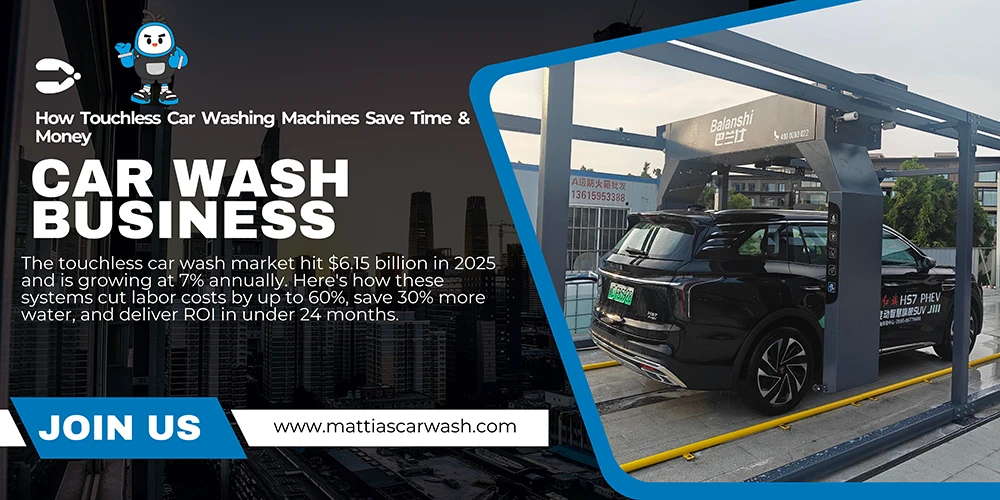
By replacing physical contact with high-pressure water jets and pH-balanced detergents, non-contact car wash machines clean vehicles faster, safer, and cheaper than either traditional method. The results are showing up in the numbers: the global touchless car wash system market was valued at $6.15 billion in 2025 and is projected to reach $12.13 billion by 2035, growing at a 7% CAGR.
This article breaks down exactly how that performance translates to real operational savings — time, labor, water, and money — for fleet operators, car rental companies, dealerships, and gas station owners.
Key Takeaways
- The touchless car wash market is growing at 7% annually, reaching $6.15B in 2025
- Touchless systems reduce staffing needs by 60–70% compared to manual operations
- Water consumption drops by up to 30–52% per vehicle wash with high-pressure touchless systems
- Premium systems in high-traffic locations achieve full ROI in 12–18 months
- 80% of drivers now prefer professional wash facilities over home washing
What Makes Touchless Car Washing Technology Different?
The car cleaning industry has shifted fast. Traditional brush-based systems rely on physical contact — soft cloth or foam brushes spinning at speed against a vehicle’s surface. The problem is straightforward: those brushes trap grit between washes, and that grit creates micro-scratches in clear coat and paint over time.
Touchless systems work on an entirely different principle. High-pressure water jets — often ranging from 1,000 to 2,000 PSI depending on the system — push a combination of heated water and chemical detergents across every surface of the vehicle. Sensors map the vehicle’s dimensions in real time so the system knows exactly where to direct pressure, including wheel wells, undercarriages, and door jambs that brush systems routinely miss.
The key advantages this creates for operators:
No paint damage risk. According to the International Carwash Association, touchless car washes have one of the lowest accident rates among all wash types, with incidents occurring in fewer than 1% of washes. That matters enormously for operators serving luxury vehicles, EVs, or fleet customers with strict vehicle condition requirements.
Consistent results every cycle. Automated systems don’t get tired, distracted, or inconsistent. Every vehicle gets the same sensor-mapped, pressure-calibrated clean.
Variable settings for different vehicles. Operators can program different wash cycles by vehicle type — lighter pressure for sedans, stronger cycles for commercial trucks, specialized modes for vehicles fresh from construction sites.
The technology isn’t new, but the recent generation of systems has become significantly smarter. IoT sensors, AI-powered dirt detection, and closed-loop water recycling have all become standard features in mid-range systems that would have cost twice as much just five years ago.
How Much Time Do Touchless Systems Actually Save?
Time savings are where touchless systems make their most immediate case to operators. The comparison with manual washing is stark.
A manual car wash — done properly — takes between 30 and 60 minutes per vehicle. That includes the initial rinse, hand soap application, scrubbing, rinsing, drying, and a final inspection. For a small detail shop doing 15 vehicles a day, that’s a full-time job for at least three workers, plus the scheduling overhead of managing them.
An automated touchless system completes a full wash cycle in 8 to 10 minutes. That means:
- A single bay running 10 hours a day can process 60–75 vehicles
- With no breaks, shift changes, or inconsistency between cycles
- And with minimal on-site supervision — typically one attendant for maintenance and customer queries
A well-sized touchless car washing machine can replace the workload of 3–4 workers per day, with some systems cleaning up to 50–60 cars per shift. For a fleet operator maintaining 40 delivery vehicles, that’s the difference between an all-day operation with a full crew and a two-hour automated run before the morning shift starts.
The throughput gains go beyond daily washing. Businesses that need vehicles camera-ready and on the road — rental agencies, dealerships, logistics companies — can’t afford a vehicle sitting in a wash queue for an hour. Touchless systems keep turnaround tight.
What Are the Real Cost Savings for Car Wash Operators?
This is where operators tend to spend the most time modelling — and where the numbers tend to be more convincing than expected.

Labor
Operators using touchless car wash machines report 60–70% savings on staffing expenses compared to manual operations. In fully unattended configurations, labor costs drop to near zero for the washing function itself.
Consider what that means in practice: if a manually operated wash facility spends $8,000 a month on wash crew wages, a touchless system running in unattended mode converts most of that into margin. Even accounting for one part-time maintenance attendant, the labor cost reduction is substantial and immediate.
Water
Touchless machines offer up to 30% water savings and 50% labor reduction compared to traditional brush systems. With modern water recycling add-ons, those savings go further. Installing a water recycling system costs $20,000–$40,000 upfront but cuts water bills by 60–70% — a payback that arrives quickly in markets where municipal water rates are rising.
To put this in concrete terms: touchless washes typically use 30–50 gallons per vehicle. A brush tunnel can use up to 60 gallons. For an operation washing 100 vehicles a day, the difference adds up to thousands of gallons saved monthly, before water recycling is even factored in.
Maintenance
Brush-based systems have moving parts that make contact with vehicles. That means bristles wear down, bearings fail, and brush arms need replacement. Touchless systems have significantly fewer mechanical failure points. Industry operators report saving $2,400–$6,000 annually on upkeep by switching from brush to touchless systems.
ROI Timeline
Entry-level systems achieve payback in 18–24 months with around 30 washes per day, while premium systems in high-traffic locations reach ROI in 12–18 months with 70+ daily washes. Profit margins typically run 35–45% after operational costs.
One documented case makes the math concrete: at 57 Express in the U.S., a commercial-grade touchless car wash machine installed at $18,000 reduced water consumption by 52% and cut labor expenses by $22,000 annually. The business achieved full payback in just 13 months.
Does Touchless Mean Clean Enough?
This is the question that holds some operators back. The assumption is that without physical contact, a touchless system must compromise on cleaning depth — especially for heavily soiled vehicles with caked mud, road salt, or grease.
In practice, modern touchless systems perform at a level that surprises most first-time users. Here’s why:
pH-balanced chemistry does the work brushes can’t. The detergents used in touchless systems are formulated to chemically break down dirt, grease, and road salt before the high-pressure rinse cycle removes them. This is especially effective on contaminants that physical brushes push around rather than lift off.
Sensor-guided pressure targeting. Advanced systems detect vehicle geometry and adjust nozzle angles in real time, directing concentrated pressure into wheel arches, grille openings, and undercarriage cavities. These are areas where brush systems physically can’t reach.
Customizable cycles by vehicle and dirt level. Operators can program heavier pre-soak stages and longer rinse cycles for vehicles coming off construction routes or long-haul deliveries, without adjusting anything manually.
The practical limit of touchless cleaning is heavy, dried mud that has cured in recessed areas over several days. In those cases, a brief pre-rinse or pressure wand pass takes 60–90 seconds, and then the automated cycle handles the rest. For standard daily or weekly fleet washing, touchless performs at or above brush quality without the damage risk.
What Environmental and Safety Benefits Come With Touchless Systems?
Sustainability is no longer just a marketing angle — it’s a compliance issue in many markets. Between 2020 and 2025, numerous countries implemented stricter water usage regulations mandating water recycling in car wash operations, compelling operators to adopt water-efficient touchless technologies.
Touchless systems respond to this pressure better than any other wash type:
Biodegradable detergents. The chemical formulations used in modern touchless systems are designed to be environmentally safe and meet local environmental protection standards. Environmental protection laws introduced in Europe and North America during 2021–2024 restricted harsh chemical detergents, pushing manufacturers to innovate biodegradable cleaning agents compatible with touchless systems.
Water recycling integration. Closed-loop water recycling systems — now offered as standard options on most commercial touchless units — capture, filter, and recirculate rinse water. Some configurations achieve up to 80% water reuse per cycle.
Workplace safety. Manual washing in commercial settings involves wet surfaces, chemical exposure, high-traffic vehicle movement, and repetitive physical strain. Removing humans from the wash process eliminates these risks almost entirely. There are no slip incidents in an automated bay. No chemical burns. No lifting injuries.
For operators managing large fleets or high-volume public-facing wash sites, both the environmental compliance and the safety record of touchless systems reduce legal and regulatory exposure alongside operational costs.
Which Businesses Benefit Most From Touchless Car Wash Systems?
Touchless car wash technology scales across a wide range of commercial applications. From what we’ve seen across the industry, these four segments get the fastest and clearest return:
Fleet operators. Logistics companies, delivery networks, and municipal vehicle fleets need consistent cleaning at high volume with minimal downtime. A touchless system running during off-hours keeps vehicles clean and road-ready without pulling drivers or staff off core duties.
Car rental companies. Turnaround time is everything. A touchless system that cleans a returned vehicle in 8–10 minutes — including drying — means the car is back in the rental pool in under 15 minutes. That directly reduces the number of vehicles sitting idle between customers.
Dealerships. Pre-delivery prep and showroom presentation require scratch-free, finish-safe cleaning. Touchless is the only automated option that meets that standard reliably. A dealership running 20–30 vehicle preps per week recovers the cost of a mid-range system in months.
Gas stations and convenience stores. Car wash services at gas and fuel stations accounted for the largest revenue share in the global car wash market in 2025. An automated touchless bay runs unattended while the forecourt team handles fuel and retail. It generates consistent add-on revenue without adding headcount.
How Do You Choose the Right Touchless Car Wash System?
The market covers a wide price and capability range. Matching the car wash system to your specific operation matters more than chasing the most advanced spec sheet.
Volume is the primary variable. How many vehicles do you need to process per day? Entry-level systems at $15,000–$25,000 work well for 30–50 daily washes. Mid-range systems at $40,000–$100,000 handle 70–100 vehicles. High-capacity tunnel configurations above $100,000 are built for 200+ vehicles per day.
Space shapes your options. In-bay touchless systems need a single bay footprint and work well for gas stations, small dealerships, and parking structures. Tunnel configurations need 80–120 feet of linear space and are suited to standalone sites or large fleet depots.
Water recycling is worth budgeting for upfront. Water recycling cuts usage by 30–60%, reducing utility bills — and in many markets, it’s a regulatory requirement rather than an optional upgrade. Building it into the initial installation is cheaper than retrofitting later.
Look for IoT monitoring and remote diagnostics. Systems with remote fault detection and predictive maintenance alerts dramatically reduce unplanned downtime. For unattended operations especially, knowing a pump is showing early signs of failure before it actually fails is worth the added system cost.
What Does the Future of Touchless Car Wash Technology Look Like?
The next wave of development is already in the market with early adopters. Three trends are worth tracking:
AI-powered cleaning optimization. Rather than running fixed programs, next-generation systems use real-time sensor data to adjust pressure, chemical concentration, and nozzle positioning mid-cycle based on actual dirt load. In January 2025, WashTec AG launched an ultrasonic touchless car wash system with advanced sensor technology that reduces water usage by 30% per wash — a meaningful jump over standard high-pressure configurations.
Subscription revenue models. Subscription model adoption is growing, with 45% of operators moving toward membership-based pricing. Monthly unlimited plans at $30–$50 convert irregular customers into predictable recurring revenue, and they work especially well when paired with automated systems that can handle high wash frequency without wear concerns.
IoT integration and remote management. Operators with multiple sites can monitor wash performance, chemical consumption, fault alerts, and throughput data from a single dashboard. This reduces the need for on-site management presence and allows faster response to maintenance issues.
Subscription packages can generate 60–70% of site revenue within 18 months and increase wash frequency to three or four visits per member monthly. That model only works if the equipment can handle the volume reliably, which brings the conversation back to system selection and quality.
Frequently Asked Questions
Q1: How much water does a touchless car wash actually use compared to manual washing?
Standard touchless systems use 30–50 gallons per vehicle — already lower than brush tunnels at up to 60 gallons. With a closed-loop water recycling system installed, operators can cut actual fresh water consumption by 60–70% per wash cycle (Mattiascarwash, 2025). Manual hand washing typically uses 80–140 gallons per vehicle, with no recycling option, making touchless the most water-efficient option at scale.
Q2: What kind of ROI should a new touchless car wash operator expect?
Entry-level systems ($15,000–$25,000) serving 30 vehicles per day typically achieve payback in 18–24 months. High-traffic premium installations processing 70+ daily washes reach ROI in 12–18 months. Profit margins after operational costs typically run 35–45%. Adding a membership or subscription model typically accelerates those timelines by converting irregular customers into reliable recurring revenue.
Q3: Can touchless systems clean heavily soiled commercial vehicles as effectively as brush systems?
Yes, for most commercial dirt loads. High-pressure water jets combined with pH-balanced pre-soak detergents break down road salt, grease, and traffic grime more thoroughly than brush contact in many cases. For extremely heavy compacted mud — typical of off-road or construction vehicles — a brief manual pre-rinse takes 60–90 seconds and allows the automated cycle to complete the job. The absence of brush contact means no paint scratching risk throughout.
Q4: What maintenance does a touchless system require?
The main recurring costs are nozzle cleaning to prevent mineral buildup (quarterly), pump inspection (annually), and software updates for IoT-connected systems. An annual preventive maintenance contract typically costs $3,000–$7,000 (Mattiascarwash, 2025) and prevents the majority of unplanned repair incidents. Total maintenance cost is generally lower than brush systems, which require brush replacement and more frequent moving-part servicing.
Q5: Is a touchless car wash system viable for a single gas station location?
Yes, and this is one of the most common use cases. Gas station and fuel station locations account for the largest share of the global car wash market (Grand View Research, 2025). An in-bay touchless system runs unattended alongside the forecourt operation, generates consistent per-wash revenue, and requires minimal staff involvement. Entry-level systems sized for single-bay gas station installations start around $15,000–$25,000.