











| Written by Jordan Ellis | 15 years in car wash operations & site development
Published April 28, 2026 — Expert reviewed — Sources: ICA, IBISWorld, Grand View Research, Rinsed, Mister Car Wash Q4 2025 financials |
Starting a car wash business is one of the most capital-intensive real estate and equipment commitments in retail services — and one of the most misunderstood. Over 15 years of helping operators open and stabilize sites, I’ve watched well-funded projects fail because of poor site selection, and lean operators succeed because they understood the ramp. This guide shares what those experiences taught me, alongside current industry data.
Depending on the model you choose, you’ll invest $150,000 to more than $3 million before your first customer drives through. Expect 12 to 18 months before volume stabilizes. This guide walks every step, with particular depth on build-out and equipment — the phases most generic guides skip.
Is a Car Wash Business Right for You? An Honest Starting Point
The U.S. car wash services market was valued at $15.28 billion in 2025 and is projected to reach $15.75 billion by 2026 (Grand View Research). The broader U.S. car wash and auto detailing industry sits at $18.7 billion in 2026 (IBISWorld), with approximately 16,879 businesses nationwide. The industry has matured, and the bar for new entrants is higher than a decade ago.
| Operator insight
In my experience, the operators who struggle most aren’t underfunded — they’re underprepared for the ramp. A new site that’s cash-flow negative at month 8 is normal. One that’s still negative at month 20 has a site or membership problem, not a patience problem. |
Well-run sites typically see mid-teens to 20%+ net margins at stabilized volume. A single in-bay automatic location averages $86,000–$139,000 in annual revenue; multi-site express tunnel operators commonly clear $350,000 or more. Well-optimized express washes with strong membership programs can achieve EBITDA margins above 30%.
New sites take 12 to 18 months to reach stabilized volume, and membership bases take another 6 to 12 months to build meaningfully. SBA lenders discount optimistic year-one projections at underwriting. If you can carry conservative working capital through the ramp, you have a viable path.
The 9-Step Car Wash Startup Roadmap
| Step | Focus | Typical Duration |
| 1 | Market research and business model | 1–2 months |
| 2 | Business plan | 1–2 months |
| 3 | Financing | 2–4 months |
| 4 | Site selection | 3–6 months |
| 5 | Permits and zoning | 2–6 months (often concurrent) |
| 6 | Equipment selection | 1–3 months |
| 7 | Build-out and installation | 6–12 months |
| 8 | Hiring and training | 1–2 months |
| 9 | Launch and ramp | 12–18 months to stabilize |
These steps overlap: financing happens in parallel with site scouting, and equipment selection often informs final permit applications.
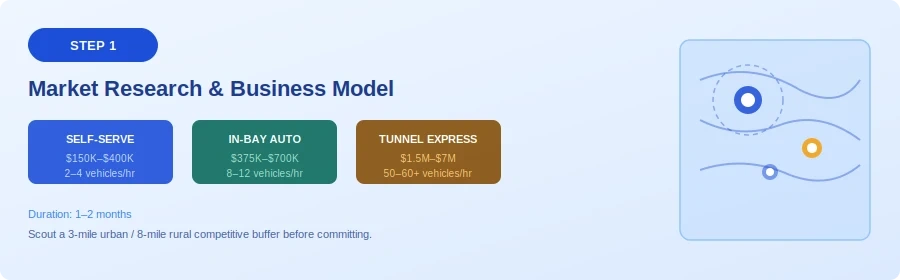
Step 1: Research Your Market and Pick a Business Model
Your business model is the first and most constraining decision you’ll make. It drives your capital requirements, staffing structure, revenue ceiling, and site criteria. Three formats dominate:
Self-Serve
Driver-operated bays with coin or card payment. Lowest capital requirements, lowest revenue ceiling. Typical annual revenue: $41,000–$80,000 per year.
In-Bay Automatic (IBA) Car Wash
Single-bay automated system, commonly added to gas stations or convenience sites. Revenue: $80,000–$250,000 per bay. In-bay/roll-over systems led the U.S. market with a 43.10% revenue share in 2025 (Grand View Research), driven by lower installation cost and suitability for smaller footprints.
Tunnel / Express Conveyor Car Wash
High-throughput, membership-driven conveyor system. Revenue: $300,000–$686,000 for standard tunnels; $700,000–$2 million+ for express sites with strong membership programs. The exterior express wash format now commands a 55% share of the U.S. market by service type (Persistence Market Research) and is growing faster than any other segment.
| Self-Serve | In-Bay Automatic | Tunnel / Express | |
| Startup cost | $150K–$400K | $375K–$700K | $1.5M–$7M |
| Equipment cost | $50K–$150K | $400K–$450K | $1M+ |
| Throughput | 2–4 vehicles/hr | 8–12 vehicles/hr | 50–60+ vehicles/hr |
| Lot size | 0.25–0.5 acre | 0.3–0.5 acre | ~1 acre |
| Ramp to stable | 6–12 months | 12–18 months | 12–18 months |
| Key data point
At top-performing express tunnels, memberships account for 40–60% of revenue, and members spend two to three times more annually than pay-per-wash visitors. At Mister Car Wash, Unlimited Wash Club revenue represented 79% of total wash sales in Q4 2025, with approximately 2.3 million active members. |
76% of car wash retailers reported membership growth in Q1 2025, with the monthly unlimited plan segment accounting for 61.2% of subscription revenue (ICA Q1 2025 report). An express tunnel with a mature membership base is effectively a subscription business with car washes as the delivery mechanism.
Step 2: Write Your Car Wash Business Plan
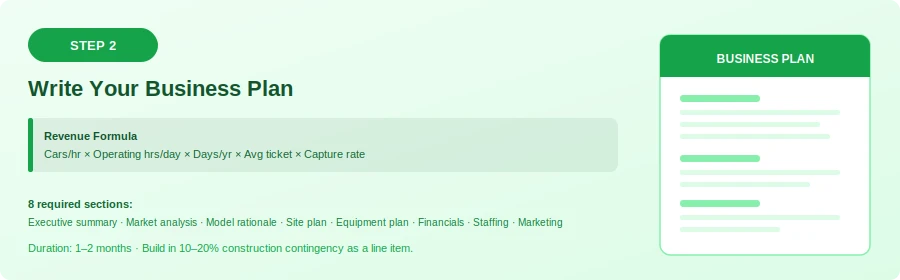
A lender-ready business plan covers eight sections: executive summary, market analysis, model rationale, site plan, equipment plan, financial projections, staffing plan, and marketing plan. Financial projections are where most plans fail in underwriting — not because the math is wrong, but because the assumptions are too optimistic.
The revenue formula lenders expect: (cars per hour) × (operating hours per day) × (days per year) × (average ticket) × (capture rate)
A tunnel engineered for 55 vehicles per hour does not produce 55 every hour. Most operators see blended capture rates of 25–40% of theoretical peak. Model for that reality, not the best day.
Build a 12 to 18 month ramp into projected income statements. Construction budgets consistently run 10–20% over initial estimates due to utility hookups, permit delays, and site-prep surprises — include that as a line item, not an assumption.
Step 3: Secure Financing — How Much You Actually Need
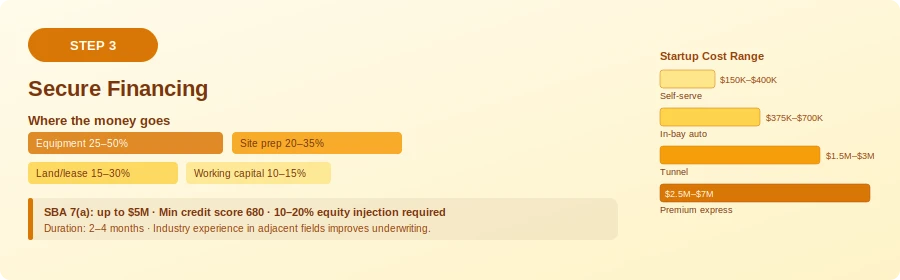
Startup costs by model:
- Self-serve: $150,000–$400,000
- In-bay automatic (per bay): $375,000–$700,000
- Standard tunnel: $1.5M–$3M
- Premium express build: $2.5M–$7M
Where the Money Goes
| Category | % of Total Capital |
| Land / lease | 15–30% |
| Site prep and building | 20–35% |
| Equipment package | 25–50% |
| Chemicals and consumables | 2–5% upfront |
| Working capital (ramp buffer) | 10–15% |
| Permits, legal, marketing | 3–8% |
SBA Financing
The SBA 7(a) program provides up to $5 million covering real estate, equipment, working capital, and goodwill in a single loan — the simpler path for first-time operators. SBA 504 is structured for larger real-estate-focused deals with fixed-rate terms up to 25 years.
Lenders typically require: minimum credit score of 680 (720+ reduces friction), 10–20% equity injection, industry or adjacent operating experience, and 24 months of projected statements modeled against a realistic ramp. Applicants from adjacent industries — fuel retail, quick-lube, property management — tend to be underwritten more favorably.
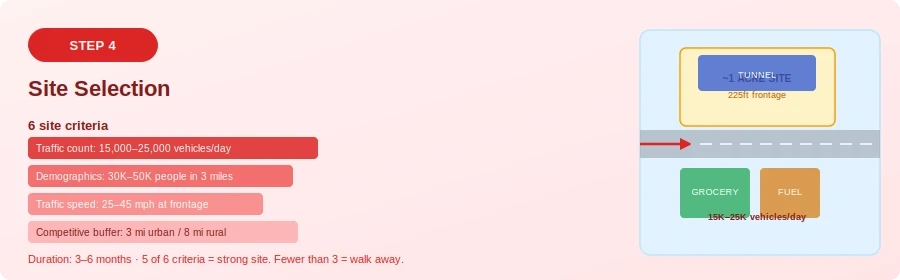
Step 4: Choose a Location — the Single Biggest Decision
Site quality sets the ceiling of your business. A skilled operator in a poor location will lose to an average operator in a great location almost every time. When I evaluate sites, I measure against six benchmarks:
| Criterion | Target | Red Flag |
| Traffic count | 15,000–25,000 vehicles/day | Below 10,000 |
| Demographics | 30,000–50,000 people in 3 miles | Low density |
| Traffic speed | 25–45 mph at frontage | Above 50 mph |
| Physical site | ~1 acre, 225ft road frontage | Poor access |
| Adjacent anchors | Grocery, fuel, fast food | No foot traffic drivers |
| Competitive buffer | 3 miles urban / 8 miles rural | Established operator nearby |
A site that checks five of these six criteria is a strong candidate. Three is a coin flip. Two or fewer is a deal to walk away from regardless of lease economics.
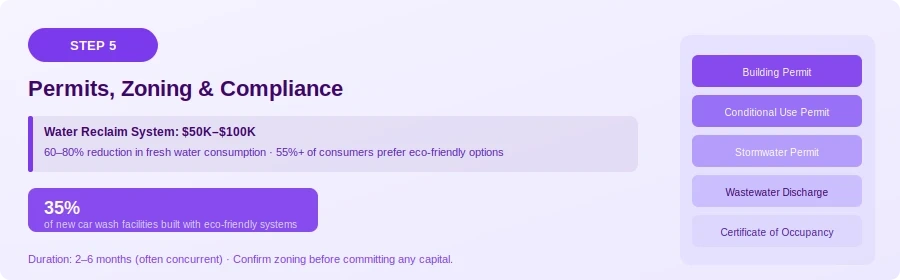
Step 5: Navigate Permits, Zoning, and Environmental Compliance
Confirm that zoning permits car wash use before committing any capital. Common permits for a ground-up site:
- Building permit (construction and plumbing)
- Conditional use permit (many jurisdictions treat car washes as conditional)
- Stormwater management permit (most states require an engineered plan)
- Wastewater discharge permit (coordinate with local sewer authority)
- Signage permit (pylon, monument, façade)
- Certificate of occupancy (final approval before opening)
Water reclaim systems run $50,000–$100,000 and are increasingly mandatory — with a 60–80% reduction in fresh water consumption as the operational upside. Over 55% of consumers now prefer environmentally conscious car wash options (industry surveys), making compliant water management both a regulatory requirement and a marketing asset. Eco-friendly options account for 35% of new car wash facilities built in recent years.
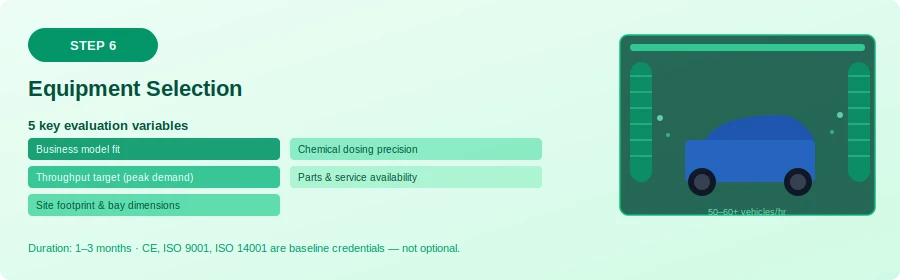
Step 6: Select Your Equipment — the Phase Most Guides Skip
Equipment selection is where generic startup guides run thin, and where most long-term operating economics get decided. The wrong system costs you for the next ten years in energy, chemical waste, downtime, and service calls.
Five Variables That Drive Equipment Selection
- Business model — self-serve, IBA, and tunnel use fundamentally different equipment families
- Site throughput target — peak-hour demand and what the system must deliver
- Available footprint — tunnel length, bay dimensions, reclaim-area space
- Chemical economics — dosing precision is a hidden operating-cost lever most operators underweight
- Service and parts availability — especially critical outside major metros
|
Operator insight Dosing precision directly affects your cost per wash. A pump that over-doses by 10% wastes 10% of your chemical budget every single operating day for the life of the site. Push every vendor: what is your dosing precision, and what does it translate to in cost per wash at rated throughput? |
Manufacturer Evaluation Checklist
- Certifications: CE, ISO 9001, ISO 14001 — baseline, not optional
- Spare parts lead times: two weeks is acceptable; two months is a red flag
- Reference deployments: three clients you can actually call, not logos on a slide
- Remote commissioning capability: critical for sites far from service hubs
- Manufacturing scale and history: years of operation and installation count across diverse markets
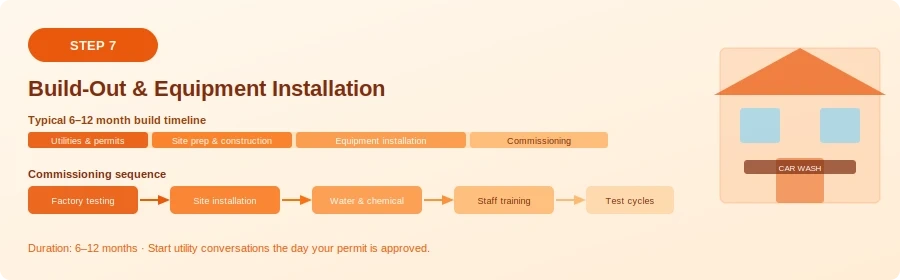
Step 7: Build Out Your Site and Install Equipment
Build-out typically runs 6 to 12 months from permit approval to soft opening. The critical path is almost always utility connections — water, sewer, and three-phase power — which gate the construction schedule more than the physical building. Start utility conversations the day your permit is approved, not the day construction begins.
The equipment commissioning sequence is consistent across vendors: factory acceptance testing → site installation → water and chemical setup → staff training → test wash cycles. Insist on documented quality benchmarks at handover: verified dosing accuracy, measured reclaim throughput, signed operator training records.
Step 8: Hire and Train Your Team
| Model | Team Size | Key Role |
| Self-serve | 1–2 attendants | Site supervision and cash handling |
| In-bay automatic | 1–2 per shift | Equipment monitoring |
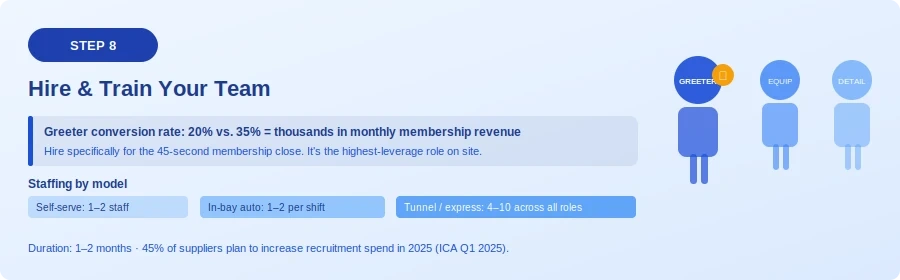
| Tunnel / express | 4–10 staff | Greeter, monitor, prep, detail, maintenance |
At an express tunnel, the greeter is your highest-leverage hire. Membership conversion happens at the point of sale — a greeter who can close a $29.99 monthly plan in a 45-second conversation is worth significantly more than one who only processes payment. The difference between a 20% and 35% conversion rate is usually that one person.
Note that labor recruitment remains a challenge industry-wide: 45% of suppliers plan to increase spending on employee recruitment and retention in 2025 (ICA Q1 2025). Budget for it.
Step 9: Launch, Ramp, and Build the Membership Base
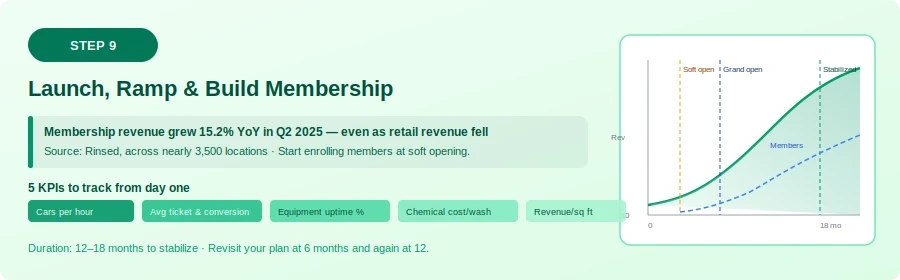
Open soft before you open grand. Two to four weeks of limited hours let you calibrate equipment under real-use conditions, catch training gaps, and tune chemical dosing to your actual traffic mix — before promotional pricing and media coverage bring crowds that punish loose operations.
If your model is express, start enrolling members at the soft opening. The membership base takes 6 to 12 months to build, and every month of delay compounds against your ramp curve. Carwash membership revenue grew 15.2% year-over-year in Q2 2025, even as retail revenue fell (Rinsed, across nearly 3,500 locations). Members are the buffer that keeps a car wash financially stable when walk-in traffic softens due to weather or economic headwinds.
KPIs to Track from Day One
- Cars per hour (actual vs. capacity)
- Average ticket and membership conversion rate
- Equipment uptime percentage
- Chemical cost per wash
- Revenue per square foot
Revisit your plan at 6 months and again at 12. Most first-year adjustments involve pricing, labor shift coverage, and membership tier structure. If your 12-month numbers are on track, the 12-to-18-month stabilization tends to follow.
| About this guide
Published April 28, 2026. Industry statistics sourced from Grand View Research, IBISWorld, International Carwash Association (ICA) Q1 2025 Operator Report, Persistence Market Research, and Rinsed Q2 2025 benchmark data (3,500+ locations). Mister Car Wash financial data from Q4 2025 earnings release. This guide does not contain affiliate links. Author: Jordan Ellis, car wash operations consultant. |