


If you’re new to the car wash business, the wide range of products on the market may appear mind-blowing at first.
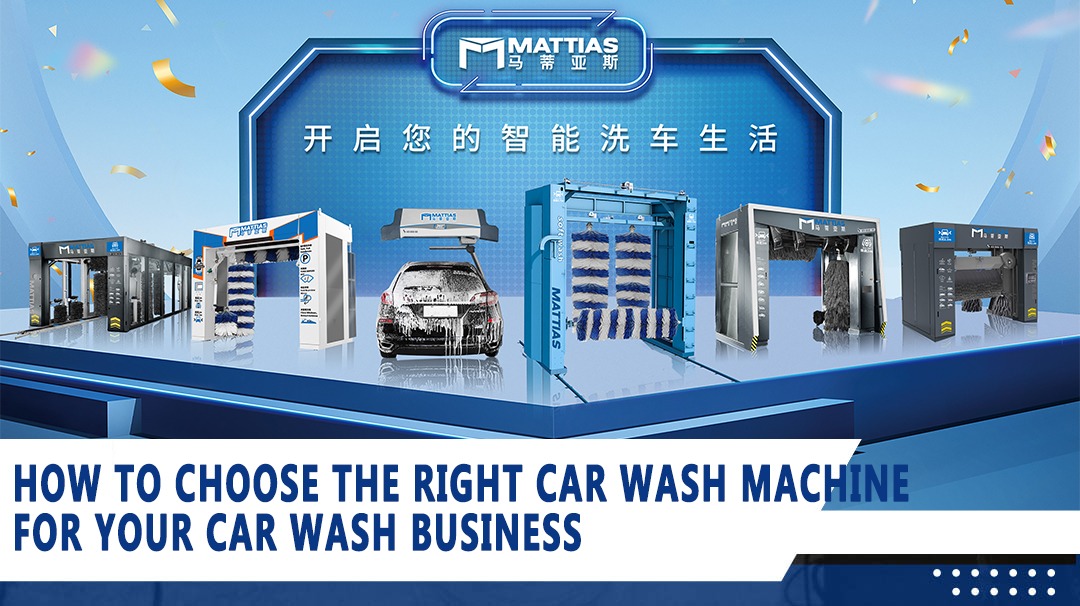
Like Karcher, PDQ, MacNeil, and Mattias in the car wash industry, there are several major car wash machine manufacturers.
Just like car wash equipment makers that turn out Self-Service Car Wash Machine, Inbay Automatic Car Wash Machines, Conveyor Tunnel Car Wash Machines, and Automatic Bus Truck Wash Systems, there are several “models” of car wash machines, each serving a different purpose and catering to certain customers.
Picking the right one for you doesn’t have to be hard. The information below can help guide you through the process.
Types Of Car Wash Machines
The most common car wash machines in use are:
Self-Service Car Wash Machine (coin-operated)
Inbay Automatic Car Wash Machines (touchless or soft-touch)
Conveyor Tunnel Car Wash Machines
Automatic Bus Truck Wash Systems
There are also versatile, more expensive flex-serve locations that offer both self-service and automatic options. Also, there are mobile detailing units for work off the electrical grid. (These more complex setups will be covered in different articles.)
For this introduction, we will focus on the basic self-service, automatic, and bus wash machines. If you’re unfamiliar with the different car wash types, check out the main car wash guide before proceeding here.
An understanding of the basic systems is important for a new or aspiring car wash owner. Your prospects for success increase dramatically if you understand the features and benefits associated with the various types of car wash machines.
For example, knowing which model works best for a particular location and what cleaning solution, brushes, or pressure settings best meet customer expectations qualifies you for work as a consultant, franchisee, equipment technician, or supplier at your company.
This article starts with the basics of choosing a machine. After that, I will show you how to read the “specs” included in the product sales literature and teach you how to compare key features.
Step 1: Determine The Type Of Vehicles You Will Be Washing
Passenger Cars
The majority of washes done involve standard passenger cars. These vehicles can handle a fair amount of water pressure. So, unlike the other vehicles listed below, these cars are very forgiving when a novice operator applies too much pressure.
Most car wash systems accommodate passenger cars. Plus, you don’t need a lot of features on the machine to produce a good-looking wash.
SUVs and Trucks
SUVs and trucks are more finicky when it comes to dealing with water pressure. Composed of various materials like aluminum, steel, and plastics, manufacturers use these alloys for their vehicles, largely because of their durability and weight-saving properties.
Workers typically wash SUVs and trucks using self-service or automatic machines. These vehicles require less pressure than standard cars to address their larger surface areas and sensitive paint jobs.
Plus, the increased difficulty with most truck washes requires a machine with decent controls to get your pressure and/or brush settings right.
You can also find self-service wands designed for trucks. This allows you to use a coin-operated bay to get the job done. But keep in mind, the vehicle must be small enough to fit in the bay, and you often get more overspray compared to an automatic wash.
RVs and Boats
For car wash owners, RVs and boats come from another planet.
As non-standard vehicles, they require special handling so well that you constantly need more space to keep your wash bay operational. At the same time, the vehicle distorts easily if it gets too close to the equipment. Consequently, RVs and boats frequently require more complex equipment to get the job done.
You can use automatic machines (especially one with a pull-through feature) on RVs. Still, many wash systems struggle to clean these oversized vehicles. So a separate add-on must be purchased, called a high-pressure arch.
If you intend to wash RVs automatically, make sure your machine can accept a high-pressure arch. Not all of them do.
A self-service bay designed for boats should include a wide-open space option (“drive-through”). Other helpful features include multiple wand options, spot-free rinse, and a vacuum option. Naturally, these added features will drive up a self-service bay’s cost.
Although it’s not the preferred choice, a bus wash machine can also clean RVs. Like boats, the vehicle must be small enough to fit in the bay without risking damage.
Transit and School Buses Transit buses (used by cities) and school buses (used by districts), have their own size and frequency issues that car wash owners must consider.
Because these vehicles are so large and washed so often, you don’t want to be making mistakes when you wash them. Hence, they require a sophisticated bus wash machine with lots of control, along with plenty of set-up and training, and a seasoned veteran at the controls.
Step 2: Establish A Pressure Range That Covers All Possible Vehicle Sizes
The larger the vehicle, the more pressure you need to wash it with good cleaning power.
Since the cost of a car wash machine is based in part on how much pressure it generates, you must determine in advance the maximum size of vehicles you’re going to be washing at your location.
Large transit buses and RVs longer than thirty feet require the use of a heavy-duty bus wash machine or a self-service bay. According to WashTec, you need one gallon per minute (GPM) of water for every foot of vehicle length.
For example, a 20-foot (.20 ft) SUV requires approximately 20 GPM. School buses need about 10% less water than transit buses, while RVs need about 25% more. Pressure settings are also tied to the type of nozzle tips, as explained in our other tutorial for setting self-service bay parameters.
Conversely, working with very small cars requires low pressure (and lower GPM) on a more sensitive washing machine. In this case, the objective is to provide just enough pressure to get the job done.
Sometimes a low pressure induces poor cleaning power, and that’s a car wash owner’s nightmare. Besides that, if too much pressure hits the vehicle, the area surrounding the impact weakens or chips.
So, if you need to work with compact cars or boats, pay attention to the low end of the GPM, too. Also, many of the features just described above for boats will also apply when washing extremely small cars of any make.
If you’re careful, you can use a mobile detailing unit to wash small electric vehicles. But make sure the pressure washer can accommodate a tiny 40-degree nozzle tip.
Step 3: Decide Where You Will Be Washing
Knowing where you will be washing most of the time figures into what sort of equipment you should purchase.
There are a couple of things to think about:
Power Supply
If you’re plugging the machine into the wall (i.e., the power grid), your choices are as follows:
- 208/230 volt AC – This is the standard power provided to most commercial car wash locations. A few entry-level self-service bays are rated for 115 volts input power, but not many.
- 460/480 volts AC – This is the high-power, 30-amp circuit used by most automatic machines. Any industrial location will have this available. Residential wiring is another matter. Since most car wash equipment requires a 30-amp circuit, you may have to hire a licensed electrician to wire a circuit from the control panel.
- Single-Phase vs. Three-Phase – Most electrical equipment is designed for normal “single phase” operation, drawing from the 208-230 voltage line coming off the grid. However, at many warehouses and other industrial locations, a “three-phase” option is available. A third hot wire joins the circuit in this scenario, making more amperage available to power large motors. This option also gives you better energy efficiency, so companies are willing to invest in three-phase machines to save a bundle on their electricity bill. You cannot, however, use a three-phase machine at home.
Off-Grid Scenario
If you’re washing outdoors and don’t have access to the power grid, you’ll need a mobile detailing unit or trailer-mounted system to complete the assignment. Mobile detailers and car wash operators who work at events typically buy this type of machine.
Depending on the model, the generators run on gasoline, diesel, or natural gas (not all three) and accommodate a pressure washer, a water tank, or a spot-free rinse system. The low end of this product niche starts at about $5000 and is used only for hand-washing.
When reviewing product sales literature, look for the symbols hot/cold water and soft/hard water if you intend to run the washer off a generator.
Hard water machines are costlier but are the right choice if you’re offering a spot-free rinse. You’ll also need to know your power requirements (i.e., maximum watts) to choose the right sized generator.
Beware, California only permits the use of generators meeting low carbon emission standards, otherwise known as CARB-compliant.
Cold Weather Conditions
If you expect to be washing in unsheltered areas where freezing is possible, this may negatively affect your washes.
The water used with the automatic process to clean a vehicle’s surface will freeze and be ineffective. This problem results in ice buildup and potential damage.
In cold conditions where heated water cannot be used, you’ll want to be able to switch an automatic machine over to the touchless mode (or use a straight touchless washer). The high-pressure system provides everything you need to make a good wash, including the cleaning power, so no brushes are needed.
Alternatively, a self-service bay will work in a cold environment (but not too cold). Like high-pressure in the automatic machine, a self-service wand is a heated option to provide what you need.
Both of these washing processes contain hot water systems within the equipment. They heat directly at the point of use, leaving a clean surface behind.
Step 4: Understanding Key Features To Compare
When reading the sales literature for different car wash machines, the jargon and sales pitch can become hard to cut through.
But here are a few key things to look for:
Water Usage
This spec tells you how much uninterrupted washing a machine can handle in one hour.
Traditionally, the water usage is defined as the number of gallons per minute (GPM) a car wash machine can use at the highest pressure the equipment offers. After reaching the limit, the machine must be allowed to refill for the remainder of the hour.
Sometimes, manufacturers report the water usage as gallons per car (GPC). So, you must do the math in your head. Simply divide the GPC by 3 to get the GPM you can use per average car wash. If you exceed the water usage, the tank empties, and the pumps inside may run dry.
For example, a very inexpensive machine with a maximum pressure of 1000 PSI may have a 3 GPM rate. This means you can wash for 20 minutes out of every hour without the equipment running out of water or burning out.
In general, you can look for water usage depending on your needs. As a rule of thumb: light-duty/residential 3-4 GPM medium-duty 4-5 GPM heavy-duty 5-8 GPM
But nowadays, manufacturers play with the formula. To boast a higher water usage, they report the percentage based on a lower pressure setting. So for a machine that provides has a 3 GPM rate at a maximum of 3000 PSI, you might see a rating of 5 GPM at 2000 PSI instead.
So, when reading the water usage for various car wash machines, note the PSI as well. The GPM goes up as the PSI goes down.
On the upside, you can use the same tactic to get around a low water usage for a machine that otherwise fits all your needs. Just buy the model with a higher maximum pressure than you expect to use. That way, you effectively increase your GPM at the PSI you need to use.
Electric Motor (HP)
This is the horsepower emanating from a car wash machine when the equipment is not running.
On the one hand, it’s sort of dangerous to have a live circuit sitting around in the bay with the potential to cause a serious injury. (That’s why OSHA limits HP on equipment.)
On the other hand, HP affects how a machine will perform when starting up. Some types of washing need the extra power you get at start-up.
In particular, bus wash machines and automatic tunnels require a reasonably high HP. That enables a crisper start as the operator activates the system to begin the wash.
A frequent problem for owners is the inability to start equipment, so a low HP on a small washing machine may aggravate the situation. You should take note of the HP in the specs if you are a rookie learning how to wash cars.
An HP of about 10 is considered normal in a self-service bay. In an automatic machine, it can go up to about 25, but it’s not a big deal since, with automatic washing, the system normally starts without fuss when you press the button.
Pump Protection
Either a machine has it or doesn’t, and you should only buy a machine that has it. This feature automatically cuts output pressure to your wand or arch if the pump inside starts running dry.
The bypass valve or other recirculating mechanism will continue running to help recycle the water (assuming you leave the machine turned on).
In some specs, this feature is clearly stated. But with other products, you may need to check the equipment manual or ask a sales rep.
Step 5: Determine If You Need To Use Special Chemicals
‘Various chemicals (detergents, waxes, protectants, etc.) or mixtures of chemicals are used for different washing processes.
For automatic washes, the type of chemical you need depends on the process, the vehicle type, washing stage, and environmental conditions. The chemicals used include pre-soak, wheel cleaner, bug remover, drying agent, and tire shine, or blends of these chemicals. For example, a blend of detergent and wax is common.
With self-service washing, you simply need soap and wax.
You can read more on car wash chemicals here.
- A bus wash machine typically uses heavy-duty detergents. But in certain special applications, it may require degreasers. Bus wash chemicals may come as a special blend designed for specific applications like truck wash chemicals.
- If you need to use special chemicals, you’ll want to consider a few other things:
- If you buy a car wash machine that requires chemicals stored in a drum under pressure, at some point, you will need to transport the drum to a supplier for refills. Check to make sure there’s a supplier in your area with a reasonable policy for exchanging and filling empty drums.
- The drums themselves can either be purchased or leased from the supplier. Chemical containers come in several sizes, so you’ll have to research what size you need based on how often you’ll be using it. As a rule, it doesn’t cost much more to fill a large drum than it does to fill a small one. Get the biggest you can afford and store.
- There are lots of safety issues and storage requirements associated with chemicals. Be sure you understand what’s involved before buying car wash equipment that uses them. If you’re thinking of buying a used drum, be sure your chemical supplier will agree to fill it before purchasing. Always keep your safety data sheet (SDS) and other documentation handy. OSHA requires that all chemicals get labeled properly.
- Most standard car wash applications call for a combination of 80% water and 20% detergent, although some owners do use 100% soap with good results. Washing buses usually calls for pure degreaser. RVs require a tri-mix blend of 90% detergent, 7.5% wax, and 2.5% protectant. Don’t worry; you don’t have to mix the chemicals yourself. You just buy the blend you need, but you will need a separate pump for each chemical you use.
- While using special chemicals with a car wash machine adds to your costs, you save money on water bills. High-quality chemicals are cheaper and more efficient than high water pressure. (Self-foaming detergents also do not require as much water.)
- Both degreasers and tire shines are expensive nowadays. That’s why the bus wash process is generally used for fleet vehicles rather than passenger cars.
- Now Find Your Car Wash Machine We’ve rounded up the top picks in each category. Find them below: Self-Service Car Wash Machines Automatic Car Wash Machines Bus Wash Machines
Wrapping It Up
Choosing the right car wash machine comes down to finding what equipment fits your needs. The five key points just covered will aid you in that process and include:
- Determine the types of vehicles you will be washing.
- Identify the size range you intend to work with (and the GPM needed).
- Think about where you will be washing (e.g., indoors vs. outdoors).
- Compare key features of competing machines, like the water usage.
- Decide if you need special chemicals. If you do, make the appropriate arrangements.
These steps not only help you walk through the process of selecting a car wash machine. You will learn about the various units and what works best in certain situations. Knowledge of the various washing processes and machines commonly used makes you a better car wash owner and more valuable to potential investors.