










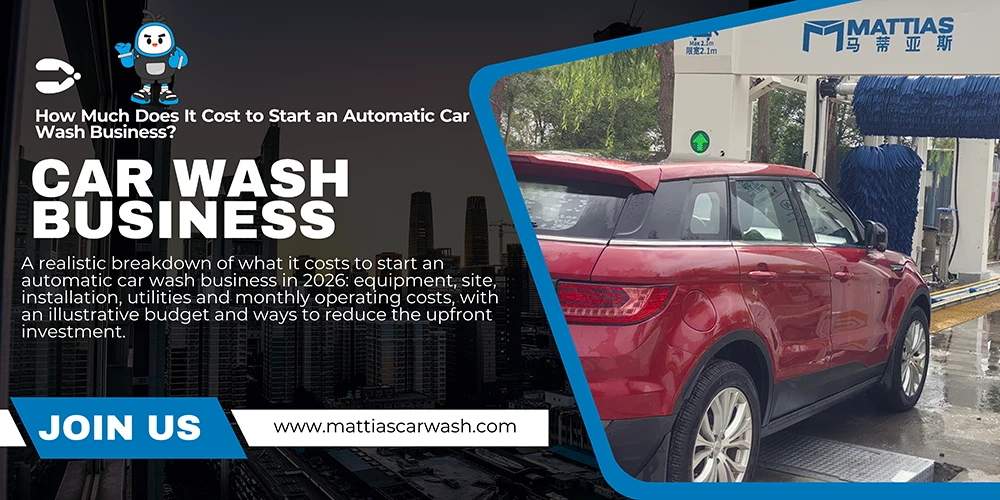

Short answer: budget US$80,000 to US$400,000+ for a complete site, depending on the machine, the building and the land. Equipment is only one line item. The rest is site work, installation, utilities and permits. Run it with the no-employee model and you cut the single biggest recurring cost in car washing: wages.
Considering an automatic car wash as an investment? See real numbers from a live installation. Book a free demo and Mattias will walk you through a machine running unattended, 24/7, with the real cost and payback math for your lot.
Key Takeaways
- Equipment is only part of the budget. Site prep, installation, water and power hookups can add another 30-60% on top.
- A single rollover (in-bay) machine is the cheapest way in. A tunnel system costs the most, but earns the most per day.
- The no-employee model removes your biggest recurring cost: wages. What’s left is water, chemicals, power, maintenance and payment fees.
- Startup cost moves with your country and market. Every figure below is an illustrative example with stated assumptions, not a quote.
- Want numbers for your specific lot? Book a demo and get a business plan modeled on your volume and ticket price.
Cost of Equipment
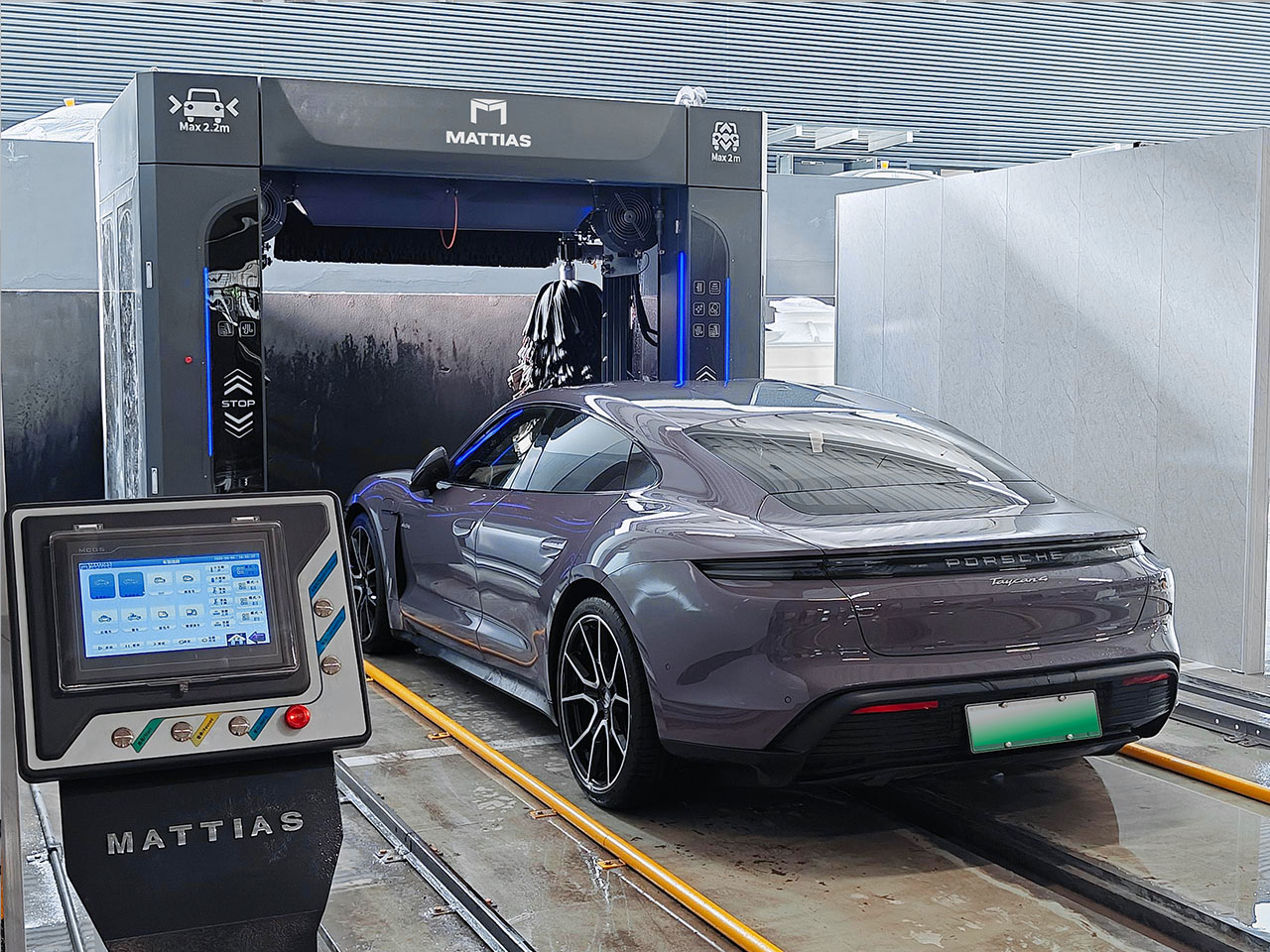
The machine is the centerpiece, and the one line item you can price precisely. Mattias builds the full range, from compact rollover machines to 40-meter tunnel systems:
| Machine type | Typical role | Capacity | Cost level (illustrative) |
|---|---|---|---|
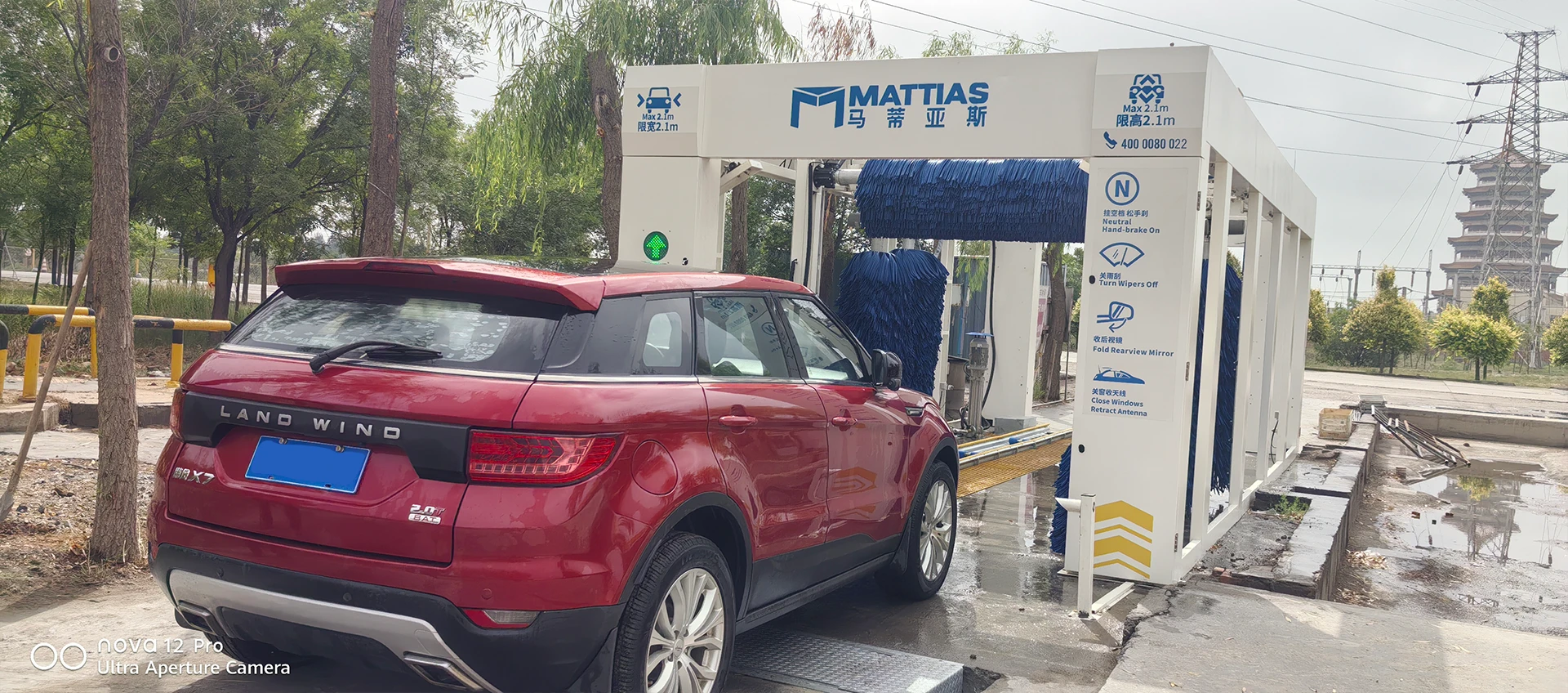
| Rollover / in-bay (e.g. M-LM535, M-WS310) | Small lots, stations, dealerships | 200+ cars/day | Lower entry |
| Conveyor tunnel (e.g. M-SD0900Q) | High-volume sites | 55-60 cars/hour | Medium |
| Large tunnel (e.g. SD1800Q-40) | Highest volume | 150-180 cars/hour | Highest |
Illustrative range: US$40,000 – US$90,000 for a rollover car wash machine; tunnel car wash systems run higher.
Cost of Site
This is land, structure and ground work — everything the machine sits on and inside of. It’s the layer that varies most by country and lot, and in a ground-up build it often costs more than the machine itself:
- Land purchase or lease preparation
- Canopy or building shell to house the machine
- Concrete base and general site grading
- Land-use and building permits
Illustrative range: US$20,000 – US$100,000. Retrofitting an existing bay instead of building new cuts this layer sharply — it’s usually the fastest way to shorten your payback period.
Installation
Getting the machine from delivery to fully operational is its own budget line, separate from the site itself:
- Mechanical installation labor
- Drainage system installation and connection
- Payment system, signage and fit-out
- Installation-related permits and inspections
Illustrative range: US$15,000 – US$55,000. Mattias’s distributor and service-partner network handles installation; your general contractor typically handles the site-side permitting and prep it connects into.
Water & Power
Utility hookups and treatment equipment sit apart from general site work because they scale with local rates and regulation, not just square footage:
- Water supply connection
- Electrical / power connection
- Water recycling system (optional — e.g. M-SH30 / M-SH60)
- Water softener (optional — e.g. RSRH-6D / RSRH-3D)
Illustrative range: US$10,000 – US$45,000. Recycling and softening are optional additions, but they pay for themselves fastest in water-stressed or hard-water regions — see the reduction tips below.
Monthly Operating Costs
Once the site is running, labor is the single biggest lever on profitability. A Mattias automatic machine runs unattended, 24/7 — no shifts, no payroll, no overtime. Compare the two operating models:
| Cost item | Staffed wash site | Unmanned (Mattias) |
|---|---|---|
| Wages | Large monthly item | US$0 |
| Water and chemicals | Medium | Medium (same wash quality) |
| Power | Low-medium | Low-medium |
| Maintenance | Low | Low (remote monitoring on IoT models) |
| Payment fees | Low | Low |
Remove wages and the whole cost structure changes: the wash earns through the night, on weekends and on holidays, with nobody on the clock. Budget US$5,000 – US$15,000 as working capital to cover your first three months of these costs before revenue stabilizes.
Total Start-Up Costs
Add the four capital layers together and you get your real startup number — not just the machine price. The example below models a compact, single-bay automatic wash in a developed market. Treat it as a planning shape, not a quote; your country, currency and site will move these numbers.
| Cost item | Illustrative range (USD) |
|---|---|
| Equipment | US$40,000 – US$90,000 |
| Site | US$20,000 – US$100,000 |
| Installation | US$15,000 – US$55,000 |
| Water & power | US$10,000 – US$45,000 |
| Working capital (first 3 months) | US$5,000 – US$15,000 |
| Total (single rollover bay) | US$90,000 – US$300,000+ |
A tunnel installation in a dedicated building sits at the high end and above, because the building itself becomes a major line item.
Want to see how this budget maps to your own site? Book a demo and Mattias will run the numbers against your lot, your traffic and your local costs.
How to Reduce Upfront Costs
- Retrofit an existing bay instead of building new — it removes the biggest site cost.
- Start with one rollover machine and add capacity as volume grows.
- Add water recycling (M-SH30 / M-SH60) to cut water bills and meet regulations in water-stressed regions.
- Use a softener (RSRH-6D / RSRH-3D) to protect equipment and keep results spot-free in hard-water areas.
- Finance in stages — let the machine’s own revenue fund the next expansion.
Who This Fits (Customer Segments)
- Investors: a single-bay unmanned wash is the classic low-cost entry, earning 24/7 with minimal headcount.
- Gas stations: adding a wash bay to existing traffic is one of the highest-ROI upgrades in fuel retail.
- Car dealerships (4S): a wash machine inside the service lane preps cars for delivery and adds a revenue line.
- Detailing and maintenance centers: a touchless in-bay machine adds volume without adding staff.
- Used-car dealers: washing cars before photos and delivery directly improves sell-through.
FAQ
Q: How much does an automatic car wash machine cost? A: Equipment alone typically runs US$40,000 for a compact rollover machine to US$100,000+ for a tunnel system. Total project cost is higher once you add site, installation and permits.
Q: Can I start an automatic car wash with a small budget? A: Yes. A single rollover machine in an existing bay is the lowest-cost path in, and the no-employee model keeps monthly costs low from day one.
Q: Do I need employees to run an automatic car wash? A: No. Mattias machines run unattended 24/7. Removing wages is the fastest way to improve your margins.
Q: What are the monthly operating costs? A: Water, chemicals, electricity, maintenance and payment fees. With no payroll, a compact site runs on a modest monthly budget — exact figures depend on volume and local rates.
Q: How can I reduce the startup cost? A: Retrofit an existing space, start with one machine, add water recycling to cut utility bills, and expand only once revenue supports it.
Conclusion
The real cost of starting an automatic car wash is the total project — equipment, site, installation, water and power, and working capital — not just the machine line. The machine is the predictable part. The cheapest way to run it is the unmanned model, which is what Mattias is built around.
See it before you commit capital. Book a free demo and Mattias will model your lot, your volume and your ticket price into a real payback timeline — no cost, no obligation.