











Introduction
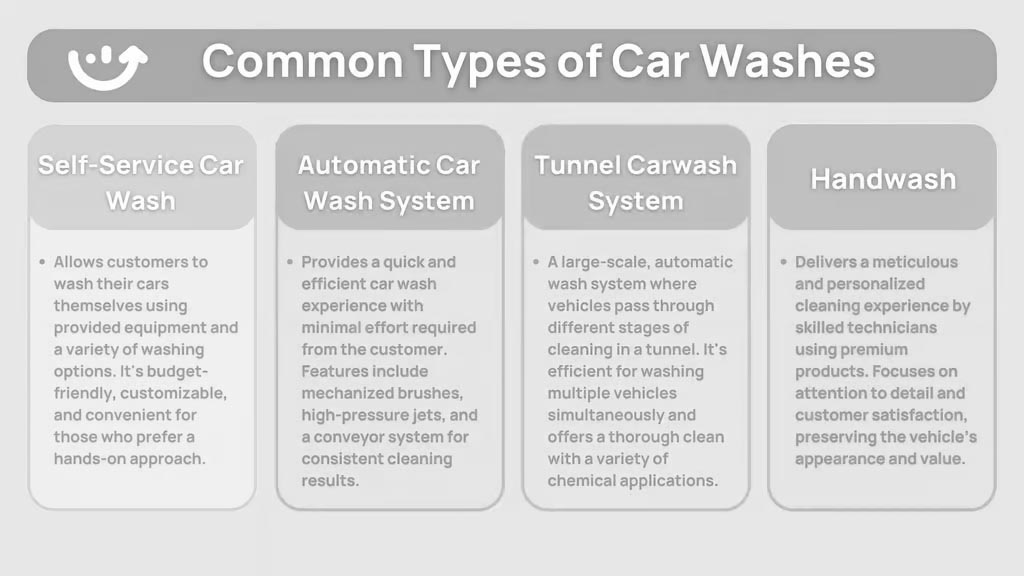
- Types of Automatic Car Washes: The main types include in-bay automatics, tunnel car washes, touchless systems, and friction systems.
- Efficiency: Tunnel car washes are generally more efficient, handling a higher volume of cars per hour compared to in-bay automatics.
- Cost: Initial investment and operational costs vary significantly. Tunnel systems are more expensive to install but can be more profitable due to higher throughput.
- Durability: High-quality equipment from reputable brands offers better durability and lower long-term maintenance costs.
- Technology: Advanced features like water recycling systems, digital payment systems, and sensors can enhance efficiency and customer satisfaction.
- Environmental Impact: Automatic car washes with water recycling systems and energy-efficient equipment can reduce water usage and operational costs.
Types of Automatic Car Washes
- In-Bay Automatics: Vehicles remain stationary while the cleaning equipment moves around them. Suitable for smaller properties.
- Tunnel Car Washes: Vehicles move through a tunnel on a conveyor system. Can handle a higher volume of cars per hour.
- Touchless Systems: Use high-pressure water jets and chemicals to clean without physical contact. Ideal for delicate vehicles.
- Friction Systems: Use brushes or cloth materials to scrub the vehicle. Provides a thorough clean but may risk minor abrasions.
| Machinery (Manual Vs. Automatic) | |
| Manual Car Wash Machine | Automatic Car Wash Machine |
| Although rare to explicitly hear or use the term “manual” wash, it is more often implied by referring to washes that are non-automatic. These are washes where humans do the vast majority of the washing and cleaning process. | An automatic car wash uses machinery to do most of the heavy lifting, without human intervention. People often use “automatic” as shorthand for express or automated car washes which is incorrect. |
| Structure (In-Bay Vs. Tunnel) | |
| In-Bay Car Wash Machine | Tunnel Car Wash Machine |
| In-Bay are structures where the vehicle stays stationary during the wash process, and machinery or washer moves around the vehicle. In-Bay washes can correctly be referred to as “non-conveyor”. Essentially, if the car is not moved from Point A to Point B by external non-human mechanisms (aka a conveyor), then it is in-bay. | Tunnel structures are where the vehicle moves through the wash equipment, and it is the equipment which is largely stationary. The vehicle is moved using an external mechanism (typically a conveyor or belt). All tunnel washes are automatic, but all automatics are not tunnels. |
| Washing Method (Touchless Vs. Friction) | |
| Touchless Car Wash Machine | Friction Car Wash Machine |
| Touchless car washes use no physical contact with external solid elements to clean the vehicle. Touchless washes use a combination of chemicals and high-pressure water to clean. That means no brushes or scrubbers that are normally associated with the established idea of a car wash. Touchless car washes go by several different names, including brushless, frictionless, no-friction, no-touch, and soft-touch car washes. | Friction car washes are washes where the cleaning is partially done by cloth, brushes, or other like physical elements touching and creating friction with the vehicle. Anytime you see brushes, clothes, or big spinning “things” that touch the car – you are looking at a friction wash. The vast majority of car washes are friction based. |
Efficiency
- Tunnel Car Washes: Can clean many more cars per hour than in-bay automatics, making them popular for high-volume operations.
- In-Bay Automatics: Typically clean a vehicle in about 5 to 10 minutes, suitable for smaller properties.
- Touchless Systems: Efficient in terms of water usage but may not remove stubborn dirt as effectively as friction systems.
- Friction Systems: Provide a deep clean but may require more maintenance due to wear on brushes and cloths.
Cost
- Initial Investment: Tunnel systems are more expensive to install compared to in-bay automatics.
- Operational Costs: Conveyor systems have higher operating costs due to multiple stop points and moving components.
- Maintenance: Touchless systems have the least maintenance costs and downtime compared to brush washes.
- Profitability: Tunnel car washes can be more profitable due to higher throughput and efficiency.
Durability
- High-Quality Equipment: Opting for reputable brands offers long-term advantages and lower maintenance costs.
- Durability: Equipment with higher durability can withstand continuous operation and exposure to water and chemicals.
- Lifespan: Durable equipment reduces the frequency of replacements and repairs, contributing to long-term cost savings.
- Customer Satisfaction: Reliable equipment enhances customer trust and satisfaction.
Technology
- Water Recycling Systems: Save money on water consumption and appeal to environmentally conscious customers.
- Digital Payment Systems: Offer convenience and flexibility, enhancing customer experience.
- Advanced Sensors: Ensure thorough cleaning by customizing the wash process for each vehicle.
- Computer Vision Systems: Improve efficiency and reduce errors in the wash process.
Environmental Impact
- Water Usage: Automatic car washes use less water compared to manual washing.
- Water Recycling: Systems that recycle water can significantly reduce water consumption.
- Energy Efficiency: Energy-efficient equipment reduces operating costs and environmental impact.
- Regulatory Compliance: Energy-efficient operations help meet environmental regulations and attract eco-conscious customers.