











If you own a modern electric vehicle — a VW ID.4, a Tesla, a Rivian, or any other EV — you’ve probably stood in a gas station parking lot, stared at the car wash entrance, and wondered: is it safe to go in there? And if so, which type?
EV owners ask this question more than almost any other car care question in online communities. The stakes feel higher: you’ve invested in a premium vehicle, possibly with ceramic coating, a vinyl wrap, or factory paint that cost a significant premium. The last thing you want is swirl marks, stripped coatings, or a damaged charge port door.
This guide breaks down the real differences between brushless and touchless automatic car washes — from the mechanics to the chemistry — and gives you clear guidance on which makes sense for your EV.
What’s the Actual Difference Between Brushless and Touchless?
The terms are sometimes used interchangeably, but they describe two meaningfully different systems.
Brushless Car Washes
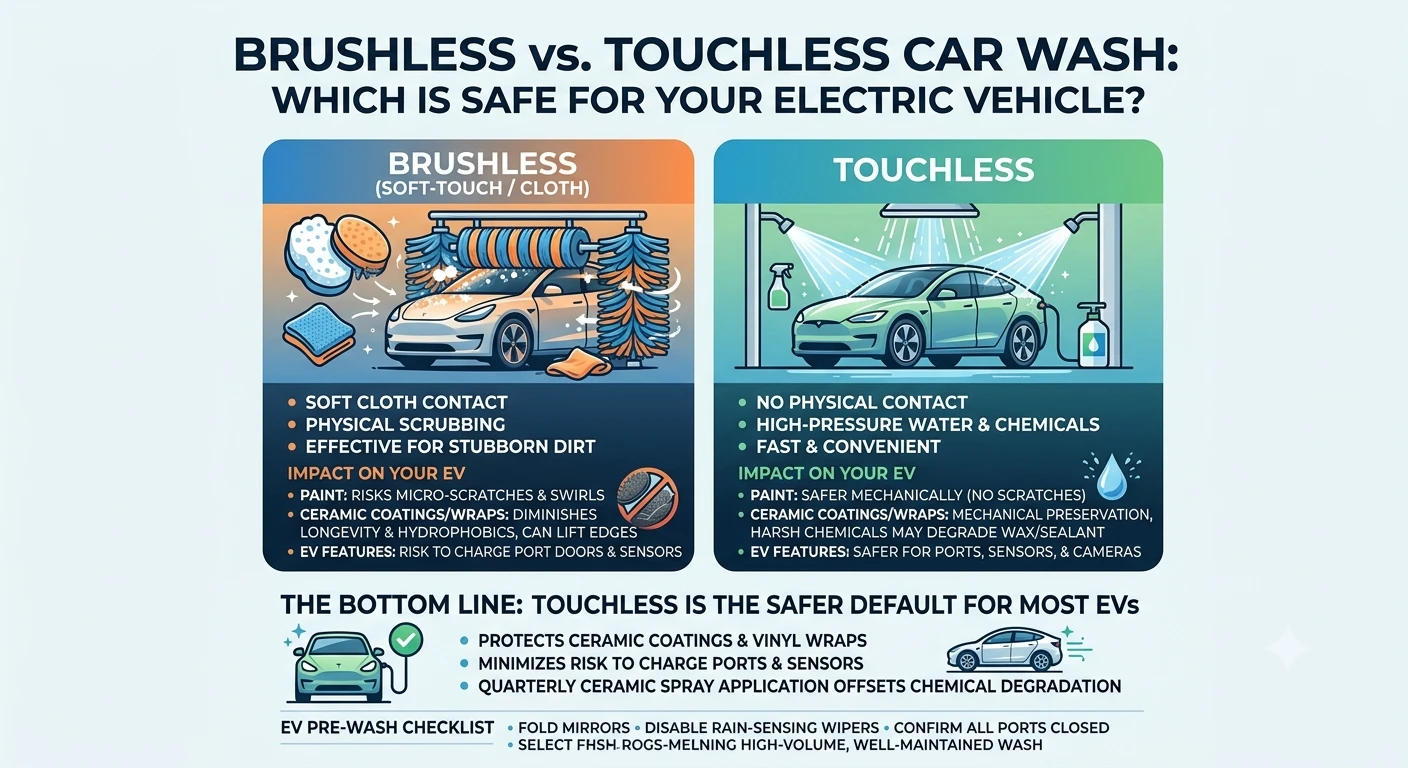
A brushless car wash — often called a “soft-touch” or “cloth wash” — uses foam pads, microfiber cloths, or flexible synthetic strips that physically contact your vehicle’s surface. Unlike the stiff-bristle brushes of decades past, modern brushless systems are designed to be gentle. They scrub the surface directly, which gives them strong cleaning power on stubborn dirt, baked-on bugs, road grime, and bird droppings.
The tradeoff: any physical contact introduces the possibility of micro-scratches and swirl marks, particularly if the wash equipment hasn’t been recently serviced or if a heavily contaminated vehicle passed through just before yours.
Touchless Car Washes
A touchless system uses no physical contact at all. High-pressure water jets combined with concentrated chemical detergents do all the work. Nothing touches your paint. For scratch-conscious owners, this sounds ideal — and for many use cases, it is.
The tradeoff: without physical agitation, touchless systems struggle with caked-on mud, heavy contamination, or sticky residues. They also tend to use stronger alkaline detergents, which can degrade wax and polymer sealants faster than gentler brush-wash formulations. For vehicles with ceramic coatings, repeated exposure to aggressive chemicals can reduce coating longevity over time.
Which Is Safer for Your EV’s Paint and Coatings?
This is where EV owners’ concerns become especially relevant. Many newer EVs come from the factory with a multi-layer paint system — an electrocoat base, a color basecoat, and a 50–100 micron clear coat designed for long-term gloss and protection. Some owners add aftermarket ceramic coatings or vinyl wraps, which raise the stakes further.
Paint Safety
For bare factory paint, touchless is generally the safer mechanical choice. With no physical contact, there is no chance of swirl marks from grit trapped in brush material. However, “no contact” does not mean zero risk. High-alkaline detergents used in touchless systems can slowly strip wax and polymer sealants, leaving paint temporarily unprotected between washes.
Brushless systems, when properly maintained and using clean, soft cloth material, are also safe for factory paint in most cases. The risk is maintenance-dependent: a well-run brushless wash poses minimal danger, while a neglected one with dirty or worn pads is a real paint hazard.
Ceramic Coatings
Touchless is strongly preferred for ceramic-coated vehicles. Physical contact in brushless systems can create fine abrasions in the coating surface over time, reducing its hydrophobic performance. Touchless systems preserve the coating’s integrity mechanically — but owners should note that harsh detergent chemistry can still shorten coating lifespan with frequent use. Choosing a touchless wash that uses pH-balanced or coating-safe detergents is worth the extra inquiry.
Vinyl Wraps
For wrapped vehicles, touchless is the only appropriate automated option. Brushes can lift wrap edges, cause peeling at panel seams, or create surface marring that is especially visible on matte and satin finishes. Many wrap manufacturers explicitly recommend touchless or hand washing only.
EV-Specific Concerns Beyond Paint
Electric vehicles introduce unique considerations that traditional car wash advice doesn’t cover.
Charge Port Doors
This is a real hazard that EV owners in online communities frequently report. Many EVs have a charge port door — either spring-loaded or motorist-operated — on the rear quarter panel. In some automated washes, moving equipment or conveyor chains have been known to catch and damage partially open charge port covers. Before entering any automated wash, verify the charge port door is fully latched shut and that your vehicle isn’t in a state that keeps it open (e.g., after an interrupted charging session).
Sensor Arrays and Exterior Cameras
Modern EVs are covered in proximity sensors, radar units, and exterior cameras used for driver assistance features. These protrusions can catch on brush systems in tunnel washes. While most are designed to be flush-mounted, it is worth familiarizing yourself with your vehicle’s exterior sensor locations before choosing a wash type. Touchless systems are inherently safer here.
Neutral Mode and Warning Lights
Many EVs lack a traditional neutral gear that feels natural to activate for a conveyor wash. VW ID.4 owners, for example, report that putting the vehicle into neutral triggers a cascade of parking-related warnings and safety alerts during the wash — sensors firing, warning chimes sounding, and notifications lighting up the dashboard. This is normal behavior but can be disconcerting the first time. Some manufacturers (notably Tesla) now include a dedicated “Car Wash Mode” that disables these systems automatically; others have yet to implement this feature.
The Conveyor vs. Rollover Question
EV owners who are concerned about conveyor drag on their vehicles sometimes prefer “rollover” or “drive-through” bays — where the vehicle stays stationary and the wash equipment moves around it, rather than the car being pulled along a track. This format eliminates conveyor-related anxieties entirely and is often available at in-bay automatic wash locations.
What Real EV Owners Have Learned
Across EV owner communities, a few patterns emerge from those who have been through automated car washes dozens of times with no issues, alongside those who have had negative experiences:
What works consistently well: Owners who use touchless systems at well-maintained, high-volume locations report no paint damage over long periods, even without hand-washing in between. Closing mirrors, disabling rain-sensing wipers, and confirming all doors and ports are latched are the most commonly cited preparatory steps.
Where problems tend to happen: Damage reports are most common at older, poorly maintained brush-based tunnels, at locations where brush media is visibly worn or soiled, or when EV-specific items like charge port doors or antenna trim pieces are not checked before entry.
The ceramic coating question: Owners with ceramic-coated vehicles strongly favor touchless but note that quarterly or semi-annual reapplication of a spray ceramic detailer helps offset the detergent effects of repeated automated washing.
Common Myths Worth Clearing Up
“Brushless means no contact.” Not accurate. Brushless means no hard bristles — but the foam pads and cloth strips in these systems still physically contact your vehicle. It is softer contact than old-style brushes, but contact nonetheless.
“Touchless is always perfectly clean.” Touchless systems excel at removing light-to-moderate dirt. For vehicles with caked-on mud, heavy bug accumulation, or tar deposits, a single touchless pass may not achieve a fully clean result. A pre-rinse at a self-serve bay, or opting for a professional hand wash in these cases, will give better results.
“Automated washes always damage paint.” A persistent myth. Paint protection and car wash choice are related, but the condition and maintenance of the equipment matters more than the broad category of wash type. Plenty of EV owners complete hundreds of automated washes without measurable paint degradation when the right wash type is chosen and basic prep steps are followed.
FAQ
Q: Is a touchless car wash safe for a VW ID.4? A: Yes, a touchless automatic wash is generally safe for the VW ID.4 and similar EVs. Put the vehicle in neutral, fold the mirrors if possible, disable rain-sensing wipers, and confirm the charge port door is fully closed before entering.
Q: Can I use a brushless car wash with a ceramic coating? A: It is possible, but not ideal. Physical contact in brushless systems can gradually diminish the hydrophobic surface of a ceramic coating. Touchless is the preferred option for coated vehicles, ideally combined with a pH-balanced wash chemistry.
Q: Does a touchless car wash strip wax or sealant? A: Over time, repeated exposure to the high-alkaline detergents used in touchless systems can degrade wax and polymer sealants faster than gentler formulations. Reapplying a quick ceramic spray detailer after each wash helps maintain protection.
Q: What is the safest automated car wash for electric vehicles? A: For most EVs, a well-maintained touchless automatic wash is the safest choice — it eliminates contact-related paint risk, has no brushes to snag sensors or trim, and poses no risk to vinyl wraps or ceramic coatings from mechanical abrasion.
Q: Should I use a rollover or tunnel car wash for my EV? A: Either can work, but rollover (in-bay) washes eliminate conveyor-related concerns entirely. If your EV has features that trigger when the vehicle rolls freely, a stationary rollover format may be less stressful — and less prone to unexpected charge port or sensor interactions.
Q: How often should I wash my EV? A: A general rule of every two weeks works for most driving conditions. In winter climates where road salt is used, more frequent washing — particularly of the undercarriage — is advisable to prevent corrosion on battery pack housings and underfloor components.
Q: Are there car washes specifically designed for EVs? A: As EV ownership grows, more car wash operators are updating their equipment and protocols with EV owners in mind. When in doubt, call the location ahead of time and ask whether they regularly service EVs — experienced operators will know exactly how to handle charge port doors, tow hooks, and neutral-mode requirements.
The Bottom Line
For EV owners choosing between brushless and touchless car washes, touchless is the safer default choice — particularly for vehicles with ceramic coatings, vinyl wraps, or EV-specific exterior features like charge port doors and flush-mounted sensors. Soft-touch brushless washes are not inherently dangerous, but they require equipment to be properly maintained and well-serviced to minimize contact-related risk.
Before your next wash, spend 60 seconds on a pre-wash checklist: fold mirrors, disable rain sensors, confirm all doors and port covers are latched, and select a location with a strong maintenance reputation. These simple steps make the biggest difference in long-term paint and coating health.
Looking for a fully automatic car wash solution for your business — one that delivers a consistently thorough clean without the contact risks car owners worry about? Explore Mattias CarWash’s touchless and soft-touch automatic car wash systems, engineered for high-volume throughput and paint-safe performance: M-WS100 Touchless System | M-WS210 | M-WS310