


If you own a pickup truck — an F-150, a Ram, a Silverado — you’ve probably had this debate. Some owners treat automatic car washes like a minor crime against their vehicle. Others run their trucks through the tunnel once a week and see nothing wrong. Who’s right?
The answer, as it turns out, depends almost entirely on which type of automatic car wash you’re using, and how well it’s maintained. Here’s a breakdown of every concern truck owners raise, and what the evidence actually says.
The Big Concerns Truck Owners Have About Automatic Car Washes
“Won’t the brushes scratch my paint?”
This is the most common fear — and the most misunderstood. The reputation for brush car washes scratching paint comes from older equipment: stiff nylon bristles from decades past that genuinely could drag grit across a clear coat and leave swirl marks behind.
Modern soft-cloth and foam systems operate completely differently. They use pliable, low-friction media combined with heavy pre-soaking that loosens and flushes surface contaminants before any contact is made. The result is lubricated, cushioned contact — not abrasive scrubbing. In a well-maintained modern rollover or tunnel wash, the risk of brush-induced swirl marks is far lower than its reputation suggests.
That said, equipment maintenance matters enormously. A brush system that hasn’t been cleaned or inspected collects grit, rubber residue, and road debris from every vehicle that came before yours. That’s the real risk — not brushes by design, but neglected brushes in practice. When choosing a wash, a well-run modern facility with frequent media inspection is a fundamentally different product from a neglected bay with decade-old equipment.
“What about touchless car washes — aren’t they safer?”
Many truck owners assume touchless means damage-free. It’s more complicated than that. Touchless systems remove the risk of contact-based scratching, but they compensate for the lack of mechanical action with two things: stronger chemical detergents and significantly higher water pressure. Both carry their own trade-offs.
Caustic detergents, used repeatedly over time, can degrade wax coatings, strip paint sealants, and accelerate oxidation on unprotected surfaces. High-pressure jets turn any surface grit that wasn’t fully pre-rinsed into a high-velocity abrasive slurry — which is essentially pressure-blasting fine particles across your clear coat. For many truck owners, especially in northern states where salt removal in winter is the primary goal, touchless works well. But “touchless” is not automatically synonymous with “gentler.”
“Can the wash damage my truck’s accessories — antenna, mirrors, running boards?”
This is a legitimate concern and one of the most frequently reported real-world issues. The risks are mechanical, not chemical: a factory or aftermarket antenna left extended can be caught by rotating wash equipment and ripped from the fender — a repair that can cost several hundred dollars or more. Extended power-fold mirrors on wide trucks can clip equipment in tighter tunnel configurations.
The fix is simple preparation, not avoidance. Before entering any automatic car wash:
- Remove or fully retract a screw-on shark fin or rod antenna
- Fold power mirrors in manually
- Note the equipment’s maximum vehicle height spec — many rollover systems accommodate trucks up to 7–8 feet; tunnel clearances vary
- Deploy or retract running boards to the position recommended by the wash operator
- If using a soft-top or tonneau cover, verify whether the wash type is compatible — some soft-cloth systems can catch at edges
“I’ve heard truck beds and tonneau covers cause problems”
A folded tonneau cover generally poses no issue in a properly configured automatic wash, though some users report minor water ingress around the tailgate depending on the cover design and seal quality. Hard folding covers and roll-up styles tend to fare better than soft tri-folds with unsecured edges. If your cover has any gaps at the tailgate rail, expect some water intrusion — it’s minor and won’t damage cargo, but worth knowing.
Open truck beds are more straightforward: water enters, drains, and the bed serves as its own collection point.
What Modern Automatic Car Wash Technology Actually Does
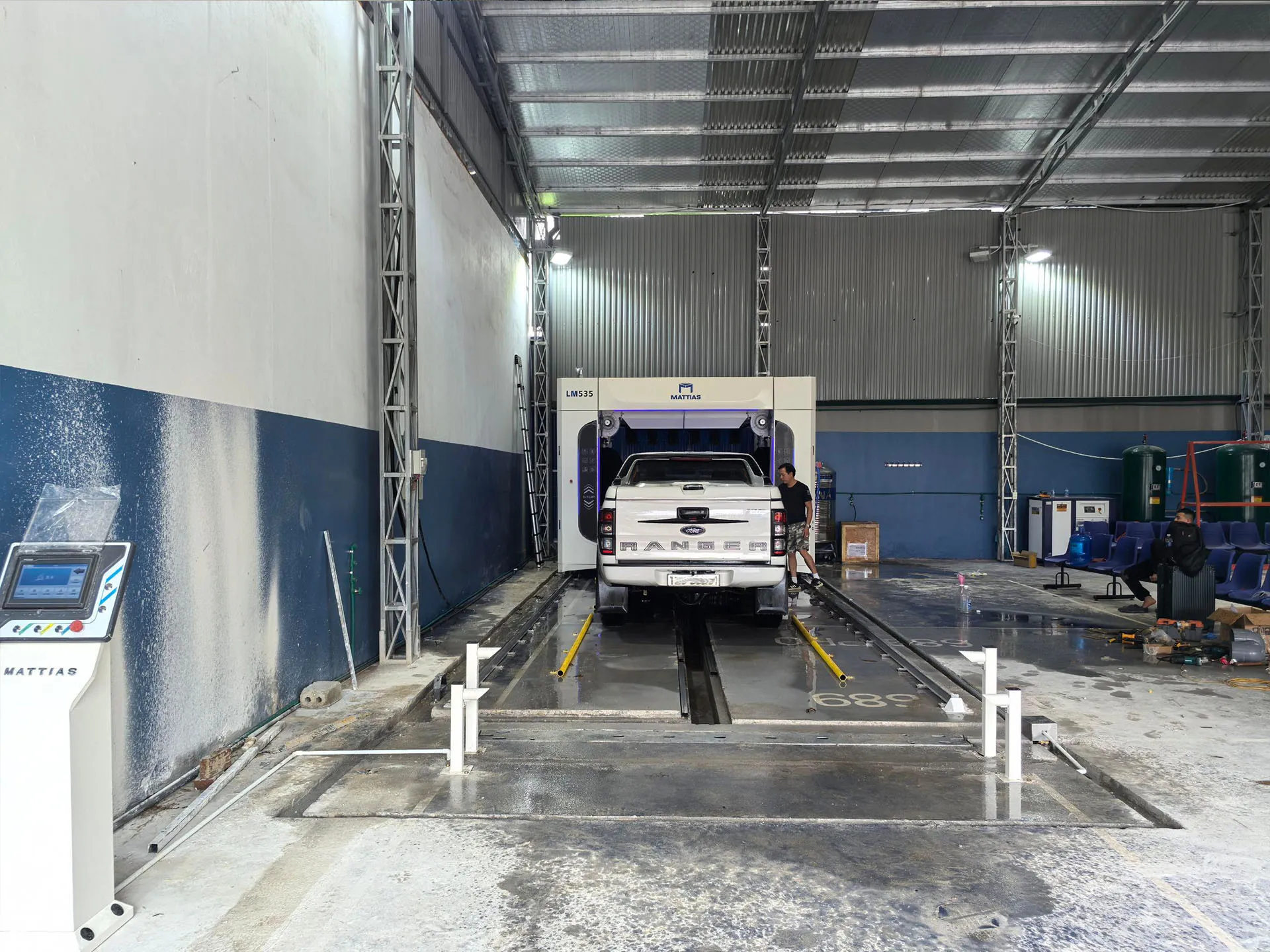
The equipment landscape has changed significantly over the past 15 years. Here’s how the main system types compare for truck owners specifically:
Soft-cloth / foam rollover systems use slow-moving, large-format foam or cloth media that wraps around vehicle contours with minimal pressure. Pre-soak cycles loosen and suspend surface contamination before contact. This is the most effective wash type for removing road grime, insects, and light mud — and when properly maintained, it is gentle enough for clear-coated truck paint.
Touchless rollover systems use rotating high-pressure nozzles and detergent chemistry. No media contact means zero brush risk, but the effectiveness on heavily soiled vehicles is lower, and detergent chemistry must work harder to compensate.
Tunnel / conveyor systems move the vehicle through a series of treatment stages — pre-soak, foam application, soft-cloth contact, rinse arches, and drying. These tend to be more thorough than single-bay rollover units and are commonly found at gas station car wash facilities. Height and width specifications are fixed, so confirming your truck’s dimensions against the tunnel’s clearance spec before entering is the correct first step.
What Real Truck Owners Actually Experience
Forum communities for F-150 owners, Ram drivers, and other truck enthusiasts generate thousands of posts on this topic every year. A few patterns emerge from the collective experience:
Most truck owners who use modern soft-cloth or touchless systems regularly report no visible damage. The minority who report problems typically identify one of two causes: older or poorly maintained brush equipment, or a mechanical issue (antenna, mirror, accessory) that wasn’t addressed before entering.
Dark-colored trucks show wear more visibly. Paint care enthusiasts point out that swirl marks are present on most vehicles — they’re simply far more visible on black, dark blue, and deep metallic colors than on silver, white, or lighter shades. A truck owner with a black finish evaluating the same wash experience as one with a silver truck may draw completely different conclusions.
Frequency and protection level affect outcomes. Owners who apply ceramic coatings or high-quality wax sealants before regular washing report consistently better results regardless of wash type. A protected surface is more resilient to both chemical exposure and minor contact.
Home hand-washing is not automatically safer. Improper technique — a single bucket that redeposits grit onto the wash mitt, a dirty or dry towel used to wipe a dusty surface — is one of the most common sources of real-world swirl marks. The assumption that “hand wash = safe, automatic = dangerous” is not supported by evidence when technique is accounted for.
Common Myths vs. Reality
Myth: All automatic car washes scratch paint. Reality: Modern soft-cloth and foam systems, when properly maintained, are designed to minimize abrasion. The reputation for scratching comes from older stiff-bristle equipment that has largely been replaced in well-run operations.
Myth: Touchless car washes are always the safest option. Reality: Touchless systems trade brush risk for increased chemical exposure and higher water pressure. For trucks with painted surfaces in excellent condition, touchless can actually be harsher on protective coatings over time than a modern soft-cloth system.
Myth: Truck accessories like running boards and antennas will definitely be damaged. Reality: These are preparation issues, not equipment design flaws. Following the wash operator’s guidelines and removing or securing accessories before entry eliminates virtually all mechanical risk.
Myth: The automatic car wash causes swirl marks I can see after one wash. Reality: Swirl marks accumulate gradually and are often already present from prior washing (including hand washing). A single visit to a well-maintained modern wash rarely produces visible damage on a vehicle in good condition.
FAQ
Can I put my Ford F-150 through an automatic car wash? Yes. Modern rollover and tunnel systems accommodate most full-size pickup trucks, including the F-150, within standard height and width specifications. Remove or retract your antenna, fold mirrors if the tunnel is tight, and confirm the wash’s vehicle clearance specs before entering.
Which is better for trucks — touchless or soft-cloth car wash? For thorough cleaning, soft-cloth systems generally outperform touchless, which requires harsher chemistry to compensate for the lack of mechanical action. For vehicles with paint protection film (PPF) or sensitive aftermarket wraps, touchless is often recommended to avoid potential edge lifting.
Will an automatic car wash damage my truck’s antenna? A factory or aftermarket antenna left extended can be damaged by rotating equipment. Remove screw-type antennas before entering, and verify that your antenna type (shark fin, stubby, rod) is compatible with the wash system.
How often can I safely run my truck through an automatic car wash? There is no standard frequency limit. Owners using modern, well-maintained systems regularly — including weekly — typically report no accelerated paint wear. The key variables are equipment quality and paint protection level.
Does a ceramic coating help if I use automatic car washes? Yes. Ceramic coatings create a hydrophobic, hard-surface layer that reduces friction contact risk, repels chemical detergents more effectively, and makes dirt easier to rinse away. Trucks with ceramic coatings report better outcomes across all wash types.
What should I do before putting my truck through a car wash? Retract or remove the antenna, fold power mirrors, confirm accessory compatibility (running boards, tonneau cover), remove any loose items from the truck bed, and check the wash facility’s posted height and width maximums.
Are soft-cloth car wash brushes bad for dark-colored truck paint? Poorly maintained brushes with accumulated grit can cause micro-scratches visible on dark paint. Clean, well-maintained modern soft-cloth media is engineered to minimize this risk. Applying a protective wax or ceramic coating adds an additional buffer.
What’s the safest way to wash a truck if I’m concerned about paint? A two-stage approach works well: use a quality automatic car wash for regular maintenance cleaning, and perform a careful hand detail with a two-bucket method a few times per year for paint correction and protection reapplication.
Conclusion: Choose the Right Wash, Prepare Correctly, Protect Your Investment
The automatic car wash vs. hand wash debate in the truck community is louder than the actual risk warrants. Modern soft-cloth and touchless systems are engineered to clean effectively without the paint damage that older brush systems sometimes caused. The outcomes truck owners experience depend far more on equipment quality, maintenance frequency, and vehicle preparation than on whether they chose an automatic wash in the first place.
What makes the real difference is choosing a facility that maintains its equipment, understanding what your specific wash type does and doesn’t do, and protecting your truck’s paint with a quality sealant or ceramic coating.
Mattias CarWash automatic rollover systems are built for exactly this — high-throughput, gentle cleaning that works for every vehicle class including full-size trucks. If you’re evaluating automatic car wash equipment for your gas station, fleet facility, or car wash business, our team can walk you through system specifications, vehicle compatibility, and equipment maintenance standards.
Contact us for a consultation | Explore our automatic car wash models